Press exit manning
The cost that grows with the plant count, not with the pallet count
A presswood pallet group that competes on price grows by copying the line, and every copy inherits the same staffing pattern at the press exit: one take-out operator for every 1250 to 1600 ton press, on every shift, in every plant. That is the cost structure the low-price plan runs into, because labor scales with the number of presses while the price per unit is supposed to fall. AutoG is the automatic pallet take-out robot from EMP that puts one vacuum suction arm across two presses, so press-side manning is set per press pair instead of per press. This page follows the arithmetic from a third press and a fourth plant to the take-out cell that has to carry it.
Why the take-out post cannot simply be worked harder
The press exit is the one station on the line that is paced by a person rather than by the machine. The press cycle is set in the line PLC, but the extraction starts when the operator reacts to the die opening, not when the signal fires. The operator reaches into the mold area with heat protection, frees the freshly pressed unit, carries it clear and stacks it, and the press waits through that window. Waiting for the pallet to cool before touching it lengthens the same window and pulls the cycle the wrong way. Add the rest of the shift and the difficulty compounds: night shifts and peak seasons need replacements for a station that has to be permanently occupied, so hiring pressure lands on the post that is hardest to fill, and the operator spends the shift beside an MDI-bonded hot press, where the adhesive and the pressing temperature put gases into the press-exit air and long-term occupancy becomes a health question even on an environmentally rated glue. A plant facing that has only one lever left inside the old design, and the lever is headcount. Headcount is also the first thing a low-price expansion plan cannot keep paying for.
What one arm across two presses changes in the manning formula
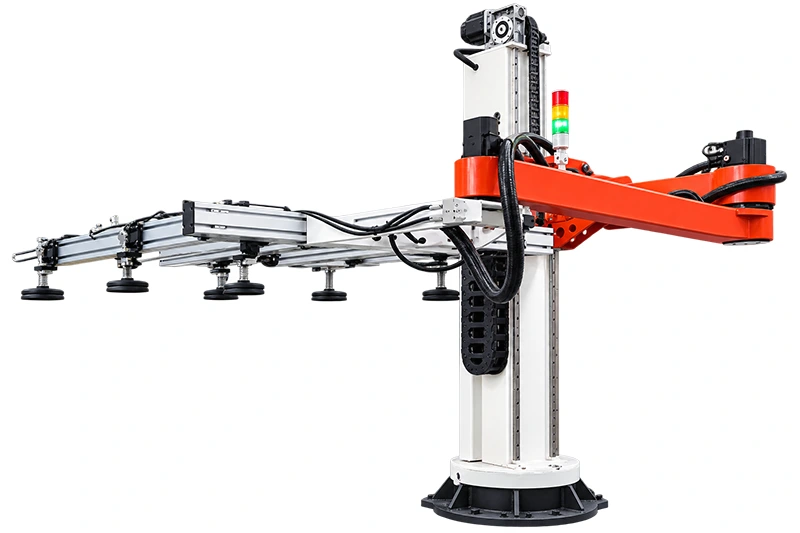
AutoG is EMP's automatic pallet take-out robot, a press tending robot built for this exact station rather than a general case palletizer. The unit works the alternating pattern that removes the one-for-one staffing rule. While press A is molding, the arm is idle. When A reaches its open position, the take-out instruction is issued on the line PLC, the arm moves into the mold cavity, the vacuum suction end effector attaches to the textured pallet surface, negative pressure takes the unit at about 80 degrees Celsius without a cooling wait, and the arm carries it to the stacking position and stacks it where it leaves the gripper. By the time that transfer finishes, press B is close to its own open signal, so the same arm crosses to the second press and repeats the cycle. Two 1250 to 1600 ton presses therefore run one robotic offloading cell. The formula changes at the point where it hurts a group most: press-exit manning becomes a per press pair figure instead of a per press figure, and on the supplier's own description of the arrangement, one robot serving two presses stands in for about two take-out operators. Copied into the next plant, the take-out line item per line is then quoted by press pairs, not by presses, so the labor curve that used to rise with site count flattens into one automation item per pair, and unit capacity take-out capex per press station falls without buying an external turnkey package for every press. The unit is also scoped as a line component, not a loose robot: it is coordinated with the leveling machine, the conveyor, the press open and close signals and the whole-line PLC on Siemens or Mitsubishi control with 4G remote diagnostics, so responsibility is not split between a robot body supplier and a third-party integrator on the day something does not time out.
What the photos show, and the figures that stay project-confirmed
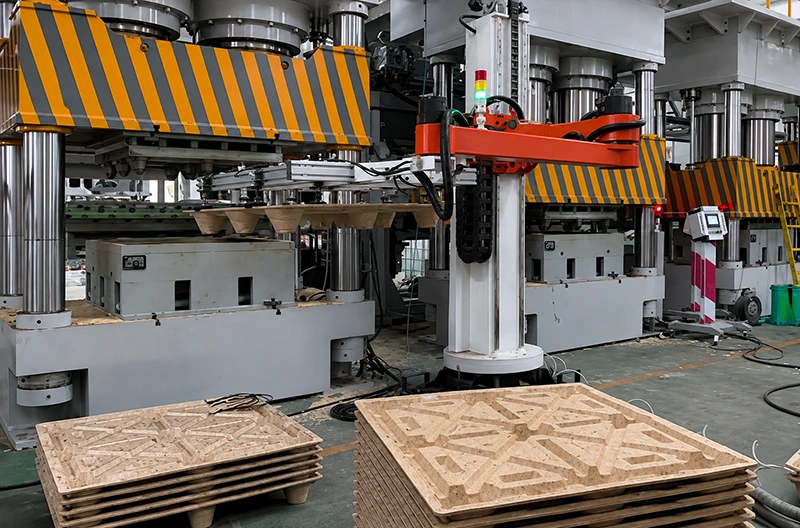
The first image is the take-out arm itself on a white background: a column-mounted base, a long horizontal arm, a multi-suction end effector, an enclosed cable chain and a three-colour stack light. It documents structure and configuration only, not capacity. The second image is the station the arm has to live in: a presswood pallet press exit with a transfer arm beside it and stacks of embossed pressed pallets in front, which shows the working envelope and the stacking position rather than the internals of AutoG. Everything else stays on the confirming side of the line. Rated load, working radius, repeat accuracy, suction cup count and vacuum generation method, footprint and installation, unit power, air demand, PLC model detail and robot body source are confirmed per project. The 1250 to 1600 ton press range, the four to five minute molding cycle, the continuous running statement and the two-operator replacement are quoted as supplier statements, not as published duty figures. No payback period, ROI or hourly output is offered here. The result the plant can plan around is narrower and more useful: adding a press no longer means adding a take-out operator to the pattern, the press exit is unoccupied from open signal to close signal, and take-out headcount is decided per press pair on every line a group copies into its next site, which is also what separates a semi-automatic line from the fully automatic configuration where 2 x EMP-1000T carries a whole line with about three people.
- Both images were taken from the resolved AutoG designer gallery and carried the English alt text from the AutoG image index.
- Every technical statement stays inside the press exit take-out scope: 1250 to 1600 ton presses, about 80 degrees Celsius pallet, one arm alternating across two presses.
- No ROI, payback, hourly output, rated load, working radius, repeat accuracy, suction configuration, footprint, power, air demand or robot body source is claimed; those remain project-confirmed.
- Body is plain text in the customer, old method, fit, evidence and result order, and the renderer owns the section markup and the contact CTA.