AutoG press exit take-out on a molded wood pallet line
The plant this decision belongs to: two presses, two people, one shift pattern
On a molded wood pallet line the press cycle is not lost inside the press, it is lost at the die exit. A freshly molded pallet leaves the mold at about 80 degrees Celsius, and a manual take-out post cannot be timed to the press open and close signals, so the press waits while an operator reaches, the shift carries one take-out worker per press, and unit cost climbs while the line is being judged on OEE. AutoG is the automatic pallet take-out robot from EMP that takes the pallet at about 80 degrees Celsius without a cooling wait, follows the press open and close signals on a line PLC, and stacks the unit where it leaves the gripper, so press waiting time is shortened and take-out headcount is set per press pair instead of per press.
Where the cycle actually goes: a take-out post that cannot follow the open and close signals
A molded pallet is a hot, heavy, textured part sitting in an open die, and the manual sequence around it is fixed by a human body rather than by the press cycle. Someone has to step into the press danger zone while the die is open, reach in, break the part away and carry it out. Nobody does that at the speed the press offers, so two costs appear at once: the operator waits for the part to cool enough to handle, or the press waits for the operator. The related press cycle on an MDI bonded pallet is roughly four to five minutes per unit as a supplier figure, and every second of that cycle spent waiting on a human hand is press capacity the plant has already paid for and cannot invoice. Then the pallet is carried to a stack by the same person, which is a second manual move that produces nothing. Add night shift cover, holiday cover and the difficulty of recruiting into a hot, high-tonnage press bay, and the take-out post stops being a labour line item and becomes a cost per pallet that sits above the plant that automated the same step, which is exactly where price competition is decided.
Why this unit fits that post: 80 degrees Celsius take-out and a handshake with the press signals
The reason a robotic offloading cell can hold the press cycle at all is that it does not need the pallet to cool. AutoG takes the freshly pressed pallet at about 80 degrees Celsius, the figure EMP publishes on its equipment centre page for the robotic offloading function, so the cooling wait that a manual post builds into every cycle is removed from the sequence rather than shortened. The second reason is the interface. The take-out motion is coordinated with the press open and close signals and with the line PLC that also carries the paving machine, the material conveyor and remote diagnosis, so the arm starts on the open signal instead of on a person's judgement, and the press is not held open waiting for a hand. The third is the pairing that makes the cost arithmetic work on an existing plant with two presses: one vacuum suction arm alternates across two hydraulic presses in the 1250 to 1600 ton range, tending press A while B is pressing and turning to B when A opens, so a single robotic cell covers a press pair and press-side manning is set per pair instead of per machine. The end effector is a vacuum suction cup head, which is what allows a textured, recessed molded pallet to be picked on its face and set down on a stack without a gripper having to find an edge.
What the photos establish, what stays project-confirmed, and the result at the press exit
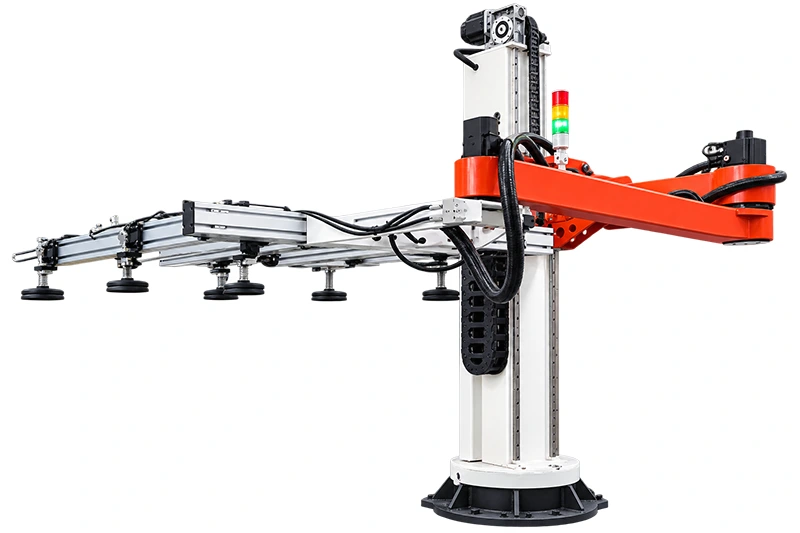
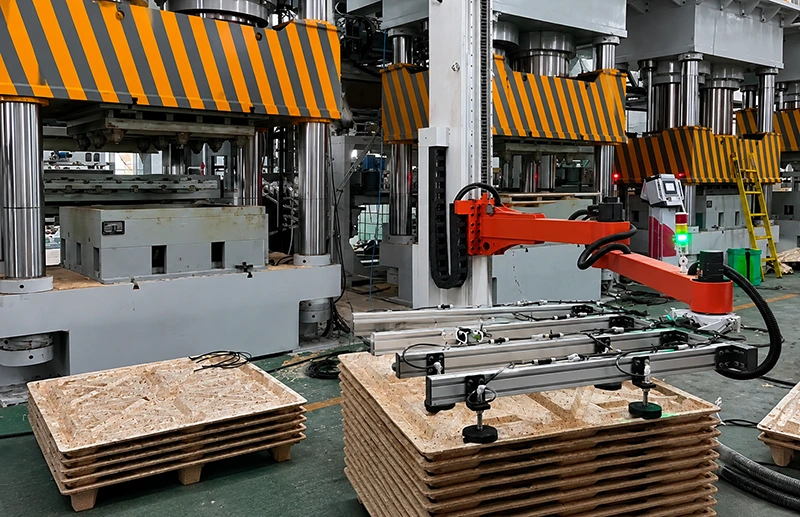
The images on this page are evidence of structure and of plant relationship, not of performance. The first shows the handling unit as a column-mounted body with an articulated arm, a multi-suction cup head, cable chain routing and a stack light, which is the shape of a press-side take-out device rather than a general case palletizer. The second shows the same working relationship in a real plant: a vacuum suction array on a rail-mounted arm standing beside a hydraulic press, with pressed panels stacked in front of it, which is the geometry of a take-out and stacking cell in a molding bay. Neither image proves load, speed, repeat accuracy or a temperature limit, and this page does not use them that way. Stated plainly, rated load, working radius, repeat accuracy, suction cup count and vacuum generation, footprint, power and air demand, control interface details and robot body source all stay project-confirmed items on a quotation, and no hourly output, payback period or ROI is claimed here. The 1250 to 1600 ton press range, the four to five minute press cycle, continuous running and the replacement of about two take-out operators are supplier statements from EMP's own product presentation, not published test data. What the configuration is bought for is nonetheless concrete: the pallet is out of the die on the open signal without a cooling wait, the press is not held while a person reaches, the unit is stacked where it leaves the gripper instead of being carried twice, and the press exit runs a defined cycle on a press pair instead of a headcount on every press, which is the sequence that shortens press waiting time and holds unit cost down on a presswood pallet production line.
- Body copy is plain text only: no HTML tags, attributes, markdown or angle brackets, and the fixed renderer owns all paragraph markup.
- No rated load, working radius, repeat accuracy, suction or vacuum configuration, footprint, power, air demand, control interface detail or robot body source is presented as a fixed specification; all stay project-confirmed.
- The 80 degrees Celsius handling figure is attributed to the EMP equipment centre page, while the 1250 to 1600 ton press range, four to five minute cycle, continuous running and two-operator replacement are labelled supplier statements with no ROI, payback or hourly output claimed.
- The unit is positioned as the press exit take-out and stacking device on a presswood pallet line, not the press itself, not the crush, dry or glue stage and not a stand-alone line, with the call to action routed to the contact page.