AutoG Automatic Pallet Take-Out Robot
The customer this page is written for: European press body, price-led pallet price
A molded wood pallet plant that buys its forming technology in Germany, Austria or Italy and sells on price carries two rules that pull against each other: the press body and the line control are expected to be European, and the unit cost has to undercut whatever the next plant quotes. The automatic pallet take-out robot AutoG from EMP is aimed at exactly that seam and at nothing else. It is the press-exit take-out and automatic stacking device on a presswood pallet production line, it works off the press open and close signals on the line PLC, it takes the freshly pressed pallet at about 80 degrees Celsius through a vacuum suction gripper without a cooling wait, and it stacks the unit where it leaves the gripper. One arm alternately tends two 1250 to 1600 ton presses, so press-exit manning and take-out capex are set per press pair rather than per press. It does not replace the European press, the crush, dry or glue stage, and it cannot run as a stand-alone line.
What a European automation package covers at the press exit, and why the saving is hard to find inside it
A turnkey European scope is priced as a scope, not as a component list. That is a real strength on the press, the frame, the hydraulics and the safety architecture, and it is where the plant's engineers are right to insist. At the press exit the arithmetic turns against the buyer. The package is quoted per press station, so installing a second and third press buys the same press-exit automation again, even though the duty at each exit is identical: pick the freshly pressed unit, transfer it, stack it. The take-out duty is also the least differentiated part of the scope, because the pallet has already been formed, densified and molded by the time it reaches the gripper. On top of the capex, the manual pattern often survives the upgrade anyway on the wider line, because a press exit that was never part of the automation scope still needs a person, and hot press pallet unloading is the last manual post that plant managers accept and the first one they complain about. Two effects follow the price strategy directly. Take-out capex per press station is carried twice over when two presses each get their own package. And operator headcount at the press exit scales with installed presses rather than with pallets sold, which is the wrong variable for a producer competing on price.
Why the take-out cell is the right place to save, and the press body is the wrong place to touch
The cost-optimised position is narrow on purpose. AutoG is specified as the press-exit take-out and stacking cell, an automatic take-out robot for a molded wood pallet line that is bought beside the existing press rather than around it. Everything upstream of the open die stays as specified: the crush stage, the dry stage to the moisture setpoint, the MDI glue mixing, the press curve and the press body source. What changes is the last metre. The arm takes its cue from the press open and close signals on the same line PLC the plant already runs, so it does not add a second control philosophy, and the take-out motion is sequenced into the press cycle instead of waiting on a person. The differentiator against a per-press package is the configuration: one arm alternately tends two presses as a dual-press tending cell. While press A is pressing, the arm stands ready; A opens, the pallet is taken and stacked; the arm moves to B and repeats. That is where the ROI argument actually sits, and it sits in scope rather than in a payback number. A press-exit robot bought per press pair instead of per press cuts the number of robotic cells the expansion plan needs in half, and it sets press-side manning per pair instead of per press, so each additional press adds capacity without adding a full take-out cell and without adding a take-out operator. For a group copying the same validated line from plant to plant on a price strategy, that is the only saving that repeats with every copy.
Structure evidence, project-confirmed parameters, and the result on the expansion plan
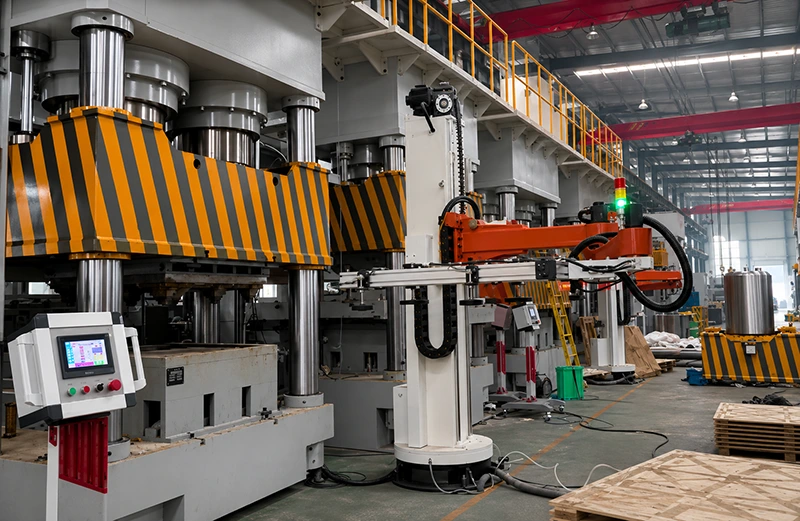
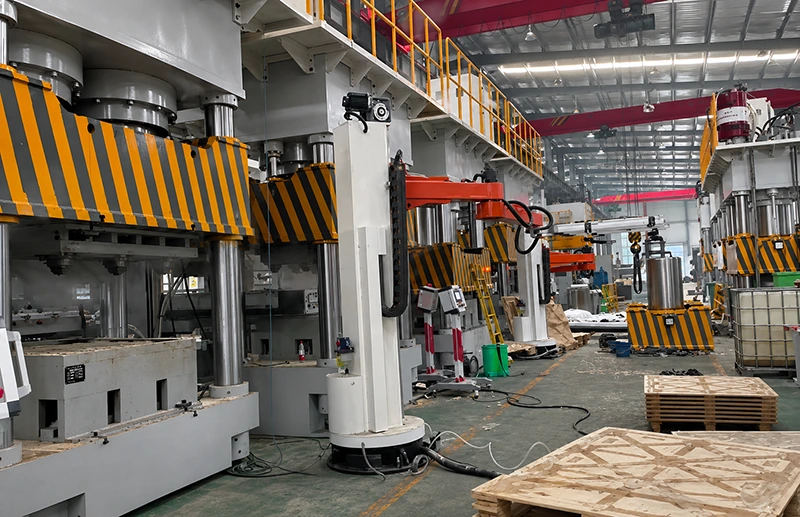
The structure is visible in the photographs and should be read as structure, not as a performance certificate. The first image places the cell where it belongs, at a heavy-duty four-column press with guarded platen, control cabinet and the handling unit mounted at the press-exit side, which is the physical relationship the whole scope depends on. The second image shows the wider press line in a factory, the multi-cylinder frame and guarded platen the arm has to work between. On the machine the visible elements are the column-mounted base, the long arm, the multi-cup vacuum suction head with its cable chain and the stack light that reports cell state to the line. The function that suction head performs is the reason a molded pallet can be handled without a cooling wait: the gripper attaches to the textured, grooved surface of a presswood pallet still near 80 degrees Celsius, transfers it and releases it at the stacking position. The scope facts this page will defend are these: the unit is a six-axis articulated arm with a vacuum suction end effector, it serves one or two 1250 to 1600 ton presses, it takes the pallet on the press open signal and stacks where it leaves the gripper, and the 4 to 5 minute MDI press cycle, the continuous running pattern and the replacement of about two take-out operators are stated as supplier statements rather than guarantees. The 80 degrees Celsius handling figure is quoted from the EMP equipment centre description of the robotic offloading function, and it is a handling statement, not a thermal specification of the pallet. Everything a plant engineer will want on paper before signing stays project-confirmed rather than published: rated load, working radius, repeat accuracy, suction cup count and vacuum configuration, footprint and mounting, power and air demand, control interface detail and robot body source. The outcome is a scope decision the customer can defend in both rooms. In the engineering room the press body, the hydraulics, the mold and the line PLC stand unchanged, and the take-out cell is wired in on signals the line already publishes, so the European technology preference is satisfied where it matters and the integration seam is owned by one supplier instead of split between a press builder and a third-party integrator. In the commercial room take-out capex is counted per press pair and press-exit headcount is counted per press pair, so the unit cost assumption behind the price strategy survives the automation step instead of being spent on it. The boundaries are worth repeating, because they are what makes the position honest. AutoG is not the hydraulic press, not the crush, dry or glue stage, not a general case palletizer and not an independently running line. No ROI, payback period or hourly output figure is quoted here, and none should be inferred from the kit count or the headcount arithmetic. Bring the press tonnage, the pallet footprint and thickness, the line PLC detail and the shift pattern to the scope review, and the configuration is confirmed against the plant rather than against a brochure.
- AutoG is stated only as the press-exit take-out and automatic stacking device on a presswood pallet production line, never as the press body, the crush, dry or glue stage, a general case palletizer or a stand-alone line
- No ROI figure, payback period, hourly output or capacity guarantee is claimed anywhere in the body
- The 80 degrees Celsius handling figure is attributed to the EMP equipment centre description of robotic offloading, and the 1250 to 1600 ton range, 4 to 5 minute MDI cycle, continuous running and two-operator replacement are labelled as supplier statements
- Rated load, working radius, repeat accuracy, suction and vacuum configuration, footprint, power and air demand, control interface detail and robot body source are left project-confirmed, and images are used as structure and site evidence only