Coconut husk fibre vs wood fibre at the press exit
Coconut husk changes three things at the press exit, not one
A plant that has already proven molded wood pallet manufacturing on wood fibre usually meets its first material change at the press exit, not at the mixer: coconut husk fibre presses into a pallet whose density, demolding temperature and surface form can each differ from the wood pallet a take-out head was sized on, and a robotic offloading system bought against a wood-fibre reference cannot be assumed to pick it. AutoG is the automatic pallet take-out robot from EMP for hydraulic press pallet take-out on a presswood pallet production line: a vacuum suction end effector takes the freshly pressed pallet on the press open signal, transfers it to the stacking position and stacks it where it leaves the gripper, with one arm alternating across two 1250 to 1600 ton presses as dual-press tending. What is stated plainly here: the suction head, the grip pattern and the take-out cycle are validated on your coconut husk pallet in a sample trial, the demolding temperature and the pallet form are measured there instead of assumed, and the 80 degrees Celsius direct take-out figure EMP publishes for presswood pallets is not carried over to a coconut husk pallet before that trial. Rated load, working radius, repeat accuracy, suction and vacuum configuration, footprint, power and air demand, robot body source and control interface stay project confirmed, and no ROI, payback or hourly output is claimed.
Why a take-out package proven on wood fibre cannot simply be re-used
The old solution on a molded pallet line has only two forms. One is manual: two operators, one per press, reaching into a 1250 to 1600 ton hydraulic press for a pallet that has just come off a hot mould, then carrying it to the stack, shift after shift, on a cycle that keeps drifting away from the press open and close signals. The other is a generic press tending robot quoted from a wood-fibre reference, with a fixed cup layout and a fixed cycle, priced on the assumption that a pallet is a pallet. The second form fails quietly rather than loudly. Cups that seal well on a wood-fibre deck can lose vacuum on a more open coconut husk face, so the pick is aborted and repeated. A cycle written around one demolding temperature can be wrong in either direction: too slow on a hotter pallet and the press waits, too eager on a softer one and the grip is taken before the surface is stable. A semi-auto to full-auto line upgrade inherits exactly this risk, because the take-out spec is usually copied from the last line rather than re-derived from the material in front of it. The take-out robot then takes the blame for a material assumption nobody tested.
What is adjustable in AutoG, and what has to be measured first
The parts of an AutoG take-out cell that follow the material are the end effector and the cycle. The vacuum suction cup arrangement, the number and pitch of cups across the gripping beam, the reach of the arm over the mould and the transfer path to the stacking position are configuration, not a catalogue constant, and the take-out and stacking motion is timed against your press open and close signals on the line PLC, with one arm alternating between two presses so a slow pick on press A is absorbed while press B is still closing. That is what makes 80 degrees Celsius pallet handling practical on a wood-fibre line: the pallet is taken without a cooling wait, so no press cycle is spent waiting for the part. None of that is claimed for coconut husk before measurement. What we do first is a sample: run your coconut husk pallet on your mould and record the die-exit temperature at more than one point on the deck, log pallet form, deck flatness, groove depth and edge condition, and test vacuum hold on the actual surface while it is still hot. Only from that record does the suction head, the grip pattern and the take-out cycle get confirmed. If the surface says the direct hot take-out that works on presswood pallets does not apply, we say so and quote a different cycle rather than shipping an assumed one.
The structure you can inspect, and the trial that decides the specification
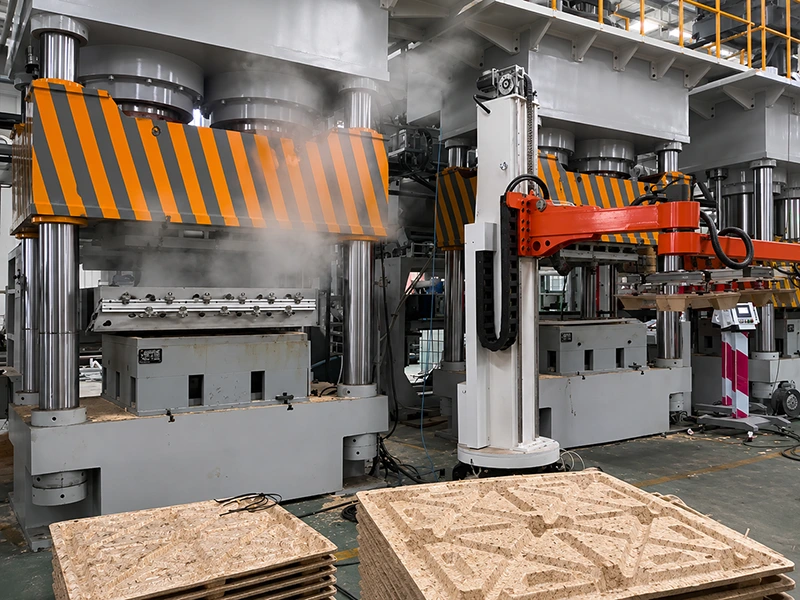
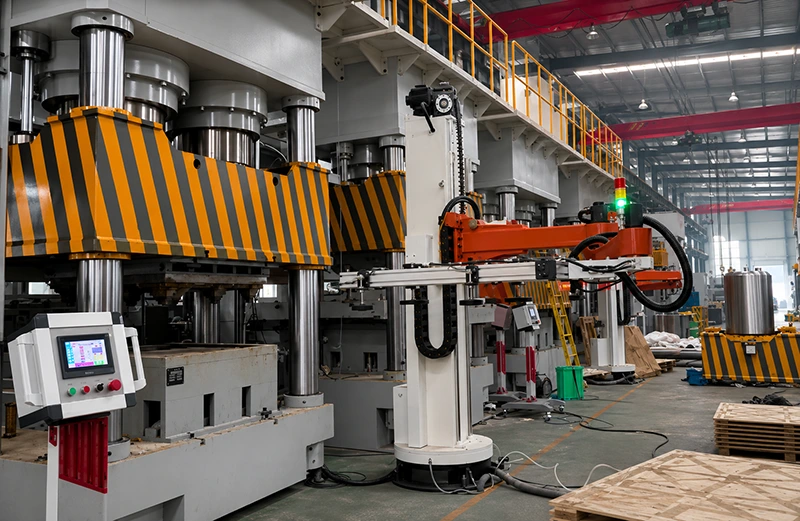
Two things can be inspected now. The photograph of the press-side cell shows the environment the take-out happens in: a four-column hydraulic press with high-visibility safety guarding and a control cabinet, a transfer arm at the platen, and the take-out position beside it, which is the layout any coconut husk line would inherit when it moves from two manual take-out operators to a single robotic offloading cell. The hot press line view shows the exit itself, with steam venting at the platen, which is why the pick is taken at temperature instead of after cooling. On the hardware, the visible structure of the take-out unit is a column-mounted arm with long horizontal reach, a multi-cup suction head, a cable chain for the vacuum line and signal cable, and a stack light for cell status: what a photograph proves is structure and layout, not rated load, reach, repeat accuracy or a temperature ceiling. The honest result on a coconut husk project is therefore a confirmed specification, not a promise: a suction head and take-out cycle proven on your own pallet, a measured die-exit temperature instead of an assumed one, and a working cycle that either holds the press cycle or tells you before the order which part of your line has to move. The 1250 to 1600 ton press range, the 4 to 5 minute MDI press cycle and the two-operator replacement figures are supplier statements, the 80 degrees Celsius reference belongs to the presswood pallet description, and the automatic pallet grabbing manipulator is the press-exit take-out and stacking device on a molded wood pallet line, not the press, not the crush, dry or glue stage, and not a stand-alone line.
- The coconut husk demolding temperature, pallet density and deck surface condition are listed as trial measurements, not as published AutoG figures; the 80 degrees Celsius reference is quoted for presswood pallets and is explicitly not carried over to coconut husk.
- Rated load, working radius, repeat accuracy, suction cup count and specification, vacuum generation, footprint, power and air demand, robot body source and control interface are stated as project confirmed; no ROI, payback, hourly output or capacity guarantee is claimed.
- Images are press-side and press-exit references for layout and environment only; they are not used to assert AutoG rated load, reach, accuracy, cycle time or temperature rating.
- The 1250 to 1600 ton press range, the 4 to 5 minute MDI press cycle and the two-operator replacement are flagged as supplier statements, and AutoG is bounded as the press-exit take-out and stacking device rather than the press, an upstream process stage or a stand-alone line.