Press-exit take-out and automatic stacking for a 24/7 molded pallet line
The press exit is where a cheap pallet quietly stops being cheap
A molded pallet plant that runs 24 hours a day at more than 200,000 pallet blocks a day does not usually lose its margin at the press, the dryer or the mixer. It loses it at the press exit, where a take-out crew has to be standing by day and night, and where every lift in volume pulls another shift of people into the same two square metres. AutoG is the automatic pallet take-out robot from EMP, delivered as the press-exit take-out and automatic stacking cell on a presswood pallet production line: it takes the freshly pressed pallet on the press open signal, transfers it on a vacuum suction head without a cooling wait and stacks it where it leaves the gripper, with one arm alternating across two 1250 to 1600 ton presses. The argument is arithmetic rather than technology. Output can double without the take-out headcount doubling, which is what a pallet priced against recovered wood instead of against sawn timber actually needs. Limits are stated plainly: rated load, working radius, repeat accuracy, suction and vacuum configuration, footprint, power and air demand, control interface detail and robot body source stay project-confirmed; the 1250 to 1600 ton press range, the four to five minute MDI cycle, the 24-hour running statement and the replacement of about two take-out operators are supplier statements; the 80 degrees Celsius figure is quoted from the EMP equipment centre description; and no ROI, payback or hourly output is claimed.
A staffed take-out post cannot be negotiated down, because the constraint is not the wage
It is tempting to treat this as a payroll question and answer it with overtime discipline or a lower wage region. On a 1250 to 1600 ton molded pallet press the constraint is simpler than that. Someone has to be at the die when it opens, because the pallet is at roughly 80 degrees Celsius when it comes out, and the two available manual answers both cost money. Wait for it to cool and the press stands open between the open signal and the close signal, which is cycle time the plant paid for and did not use. Reach in while it is hot and the post becomes a heat exposure and a handling risk that no plant manager wants to defend at the safety meeting, especially on a night shift with a thinner crew. Add the two things that never appear on the process sheet: the pick pose changes with whoever is on shift, so one stack is built true and the next one leans, and cover for absence or peak season has to exist before it is needed. None of that responds to a cheaper wage. It responds only to removing the post from the staffing plan.
Where AutoG fits the line, and the cooling wait it deletes
AutoG sits at one position only: the press exit. The freshly pressed pallet is taken on the press open signal, transferred by vacuum suction through a multi-cup head and stacked where it leaves the gripper, so the pallet is never handed to a second pair of hands before it reaches a stack. Because the pick happens at about 80 degrees Celsius, the plant no longer buys cycle time back by waiting for a cooler pallet, which is the quiet saving behind the visible one. One arm alternates between two 1250 to 1600 ton presses, tending press A while press B is closed and swapping on the open signals, so press-exit manning is set per press pair instead of per press, and the open and close signals are wired into the line PLC rather than run on a separate controller. Two boundaries are worth stating before the quote stage. This is the take-out and stacking device on a molded wood pallet line, not the press itself, not the crush, dry or glue stage, and not a stand-alone line; and it is not a general case or bag palletizer, so a plant looking for a carton cell is looking at the wrong machine. Used inside those boundaries, the arithmetic changes shape: volume can rise without the take-out crew rising with it, which is the only version of the cost argument that survives a doubling of output.
What the photographs show, what stays project-confirmed, and the number to judge it by
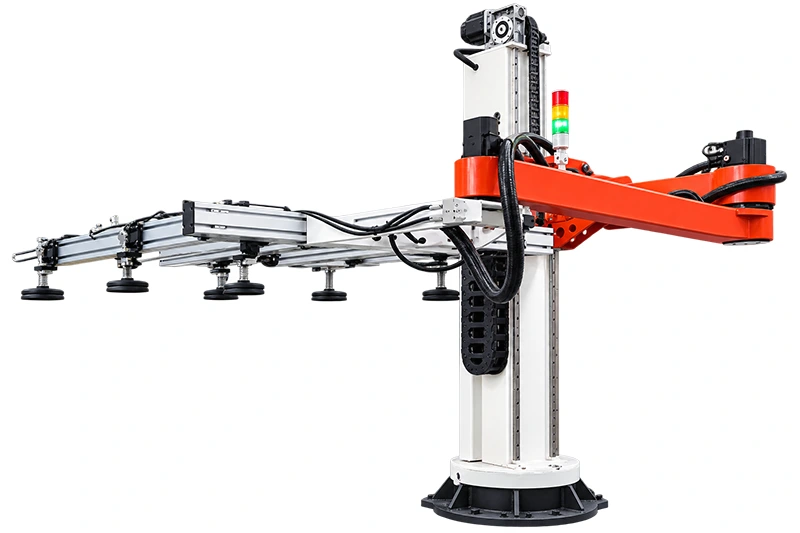
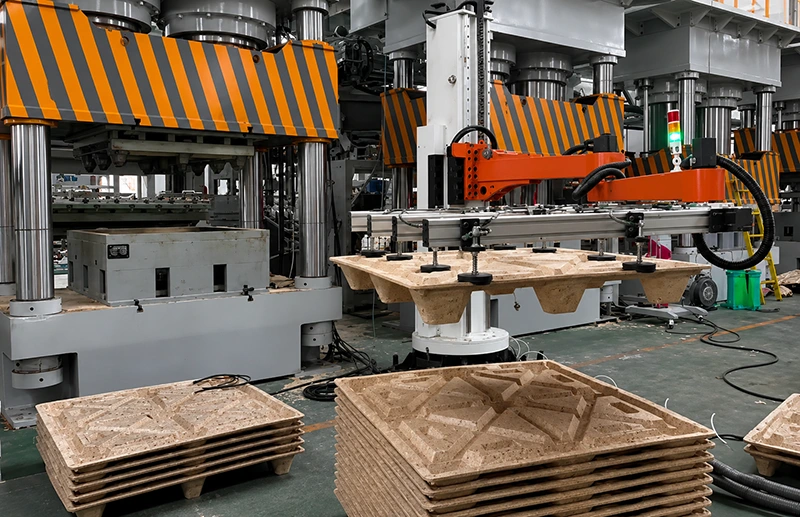
The white-background image shows the machine as a structure rather than a promise: a column base carrying an articulated boom, a multi-suction vacuum head at the end of it, a cable chain running the services along the arm and a stack light on top, which is what a plant needs to see before it can judge reach and access beside a press. The second image shows the relationship that matters more than any single component: a four-post press with the vacuum gripper at the die and pressed pallets stacked in front of it, which is the geometry the cell has to live inside. Neither photograph certifies load, speed, accuracy or temperature, and neither should be read that way. The open items are real and are settled per project: rated load, working radius, repeat accuracy, suction cup and vacuum configuration, footprint, power and air demand, control interface detail and the robot body source. The judgement number is not an hourly output claim, and EMP does not publish one here. It is pallets per person at the exit. When the take-out post stops being one operator per press per shift, a 24-hour day of more than 200,000 blocks runs on a fixed take-out cell instead of a growing crew, and the plant's low-price strategy stops being undercut by the one station on the line that scaled with volume.
- Scope kept to the press exit: take-out plus automatic stacking, not the press body, not the crush, dry or glue stage, not a stand-alone line or a general palletizer
- Every specification gap named as project-confirmed; no ROI, payback or hourly output claimed anywhere in the copy
- The 80 degrees Celsius figure attributed to the EMP equipment centre description, with tonnage range, MDI cycle, 24-hour running and two-operator replacement carried as supplier statements
- Both images limited to visible structure and press-side layout, with alt text taken from the product image index entry



