Occupational health at the press exit
The press exit is the one station that still asks a person to stand in it
A molded wood pallet plant is automated from crushing and drying through glue mixing to the press, then keeps a person standing in the hottest, dustiest metre of the line: at the press exit an operator reaches into the open die for a pallet that leaves the mold at about 80 degrees Celsius, one operator per 1250 to 1600 ton press, on every shift, inside a bay that carries radiant heat, airborne wood fibre and the gases released by hot pressing with MDI adhesive. AutoG is the automatic pallet take-out robot from EMP, delivered as the press-exit take-out and automatic stacking cell on a presswood pallet production line: on the press open signal a vacuum suction cup end effector takes the freshly pressed pallet, transfers it without a cooling wait and stacks it where it leaves the gripper, with one arm alternately tending two presses as a dual-press tending cell, so the take-out position is unoccupied from the open signal to the close signal. The value is stated as two things at once, safety and health: nobody has to stand in that bay to lift a pallet. Limits are stated plainly: rated load, working radius, repeat accuracy, suction and vacuum configuration, footprint, power and air demand, control interface detail and robot body source stay project-confirmed.
Why personal protective equipment and job rotation leave the exposure where it was
Heat-resistant gloves, a face shield and a dust mask shorten the contact per pick but keep the operator in the radiant field. Job rotation spreads the dose across more people instead of removing it, and it multiplies the training and supervision the station needs. Waiting for the pallet to cool before the pick drops the surface temperature and buys the wait back as lost press cycle time, which the line OEE will not absorb. Guarding the opening slows the reach without shortening it. The structural reason is in the line tiers: EMP's semi-automatic tier, EMP-500T to EMP-1000T at 30,000 to 200,000 pallets a year, does not include the automatic take-out robot, so hot press pallet unloading and stacking stay manual work. The line is closed up to the die and then hands the last metre back to a person.
The fit: the take-out position is unoccupied from the open signal to the close signal
AutoG is the automatic pallet take-out robot on the press exit, not the press and not a general case palletizer. The press open signal releases the cycle, the arm enters the mold cavity, the vacuum suction cup end effector attaches to the pallet deck, and the hot unit is transferred to the stacking position without a cooling wait and stacked where it leaves the gripper. Six-axis articulation carries the pallet through the transfer with the orientation changes a person makes by hand, and the suction pads read a molded surface that is textured and grooved rather than flat. One arm alternates across two 1250 to 1600 ton presses as a dual-press tending cell, so the unmanned position covers a press pair rather than a single press while both keep a four to five minute MDI cycle. Because the open and close signals, the flattening machine, the conveyors and the line PLC on Siemens or Mitsubishi control are wired into one logic, the take-out motion is coordinated with the press instead of fitted beside it.
What the structure shows, what stays project-confirmed, and what the shift looks like afterwards
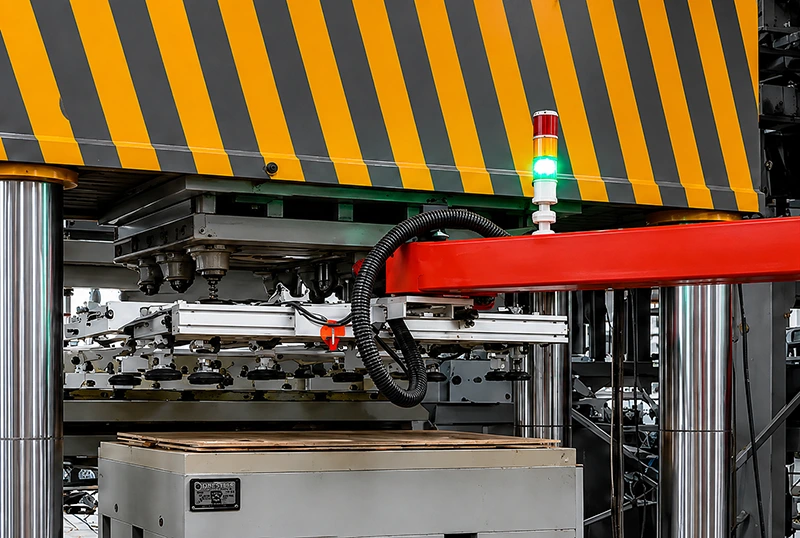
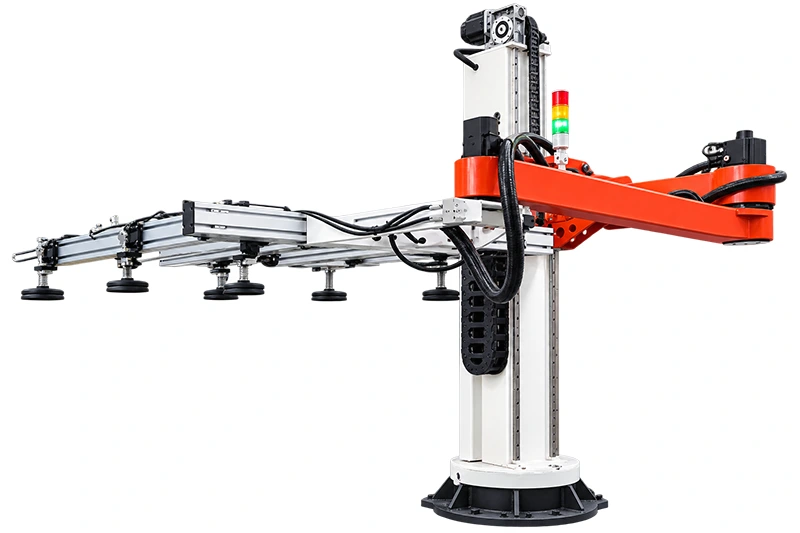
The two images document the station as built: a vacuum suction gripper working under the striped safety enclosure on a linear guide with the warning beacon above it, and the handling arm itself with the column base, the long articulated boom, the multi-suction pad head, the cable chain and the stack light. They are evidence of visible structure and press-side layout, not of load, speed, repeat accuracy or temperature rating. Rated load, working radius, repeat accuracy, suction and vacuum configuration, footprint, power and air demand, control interface detail and robot body source stay project-confirmed, and the 80 degrees Celsius direct take-out figure is quoted from the EMP equipment centre description while the 1250 to 1600 ton range, the four to five minute MDI cycle, continuous running and the replacement of about two take-out operators are supplier statements. What changes on the floor is the definition of the post. The operator supervises a robot cell and a stacking position from outside the hazard envelope instead of reaching into an open die, so the exposure hours on that station stop being set by press cycles, and manning is written as one cell per press pair instead of one operator per press.
- The 80 degrees Celsius direct take-out figure is quoted from the EMP equipment centre description; rated load, working radius, repeat accuracy, suction and vacuum configuration, footprint, power and air demand, control interface detail and robot body source stay project-confirmed.
- The 1250 to 1600 ton press range, the four to five minute MDI cycle, continuous running and the replacement of about two take-out operators are supplier statements; no ROI, payback or hourly output is claimed.
- The health and safety value is stated as removing the operator from the hot, dusty press exit; no medical conclusion, occupational exposure limit or regulatory compliance claim is made.
- The unit is the press-exit take-out and stacking device on a presswood pallet production line, not the press itself, not the crush, dry or glue stage and not a stand-alone line.