Presswood pallet line / press-exit take-out
The Plant That Can Staff the Press but Not the Station in Front of It
A presswood pallet plant in Europe can now run a hot press 24 hours a day and still be unable to run the station in front of it: the press exit needs one take-out operator per 1250 to 1600 ton press, on every shift, and the night shift is where that arrangement breaks. AutoG is the automatic pallet take-out robot from EMP, delivered as the press-exit take-out and automatic stacking cell on a molded wood pallet line, where a vacuum suction cup end effector takes the freshly pressed pallet on the press open signal, transfers it without a cooling wait and stacks it where it leaves the gripper, with one arm alternately tending two presses as a dual-press tending cell. Where the hiring fails, the intent is a robotic take-out cell that is powered on and keeps the cycle going, so press-exit manning is set per press pair instead of per press and per shift. Limits are stated plainly: rated load, working radius, repeat accuracy, suction and vacuum configuration, footprint, power and air demand, control interface detail and robot body source stay project-confirmed; no payback or hourly output is claimed; the unit is the press-exit take-out and stacking device on a molded wood pallet line, not the press itself, not the crush, dry or glue stage and not a stand-alone line.
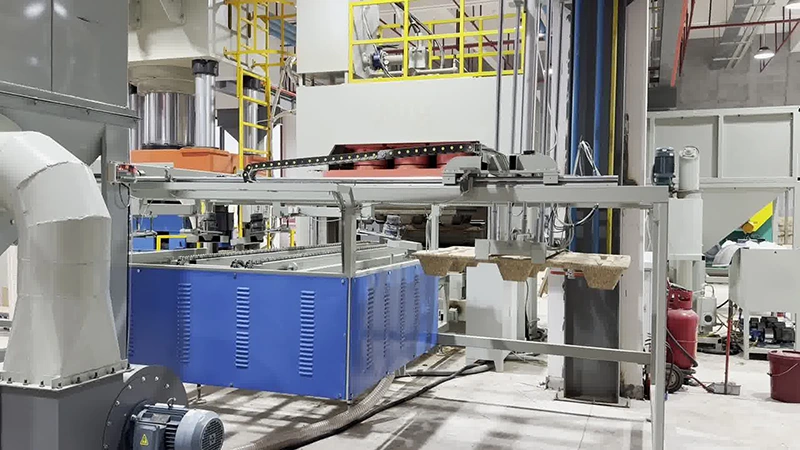
What Manual Hot Press Pallet Unloading Costs Between 22:00 and 06:00
Manual extraction looks inexpensive on a cost sheet because the wage line is visible and everything else is not. Look at the same post at night and three costs separate out. The first is coverage risk. A take-out post cannot be paused, so an absence at three in the morning is covered by overtime, by a supervisor pulled off another job, or by slowing the line, and none of those options is priced into the staffing plan. The second is the press wait. A manual take-out is not synchronised to the press open and close signals, so between the open signal and the close signal the press is waiting on a person to finish reaching, lifting and turning, and the hydraulic press pallet take-out step becomes the pacing item on the line rather than a downstream detail. The third is the nature of the duty itself. The pallet leaves the mold hot, EMP equipment centre description puts direct take-out at about 80 degrees Celsius, the pallet surface is textured and grooved so it has to be handled with some care, and a hot MDI adhesive releases gas during pressing, which is a long-term presence question rather than an incident. Put those three together and the press exit is a classic dirty, dangerous and difficult post: hard to fill, expensive to cover, and carrying a cycle penalty the plant pays every shift.
Why a Press Tending Robot Fits This Post and Not the Rest of the Line
The fit question is not whether a robot can be bought, it is whether the robotics belong to this one metre of the line. On AutoG the scope is deliberately narrow: the automatic pallet take-out robot is the press-exit take-out and automatic stacking cell, not the press, not the crush, dry or glue stage, and not an independently running line. Within that boundary the sequence is fixed. On the press open signal the arm enters the die area, the vacuum suction cup end effector attaches to the pallet surface, the pallet is transferred without a cooling wait, and it is stacked where it leaves the gripper, so the secondary manual lift that a person would do after take-out disappears with the take-out itself. Then comes the part that answers a shift rota: one arm alternately tends two presses as a dual-press tending cell, standing by while press A is pressing, taking out when A opens, then moving to B, so a press pair is served by one robotic position instead of two staffed ones. Press open and close signals are wired into the line PLC, and the take-out motion is coordinated with the presses, the leveling machine, the transfer equipment and the line control the plant already runs. A supplier statement puts continuous operation at a powered-on basis, which is the difference between a headcount plan and an equipment plan: the cell does not decline a night shift, does not rotate out after a season, and does not need a second person to cover absence.
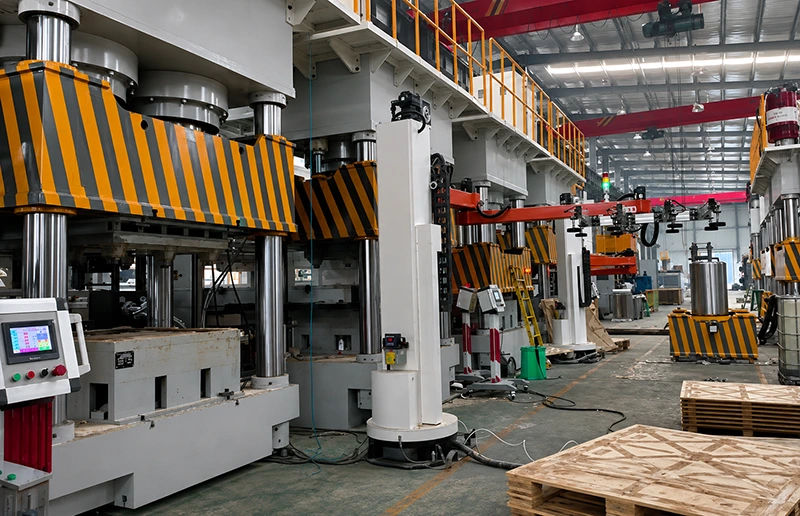
What the Visible Structure Supports, What It Does Not, and What the Plant Ends Up With
Photographs are used here as structure evidence and nothing more. The press-side field photo shows the environment the cell goes into: a four-column hydraulic press with striped safety guards, chrome guide columns, a guarded die area and the transfer arm mounted beside it, which is the layout question a plant engineer actually has to answer about where a robot can stand. The gantry station photo shows the frame side of the same duty: a steel portal frame, a linear rail drive with cable chain, a blue sheet-metal enclosure around the moving elements and ducted ventilation, which is the kind of guarding a take-out position needs when the press exit is unoccupied rather than staffed. The white-ground product photos of the arm show a column base, a long reach, a multi-cup vacuum head, cable chain and a stack light. None of these images proves load, reach, repeat accuracy, cycle time or a temperature rating, and this page does not use them that way. What the plant ends up with is a defined position: the take-out spot is unoccupied from the open signal to the close signal, press-exit manning is set per press pair rather than per press, about two take-out operators are replaced as a supplier statement, and the capacity plan no longer depends on filling three shifts of a hot, repetitive station. Rated load, working radius, repeat accuracy, suction and vacuum configuration, footprint, power and air demand, control interface detail and robot body source stay project-confirmed, and the 80 degrees Celsius figure is quoted from the EMP equipment centre description. If your line already runs 1250 to 1600 ton presses and the hard part is the rota, send the press count, the pallet specification and the shift pattern, and we will size the take-out cell against them.
- Body root is section.emp-section.emp-blog-p0.emp-blog-p0–tw-layout with the required emp-section, emp-btn-primary and /contact/ markers
- All four section bodies are plain text with no HTML tags, attributes, Markdown or angle brackets
- Both image URLs are the previously returned WordPress uploads of the source paths 2 (4).webp and 1 (4).webp, with index ALT text
- No ROI, payback, hourly output or unspecified specification is claimed; unsupported figures are marked project-confirmed