Press-exit safety on a presswood pallet production line
Who is standing at the press exit when the die opens
A presswood pallet production line is automated from crushing and drying through glue mixing to the press, and then it hands the last metre back to a person: someone reaches into the open die for a pallet that leaves the mould at about 80 degrees Celsius, lifts it out and stacks it by hand, one operator for every 1250 to 1600 ton press, on every shift. That post is not a handling job, it is a position inside the press danger zone. AutoG is the automatic pallet take-out robot from EMP, delivered as the press-exit take-out and automatic stacking cell on a presswood pallet production line: a six-axis articulated arm with a vacuum suction cup end effector takes the freshly pressed pallet on the press open signal, transfers it without a cooling wait, stacks it where it leaves the gripper and alternately tends two presses as a dual-press tending cell, so no one is inside the die area between the open signal and the close signal and press-exit manning is set per press pair instead of per press. The intent is the plainest one a plant can state: move the person out of the danger zone instead of training the person to survive it.
Why a six-axis vacuum arm fits this take-out duty
Take-out from a hot press is short, repeated and highly constrained: enter the open die, align to a textured deck, hold, withdraw, rotate, place, then start again on the other press. A six-axis articulated arm gives the up-down, left-right and front-back axes plus rotation and flip, so the pick pose and the stack pose are set by the motion path instead of by whoever is on shift, and a vacuum suction cup end effector holds the deck without clamping a surface that is still hot. Because the arm takes the pallet directly at about 80 degrees Celsius there is no cooling wait between the open signal and the close signal, and because it stacks where it leaves the gripper there is no second manual move. One arm alternating across two presses on their open signals is the configuration that makes press-exit manning a per press pair decision.
What the structure shows, and what the photos do not prove
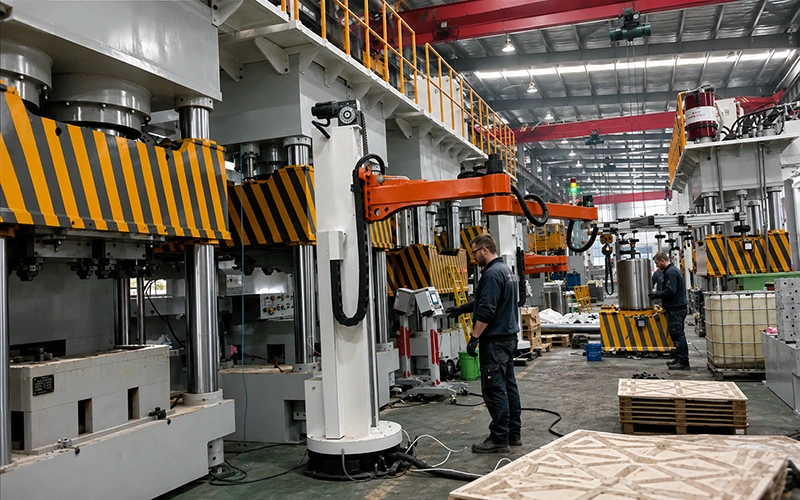
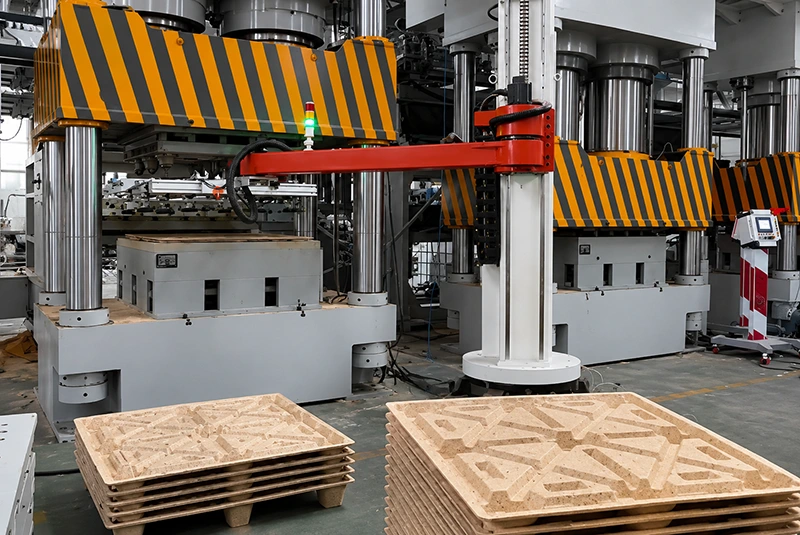
On the white-ground unit you can check the elements that carry the take-out and stacking duty: a floor-mounted column with a heavy base, a long articulated boom over the working envelope, a multi-cup vacuum head with cable chain management and a stack light for status. On the line photos you can check the environment the cell is installed into: multi-column press frames, striped safety covers and guard panels, the die opening, the control console and the press-side layout where a person would otherwise stand. Those images are evidence of visible structure and of the press-exit relationship only. Rated load, working radius, repeat accuracy, suction cup count and arrangement, vacuum generation, footprint, power and air demand, control interface detail and robot body source are not fixed by a photograph and stay project-confirmed on the technical confirmation list.
The result: nobody inside the die area, and a manning number set per press pair
What changes on the floor is not the press and not the recipe, it is who is inside the guarded opening. From the press open signal to the close signal the take-out position is unoccupied, the pallet is transferred by vacuum and stacked automatically, and the operator moves to supervision and quality instead of standing in a crush zone, which is the cheapest form of safeguarding a plant can adopt because it removes the exposure rather than monitoring it. On a presswood pallet production line this is also what separates the tiers: the semi-automatic lines at 1250 to 1600 ton carry manual take-out and stacking, while the fully automatic configuration includes the automatic take-out robot and runs two EMP-1000T presses with roughly three people on the whole line. The stated boundary is simple: the 80 degrees Celsius direct take-out figure is quoted from the EMP equipment centre description, the 1250 to 1600 ton range, the four to five minute MDI press cycle, continuous running and the replacement of about two take-out operators are supplier statements, no ROI or hourly output is claimed, and the unit is the press-exit take-out and stacking device on a molded wood pallet line, not the press itself and not a stand-alone line.
- Rated load, working radius, repeat accuracy, suction and vacuum configuration, footprint, power and air demand, control interface detail and robot body source stay project-confirmed and are not published as AutoG specifications.
- The 80 degrees Celsius direct take-out figure is quoted from the EMP equipment centre description; the 1250 to 1600 ton press range, the four to five minute MDI press cycle, the continuous running statement and the replacement of about two take-out operators are supplier statements.
- No ROI, payback, hourly output, certification, guarding standard compliance or medical conclusion is claimed; visible structure in the photos does not prove load, speed, accuracy or temperature limits.
- The unit is the press-exit take-out and automatic stacking device on a presswood pallet production line, not the press itself, not the crush, dry or glue stage, not a general case palletizer and not a stand-alone line.



