Scope 3 packaging carbon
The buyer side: a 2030 carbon target that reaches the pallet under the drum
A chemical buyer that has put a 25 percent cut in Scope 1 and 2 and a 15 percent cut in Scope 3.1 on its 2030 calendar does not stop asking questions at the drum, the liner or the label. It works back to the platform the load arrives on, and the presswood pallet question arrives at the supplier as a supplier question: what is in your packaging, what does it weigh, where does it come from and what happens to it after discharge. This page follows that question through a drum and jumbo bag shipper who has to answer it with a molded wood pallet pressed in one piece from recovered wood fibre and MDI adhesive, with no nail, no heat treatment chamber and no repair bench standing behind the unit.
The old solution: nailed solid wood carries treatment, repair and return air into the buyer's file
The incumbent pallet is a sawn timber platform held together by fasteners, and each of its properties lands somewhere in the buyer's reporting. It is solid wood, so it stays inside the ISPM 15 heat treatment regime with a chamber booking, a marking and a certificate attached to every consignment. It is nailed and boarded, so a bent nail or a split board turns into a repair bench job with de-nailing and re-boarding, and every replacement board is another purchase of certified timber upstream. It is rigid, so an empty unit holds the same floor and the same trailer volume as a loaded one, and empty pallets travel as air in both directions. It also has a damage path the buyer already knows: a nail pop or a splinter punctures a jumbo bag or a stretch wrapped drum skirt. The low cost bonded alternative has its own line in the file, because a urea formaldehyde bonded pressed pallet releases free formaldehyde in humid heat and swells once it takes water, which is a contamination route rather than a carbon saving.
Why a presswood pallet fits: recovered wood fibre, an MDI binder and a one-piece body
Ampallet is a pressed wood pallet molded in one piece from wood fibre and MDI adhesive, and the fit starts with the feedstock. Wood chips, sawdust and wood residue in the three to fifty millimetre range are steam dried from about 148 down to 138 degrees Celsius over roughly thirty minutes, blended with about five percent MDI, and molded at about 220 degrees Celsius with the pallet body reaching 105 degrees Celsius and holding above 56 degrees Celsius for at least thirty minutes, with finished moisture at 9 percent or below. Nothing about that route needs a sawn board of a certified grade, so the upstream line in the buyer's file reads recovered fibre rather than purchased lumber. MDI is a polyisocyanate binder named on the material sheet, and the CARB-NAF no-added-formaldehyde position is recorded for this pallet type, supplied per product and per plant rather than assumed for every line. The finished body is a processed wood material, which supports a fumigation-free and ISPM 15 exempt reading, subject to the destination rule and the forwarder's own confirmation. Deck and support feet come out of the same mold, so there is no fastener to fail, no board to re-board, and no separate foot to come loose in a repair bay.
What goes into the supplier file: load, nesting, fork entry and the limits in writing
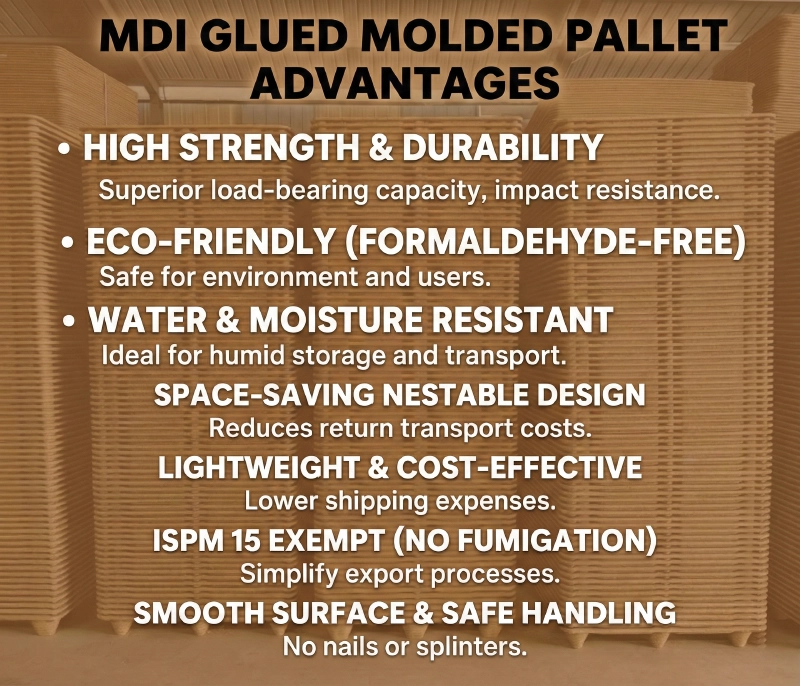
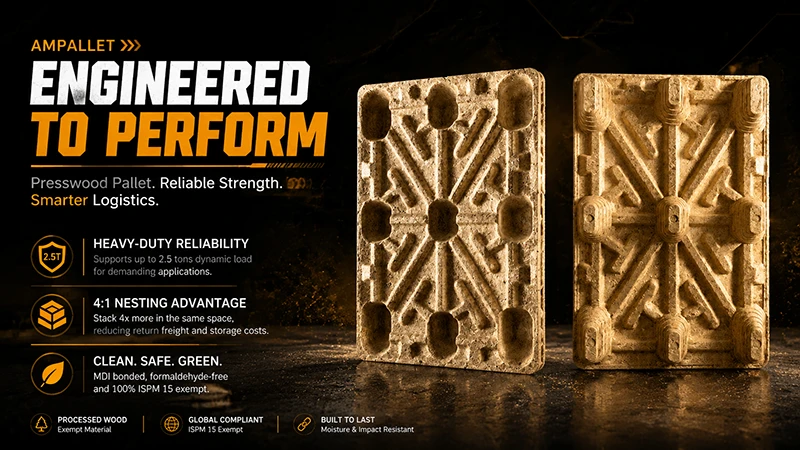
A buyer's packaging clause needs figures, not adjectives. The 1140 x 1140 x 135 drum unit is quoted at 17 kg with 2500 kg dynamic and 7000 kg static load and fork entry at 96 plus or minus 3 mm. The 1200 x 800 x 125 nine-leg unit is quoted at 14 kg, 2000 kg dynamic, 6000 kg static and 92 plus or minus 3 mm. The 800 x 600 x 125 six-leg half unit is quoted at 6 kg, 1000 kg dynamic and 3500 kg static. Height holds at plus or minus 2 mm, corner height difference at 3 mm or less, corners at R25 or R35 plus or minus 2 mm, and finished moisture at 9 percent or below. The inverted cone feet nest about four to one, and published positioning places empty pallet storage saving near 70 percent and return freight reduction near 60 percent on a matched lane, recalculated per site rather than assumed. The photographs in this file are the audit trail: the stacked MDI bonded molded pallets show a smooth nail-free deck surface, and the underside view shows the ribbed deck and molded support feet as one body. Limits are stated plainly. The nestable single face unit is not a long-term racking pallet. One-piece molding cannot be locally repaired. A carbon figure is re-run per specification, mould and lane. Certification is supplied per product and per plant, and destination acceptance of a fumigation-free pallet stays a buyer and plant protection authority question. Send the drum size, the load per unit and the destination lanes, and the specification line, the binder statement, the unit weight and the recalculated nesting and freight numbers go back in a form the sustainability review can file.
- Buyer-side carbon context is attributed to the chemical buyer's public 2030 commitments, not presented as an Ampallet claim
- Old-scheme problems are tied to solid wood treatment, repair and return leg plus UF bonded rivals, with no invented figures
- Structure and parameters are bound to named models and to the two uploaded gallery photos with their index ALT text
- Limits stated: not a racking pallet, certification per product and plant, carbon figure and nesting recalculated per lane and destination



