In-house molded pallet capacity for spec-change orders
When the pack gets lighter, the pallet order changes shape
A customer lightens the pack and the pallet spec arrives with it: new outside size, new load class, new order volume, and a supply route that was priced for the previous size. This is how a pallet supplier reads that change on a presswood pallet machine, where the outline is set by a mold instead of a board cutting list, and what has to be checked before a new size is quoted as in-house output.
Why a bought-in program and a nailing cell stall at a new size
A bought-in pallet program is built to answer a stable size. The supplier purchases a standard 1200 x 1000 or 1219 x 1016 unit from a pallet yard, prices it with a margin and lets the yard carry the production risk. A customer-specific size breaks that arrangement in three places at once: the yard quotes a minimum run or a longer lead time while it sets tooling, the volume discount attached to the old size disappears, and the delivery date leaves the supplier's control. A traditional pallet nailing machine or a wooden stringer pallet equipment cell does not close the gap either, because that route is organised around bought boards, fastener stock and a fixed stringer pattern. A non-standard outline becomes cutting, jig re-setting, nail pattern changes and a per-unit cost that climbs exactly when the buyer expects a lighter and cheaper pack.
Why a molded pallet production line fits a changed spec
The reason a presswood pallet machine changes this calculation is that the geometry lives in the tool. Recovered wood fibre, sawdust, shavings, straw and other lignocellulosic residue are crushed, dried, glue mixed, dosed, spread, hot pressed and demolded into a one-piece nail-free body, so the outside size, foot pattern, fork entries and rib layout come from the steel mold rather than from a board cutting list. A new customer size therefore becomes a mold question, not a purchasing question. Sizes in the product record run from 1000 x 1000 and 1100 x 1000 through 1200 x 1000 and 1219 x 1016, with custom molds for special loads, and the same platform covers nine-leg single-face, flat single-face, cross-base double-layer and three-runner flat structures. Configuration is deliberately modular: a semi-automatic line or a fully automatic line, chosen on local labour cost, raw material supply, plant layout, electrical capacity and target output, with the press and glue module kept inside a tighter budget when downstream automation has to wait.
The evidence to test, and the three numbers to send first
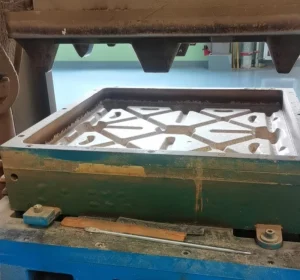
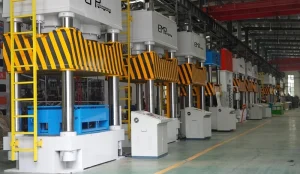
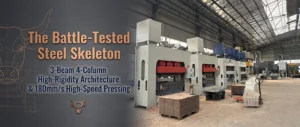
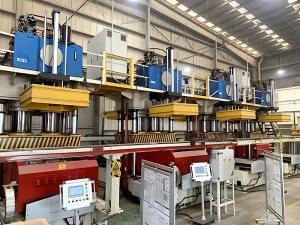
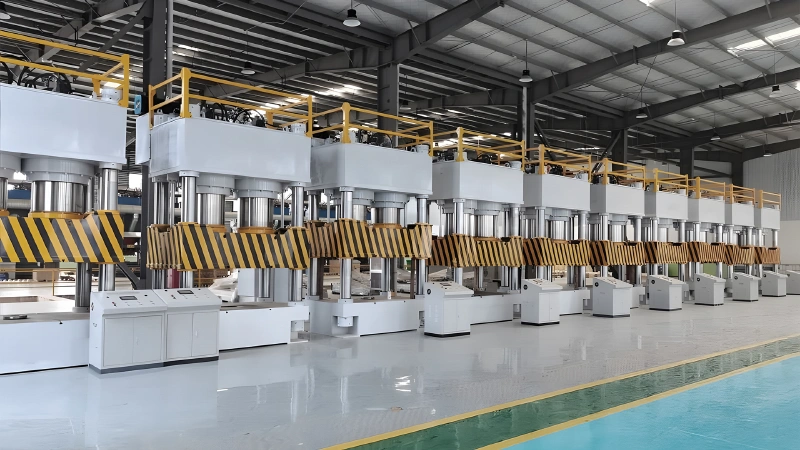
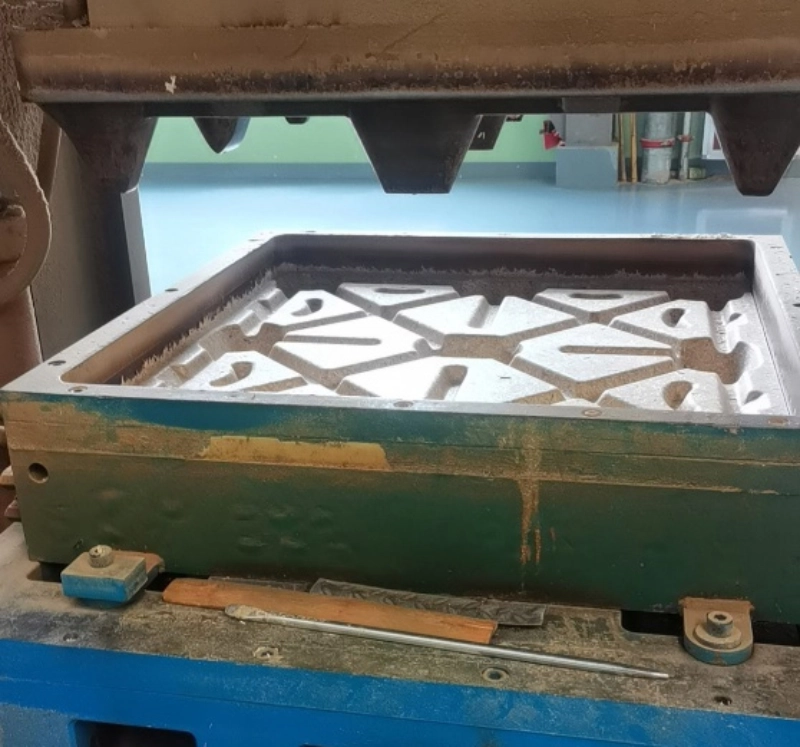
The design references worth testing against your own drawings are specific. A 1600T class press appears repeatedly in the product record, with tonnage tiers from 1200T through 1250T, 1800T and 2200T depending on pallet size, structure and load target; pressing runs at about 150 to 180 degrees Celsius at 15 to 20 MPa with a cycle near 180 to 240 seconds; raw material is prepared at roughly 5 to 30 mm length and 2 to 5 mm thickness; finished density is quoted at 0.8 to 1.2 grams per cubic centimetre. The two photographs mark the two halves of the argument. The press row is the capacity side of an automated pallet manufacturing line, and the open mold cavity is the spec side: deck ribs, foot pattern and fork pockets are all formed by tooling, which is precisely where a customer-specific size is either feasible or not. What settles the evaluation is not a brochure. Send the target pallet drawing with tolerances, the load and the handling, storage and export duty cycle, and the estimated monthly and annual order volume, and the mold design, tonnage tier, moisture and glue window, cycle time and semi or fully automatic configuration can be quoted against those numbers. Any moulded pallet performance on your own load class, and any high ROI pallet production setup reading, stay open until a sample trial and a technical agreement confirm them.
- Body text carries no HTML tags, attributes or angle brackets; the fixed renderer owns all paragraph and CTA markup, and no H1 is added.
- Keyword presswood pallet machine and the product, scenario, problem and result terms are used in title, intro, headings and body without stuffing.
- Every figure is presented as a design reference from the product record; no output rate, payback, order revenue or performance guarantee is claimed.
- The close asks for target drawing, duty cycle and order volume, routes to the contact page, and keeps performance and return open until trial and technical agreement.