Make or buy – in-house pallet output
Start With the Pallet Count You Already Buy, Not With the Machine Price
A plant that buys several thousand pallets a month rarely loses money on the unit price it agrees in January. It loses it on the re-quotes that follow: sawn lumber moves, freight moves, the heat treatment chamber queue moves, and the pallet arrives with a different figure on the invoice than the one in the annual budget. The question worth answering is narrower than buying equipment. On your own pallet count, your own local fibre price and your own operating cost, does in-house molded output beat continued purchase, and what does a presswood pallet machine have to prove before that answer becomes yes.
What the Purchase Price Leaves Out on a Nailed Wood Pallet
A nailed stringer or block pallet costs more than the invoice line. On export lanes it carries heat treatment to 56 degrees Celsius core for 30 minutes, stamp custody, segregation and per-consignment paperwork, and the booking of chamber hours competes with everyone else in the region. On internal lanes it carries a repair bench, a de-nailing and re-boarding operation, and a scrap rate the buyer usually measures badly. Empty rigid pallets take the same floor as loaded ones, so the buffer competes with finished goods. Published case records put solid wood replacement on some chemical lanes near 22 percent a year, but that figure belongs to that case record and must be replaced by your own scrap count. These are the costs that a make-or-buy sheet has to place on the in-house side of the line before capex appears at all.
Where AutoML Sits in That Cost Chain
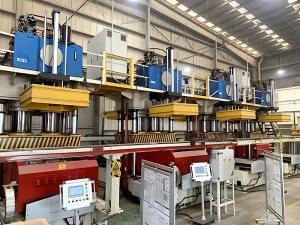
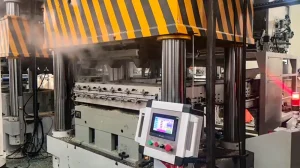
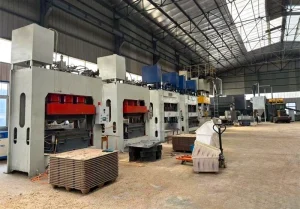
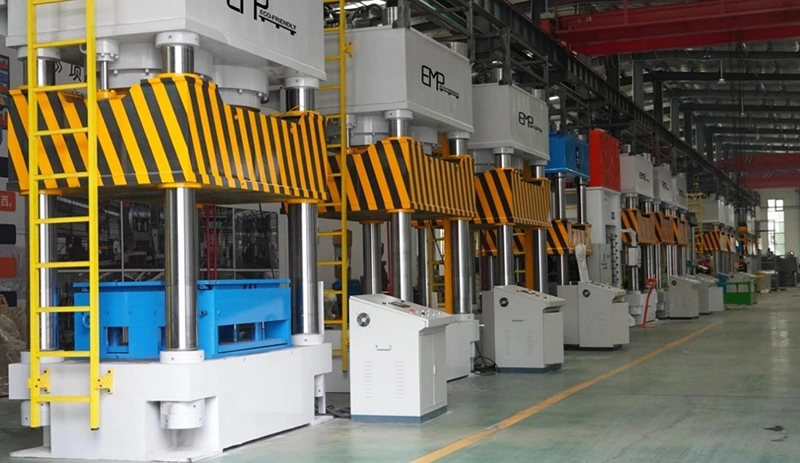
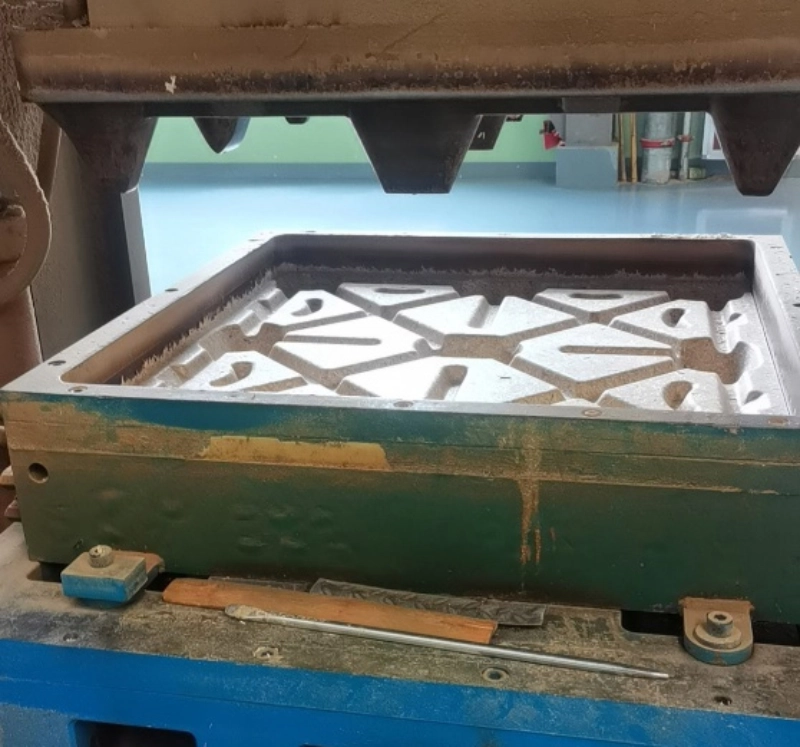
AutoML is a molded pallet production line, not a single press: crushing, drying, glue mixing, dosing and spreading, hot pressing, demolding and stacking on one process chain, delivered as a semi-automatic or a fully automatic tier. The first image is the capacity argument, a row of EMP heavy-duty four-column hot presses with control panels and safety access, the 1600T class machine that product files reference most often. The second image is the cost argument, an open steel mold cavity holding a newly demolded pallet with its reinforcement ribs and four-way entry recesses: pallet size, structure and load class are set by the tool, not by tonnage alone. Published process parameters run 150 to 180 degrees Celsius, 15 to 20 MPa and about 180 to 240 seconds per cycle, with fibre crushed to 5 to 30 mm length and 2 to 5 mm thickness, finished density 0.8 to 1.2 grams per cubic centimetre, and common molds at 1000 x 1000, 1100 x 1000, 1200 x 1000 and 1219 x 1016 mm. The project costing notes carry an investment reference near RMB 2 million for a semi-automatic line and RMB 4 million for a fully automatic line, with static payback about 1.3 to 1.8 years in ideal cases and up to about 3 years in worse cases. Those are costing references for the feasibility sheet, not a quotation and not a payback promise.
Four Conditions That Decide Make Versus Buy, and the Line Where the Answer Turns
Fibre comes first. A sawdust pallet making machine competes with every other buyer of the same residue, so the sheet needs the tonnage available inside an economic haul, its landed cost per tonne and its seasonal gap, not an assumption that wood waste is free. Second is the utility and heat demand of drying and pressing, taken from real capacity rather than from a catalogue. Third is shift labour: manning and wage level decide whether the first line is semi-automatic or fully automatic, and a low-labour-cost market should keep the press and glue module and trim upstream and downstream automation instead of buying the largest automated pallet manufacturing line available. Fourth is order discipline, because a mold is only paid for by repeatable volume in that footprint. Run those four against the purchase sheet and the answer usually turns on one line. Where the outcome is marginal, the next step is more fibre and moisture data, not more capex, since the moisture band and glue ratio are set on joint trial data with the glue system in use. Send the pallet count, the size mix, fibre samples and utility figures gathered this way and the configuration and the cost model are built on your numbers. Limits stay stated: payback depends on local selling price, labour, energy, raw material cost, utilization and financing, a one-piece nail-free wooden pallet process and nestable pallet manufacturing change the storage and repair line rather than the whole cost base, and any fumigation-free or ISPM-15 exempt pallet equipment reading remains a destination rule and a forwarder question.
- Twelve months of purchase orders: pallet count, size mix and delivered cost per unit, split by material, treatment, freight and repair
- Fibre available inside an economic haul: monthly tonnage, landed cost per tonne, particle size band and seasonal gap
- Utility and heat demand, installed power capacity and shift labour cost taken from the plant's own invoices, not estimates
- Mold footprint, pallet structure and load class confirmed in a joint trial before tonnage and automation tier are fixed