Molded Pallet Production Line: Press Exit Take-Out and Stacking
After the Press Opens, the Line Still Wants a Pair of Hands
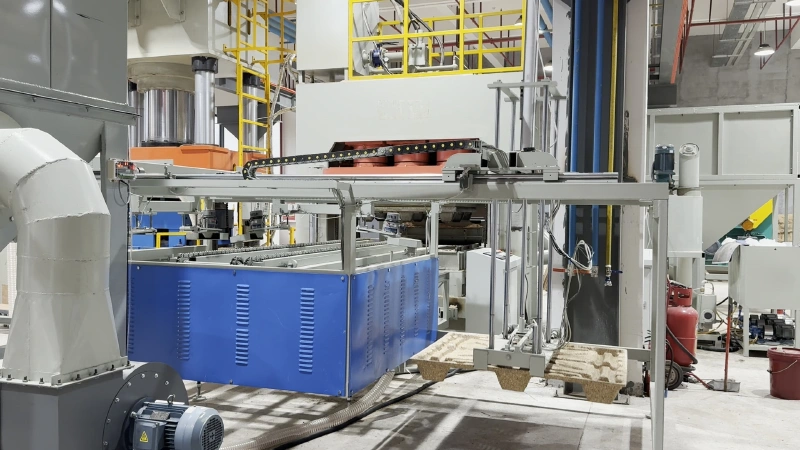
On a molded pallet production line the press is already engineered and the last metre is not: every hot cycle ends with an open die and a finished unit that has to be taken out and stacked, and on many presswood pallet machine installations that work is still done by hand, shift after shift. AutoML carries a four-axis servo robot at the back end of the line, configured to follow the process motion and take the pressed pallet out of the mold and stack it, so the repeated handling after pressing stops being a job description. Robot motion, safety zone and stacking pattern are confirmed against the actual configuration and the site layout, not assumed.
Why a Manual Take-Out and Stacking Post Sets the Line Takt
A manual post cannot be tied to the press open and close signal, so its rhythm is human: it drifts with shift start, with breaks, with fatigue and with who is on the post that day. The pallet is taken hot from a tool held at 150 to 180 degrees Celsius, lifted and stacked by hand, which keeps an operator inside the working envelope next to moving platens and inside the area a guard or light curtain is meant to protect. Each pick also decides how the stack is built, so stack squareness and deck condition vary with the operator on shift. The cost goes three ways at once: output is capped by staffing rather than by press capacity, headcount scales one for one with installed presses, and the exit becomes the constraint that every expansion plan has to carry. That is the specific load an automated pallet manufacturing line is asked to remove.
Where the Four-Axis Servo Take-Out Station Sits in an AutoML Line
AutoML is not a single press: it is a modular presswood pallet machine scope that runs everything from crush to stack, and the take-out and stacking stage at the back end is one of the modules that can be engineered rather than staffed. In a configured line, a four-axis servo robot follows the process motion, takes the finished pallet out after the die opens and places it as a stack, so the repeated material handling between the press and the outgoing conveyor is carried by the machine and the two ends of the line run on the same clock. Because the scope is modular, the automation boundary is a decision and not a lump sum: a plant can keep the core press and glue mixing module and trim upstream or downstream automation, or include the robotic take-out and stacking stage where press-exit manning is already the bottleneck. This is the difference between buying a machine and buying a line that ends in a stack.
What the Line Evidence Shows, and What the Site Still Has to Confirm
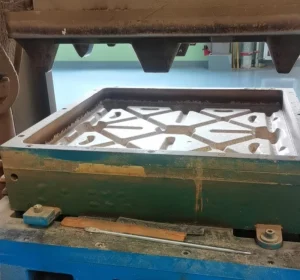
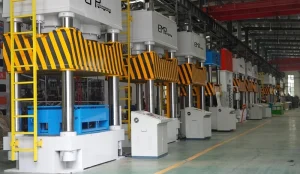
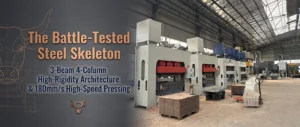
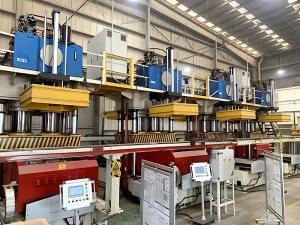
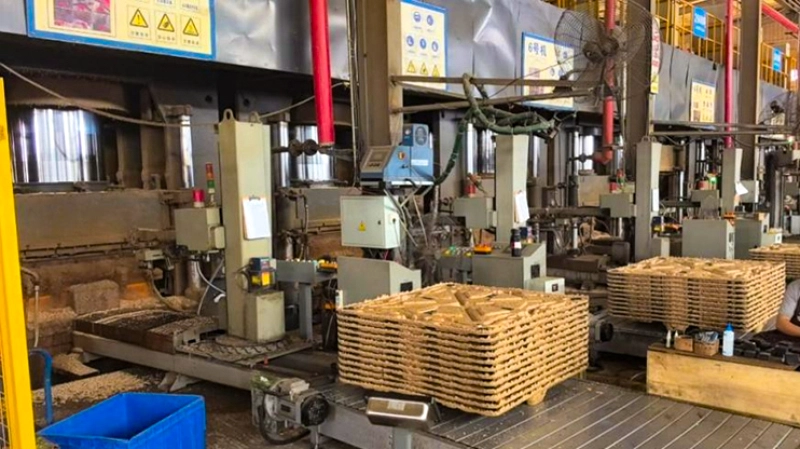
The documents behind this configuration are specific. Presses in the reference builds are 1600T class three-beam four-column units arranged in rows with their own control cabinets, with tonnage references in the 1200T, 1250T, 1600T, 1800T and 2200T tiers; the spreading stage runs rail-mounted dosing carriages from a central PLC; the demolding station is a servo-driven take-out arm on a gantry with a vertical linear guideway that pulls a nine-leg pallet out of the open cavity; powered roller and chain conveyors carry the stacks away under steel protection. Pallet footprints run from 1000 x 1000 and 1100 x 1000 to 1200 x 1000, 1219 x 1016 and custom molds, at a product density reference of 0.8 to 1.2 grams per cubic centimetre. What stays a project confirmation is equally plain: the robot working envelope, gripper or suction arrangement, pallet pick pose, stacking pattern and stack height, safety zone and guard layout, cycle matching to the press, power and air demand, and the semi-automatic or fully automatic split are set per configuration and per site design, with pressing temperature, pressure and cycle fixed in the technical agreement. Handled that way, the result is a line where the repeated take-out and stacking work is thinner, the transfer from pressing to stacking is continuous, and fewer people are scheduled beside hot tooling.
- Take-out and stacking are stated as a configurable module of the AutoML molded pallet production line, not as a stand-alone machine or a separate product.
- Press parameters (150 to 180 C, 15 to 20 MPa, 180 to 240 s), tonnage tiers (1200T to 2200T) and pallet footprints are the published references, with the final values fixed in the technical agreement.
- Robot working envelope, gripper or suction arrangement, stacking pattern, safety zone and guard layout are declared as project confirmations rather than fixed promises.
- No ROI, payback, hourly output or headcount-reduction figure is claimed for the robotic stage; only the removal of repeated manual handling is described.