Presswood pallet machine · capacity planning
The expansion plan this replaces: another bay, another row of stations
A molded pallet plant that already runs two or three shifts and wants 30 to 40 percent more output usually reaches for the only lever a staffed line offers: another spreading bay, another take-out hand at every press, another two people at the end of the line, and a supervisor span that quietly doubles. This is the expansion arithmetic of a presswood pallet machine line read as a set of manual stations. AutoML is EMP's modular molded pallet production line, built as a semi-automatic or a fully automatic configuration, where rail-mounted weighing and spreading, dosing screw feeding, hot pressing, robotic demolding and conveyor stacking carry the repeated motion that otherwise has to be staffed shift after shift. The point is not that people disappear from the plant. The point is that volume growth becomes a question about press count, cycle time and configuration instead of a question about how many more stations you can staff, train and supervise at the same time.
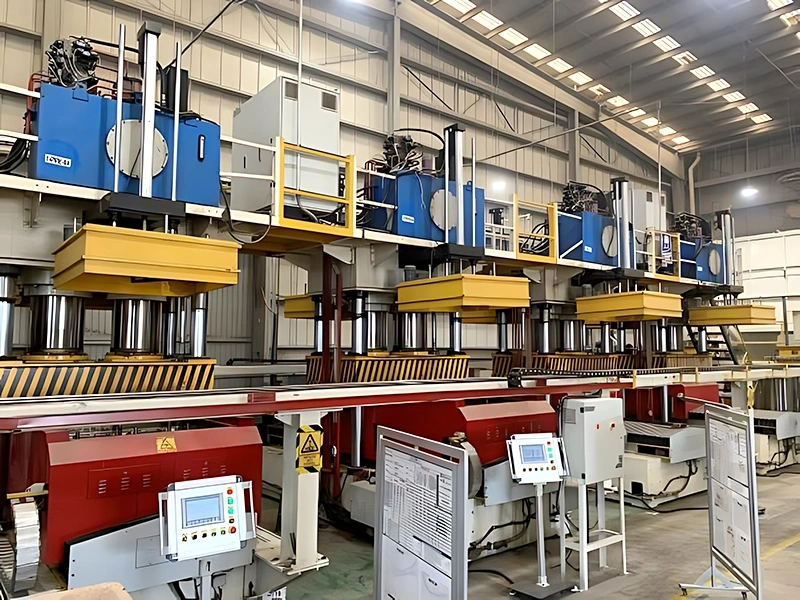
Where headcount actually scales on a molded pallet production line
Output on a molded pallet production line is set by press count and press cycle, not by how fast a person can move. With a 1200T to 2200T tonnage tier chosen for pallet size, structure and load class, a press holds the tool at roughly 150 to 180 degrees Celsius and 15 to 20 MPa for a cycle that commonly runs about 180 to 240 seconds, so a single press has a hard ceiling that no extra pair of hands changes. The line around the press, however, is a chain of handovers: material in, crushing, drying, glue dosing and mixing, spreading into the mold, pressing, demolding, then stacking and inspection. Every one of those handovers that stays manual needs a body per shift per station, and a plant running three shifts multiplies it by three. Add a second press and a manual spreading post, a manual take-out post and a manual stacking post each have to be duplicated with the shift cover attached. That is why an expansion plan written on a staffed line always reads like a hiring plan, and why the useful question before ordering equipment is which handovers the line itself can own.
What the line absorbs: weighing and spreading, dosing feed, demolding and conveyor stacking
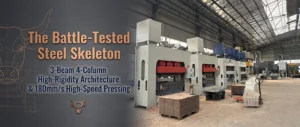
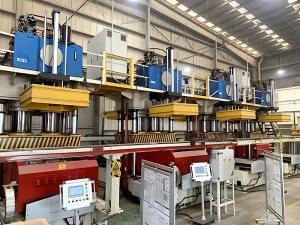
The first place the configuration changes the arithmetic is the spreading stage. On an automated pallet manufacturing line the material arrives at rail-mounted spreading machines that weigh and dose the glued fibre into the mold cavity on a set recipe, with the parameters held on central PLC screens instead of in a scoop, which is the station where two operators most often produce two densities. Upstream of it, dual adhesive blenders with pneumatic discharge gates and screw conveyors meter resin into the fibre, and downstream a robotic arm lifts the demolded pallet onto a chain or roller conveyor that builds the stack, so the press exit and the stack are mechanical duties rather than reach-and-lift duties. The press frame behind it is a three-beam four-column welded structure in the reference build, with servo-hydraulic drive options whose published energy saving claims of 25 to 55 percent belong in the technical agreement rather than on this page. Common pallet sizes across the files include 1000 x 1000, 1100 x 1000, 1200 x 1000 and 1219 x 1016 mm, with custom molds for special loads; raw material is prepared to roughly 5 to 30 mm length and 2 to 5 mm thickness and pressed to a density around 0.8 to 1.2 grams per cubic centimetre. None of that removes the operators, but it moves the capacity step from the roster to the equipment list: one spreading and dosing chain serving more than one press, one control position instead of a bay full of them, and a stacking flow that does not need a person per press exit per shift.
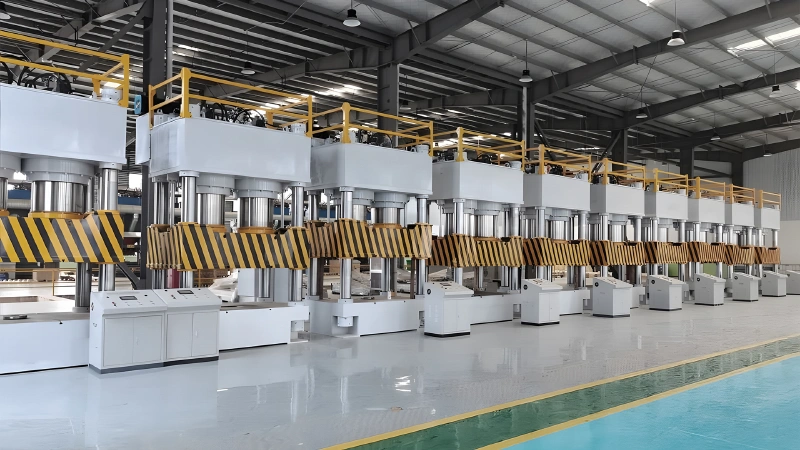
Verifying the expansion case before signing: press count, cycle, shifts, site
A line configuration is not a capacity guarantee. Real output has to be verified against press count, cycle time, the shift pattern you actually run, mold change time, raw material supply and the site conditions around the equipment, because a number quoted without those inputs is a demonstration figure. Two boundaries decide most of the cost. The first is the automation boundary: a plant in a low labor cost market can keep the press and glue mixing module and trim upstream and downstream automation, start semi-automatic and add the fully automatic sections when volume justifies them, which is why the project costing files place a semi-automatic line near RMB 2 million and a full automatic line near RMB 4 million as references rather than quotations. The second is process fit: moisture and glue ratio have to be matched to the glue system and proven in trial runs, and crushing and drying should be separated from the hot press room so dust and heat do not sit on PLC cabinets, sensors and hydraulic components. Payback in the project notes sits around 1.3 to 1.8 years in the ideal case and stretches toward three years when utilization is poor, and it depends on local pallet price, energy cost and material access rather than on the machine alone. What changes with an automated configuration is the shape of the evaluation: instead of asking how many people a 40 percent volume step adds, the plant asks how many presses, at what cycle, on which shift pattern, with which stations the line owns and which stay staffed. That is the result worth having, because it keeps the expansion plan in engineering terms and keeps management complexity from growing with every extra tonne of output.
- Capacity growth is argued from press count, cycle time and shift pattern, not from added manual stations.
- Every numeric reference is marked as a file reference or a project confirmation item, not a performance guarantee.
- Semi-automatic and fully automatic configurations are both kept open, with the automation boundary left as the customer's decision.
- The article describes line-level automation and does not claim the press exit take-out robot scope of any other product.