AutoML molded pallet line · robotic take-out at the press exit
Where the take-out duty actually sits on a three-shift line
On a molded pallet production line the last hand movement of every cycle happens in the worst place in the plant: the open die. A presswood pallet machine running at 150 to 180 degrees Celsius and 15 to 20 MPa opens, a cured pallet sits in the cavity, and on a manual line one operator steps in, pulls the unit out and stacks it, then does it again after the next 180 to 240 second cycle, three shifts a day, beside tooling that stays hot in between. AutoML places a servo take-out unit at that point instead: the arm follows the process motion, extracts the pressed pallet and hands it to the chain or roller conveyor, so the repeated take-out action is performed by equipment rather than by a person standing at the mold. This page covers where that duty sits today, why it is a shift planning and safety management question rather than only a lifting one, how the robotic take-out is configured on a semi-automatic line and on an automated pallet manufacturing line, and which parameters still have to be confirmed for the actual project. Reduced direct involvement is the stated claim; removal of all risk is not, because guarding, interlocks and local rules stay the plant responsibility.
Why manual take-out is a management problem, not only a lifting problem
A manual take-out post forces the plant to solve safety with procedure instead of with layout. People have to be inside the press bay at the moment the tooling is open, which means the guard or light curtain is by design interrupted every cycle, and the discipline that makes that acceptable is documentation, training, supervision and a culture that holds on the night shift as well as on the day shift. Heat adds a second layer: the mold face, the frame and the surrounding air stay hot between cycles, so the operator works in radiant heat for the whole shift, and steam released at pressure release puts moisture and dust into the same breathing zone. Add the ordinary industrial realities, an operator off sick, a new hire on his second week, a supervisor covering two bays, and the take-out step becomes the point where the shift plan is most fragile and where incident reports are most likely to originate. Cut-resistant gloves, a face shield and a written procedure are compensating controls; they do not change the fact that the task itself is defined by being close to a hot, moving press. That is why plants that intend to run long term usually stop treating manual demolding as a labour cost line and start treating it as an exposure they have to design out of the shift.
How the robotic take-out is configured, and where the automation boundary sits
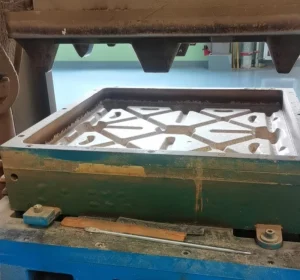
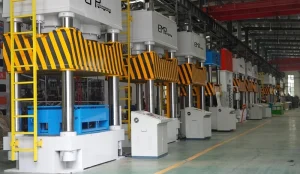
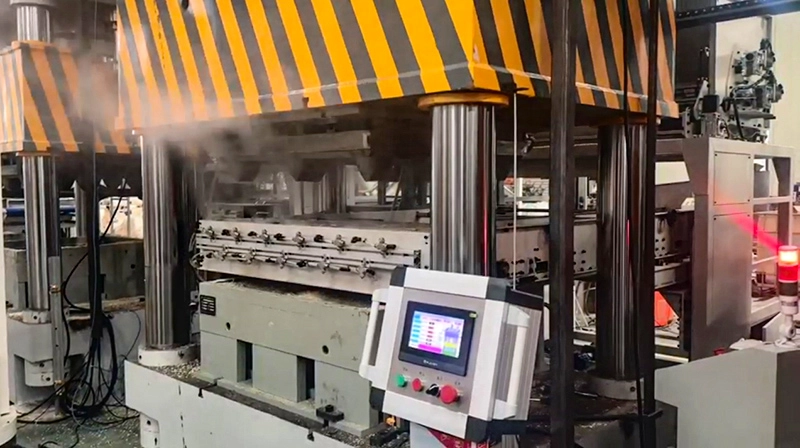
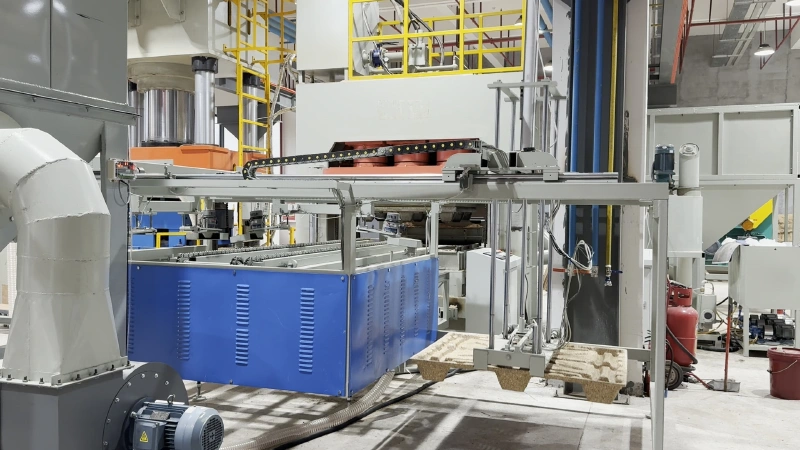
AutoML builds the take-out step into the line rather than leaving it to the crew. A four-axis servo unit is mounted at the press exit on a vertical linear guideway: the end effector enters the open cavity, clamps the freshly pressed pallet, lifts it clear of the tooling and traverses to the discharge side, where it places the unit on a chain conveyor with steel side protection or on a powered roller line that carries the stack away. The sequence is tied to the press open signal, so extraction starts on the process motion rather than on a person noticing that the die is open, and the pallet reaches the stack without an intermediate manual position. The second photo shows the same handover at the other end of the cycle: the arm holding a cured unit above the guarded conveyor instead of an operator holding it above his boots. The first photo is the reason the position exists at all, steam lifting off the tooling as the press opens at curing temperature. Configuration remains a commercial decision. A semi-automatic line keeps the press group, the metered glue mixing and the robotic take-out while trimming upstream and downstream automation, which suits plants in low-labour-cost regions that want the exposure reduced without buying the whole chain. A fully automatic line sequences spreading, dosing, pressing, demolding and stacking on the line control, and the crew moves to supervision, spreading checks and finished-pallet inspection. In both cases the job changes character: the person who used to stand at the mold becomes the person who watches parameters and checks the stack, and the plant gains a role it can staff, train and rotate.
Parameters and site facts to confirm before you count the labour change
The line references behind this configuration are concrete enough to plan against: press tiers from 1200T to 2200T with a 1600T class press used repeatedly across projects, pressing at 150 to 180 degrees Celsius and 15 to 20 MPa, a 180 to 240 second cycle, finished density at 0.8 to 1.2 grams per cubic centimetre, MDI glue commonly around 8 to 10 percent and UF or PF around 10 to 12 percent, and mold footprints from 1000 x 1000 mm and 1100 x 1000 mm through 1200 x 1000 mm to 1219 x 1016 mm, plus custom molds. What those numbers do not answer is the local question. Robot reach, traverse speed, stacking pattern, fence height and interlock arrangement have to be drawn against the actual press bay, walkway and forklift route, because a take-out unit that is correct on paper and boxes in the maintenance access is a problem the plant inherits. Moisture still has to be matched to the glue system from trial data rather than taken from a table, and dust and steam extraction have to be laid out so that the new arm is not breathing the same cloud the operator used to stand in. The result worth planning for is a measurable change in the roster at the press exit, a smaller number of people whose task definition puts them at an open hot mold, and a safety file that describes equipment guarding rather than operator discipline. Reduced direct participation is what the machine delivers; guarding, verification and local regulation remain the project scope, and any labour or risk figure has to be measured on your own crew, fibre and shift pattern rather than quoted from a reference line.
- Press tier, mold footprint and cycle time confirmed in the technical agreement rather than assumed from the 1600T reference.
- Robot reach, stacking pattern and guard or interlock layout drawn against the real press bay, walkway and maintenance access.
- Moisture window matched to the fibre and glue system from trial data before the run plan and acceptance criteria are fixed.
- Take-out labour and exposure change measured on your own shift roster, with guarding sign-off following the equipment plan and local rules.