Manual line coordination span
Where a manual pallet line spends its management hours
A plant that molds its own pallets rarely loses output at the press itself: it loses it in the handovers, where fibre, glue, weighing, spreading, take-out and stacking are still run as separate manual stations and one production lead carries the whole span. This page follows that coordination cost onto an AutoML presswood pallet machine line, configured as a molded pallet production line from pretreatment through forming, demolding and pallet stacking, on a 1600T class reference press at 150 to 180 degrees Celsius, 15 to 20 MPa and a 180 to 240 second cycle, and it states plainly which jobs the equipment flow takes over and which staff positions the plant still has to fill.
Why the line, not the press, is the unit that changes the load
AutoML is configured as a molded pallet production line rather than a single industrial pallet press machine because the handovers are where the coordination cost actually sits. Crushing, drying, glue mixing with dosing screw conveyors, weighing and dosing spreading, hot pressing, demolding and conveyor stacking are engineered as one chain and sequenced from the line control, so the timing question moves from who calls whom to what the sequence is set to. The same scope is delivered either as a semi automatic pallet line or as a fully automatic pallet manufacturing line, depending on local labour cost, raw material supply, electrical capacity, plant layout and the payback logic the customer is working to. Upstream or downstream automation can be trimmed while the press and glue module are kept, so the coordination reduction can be bought in stages instead of in one order.
What the equipment carries, station by station
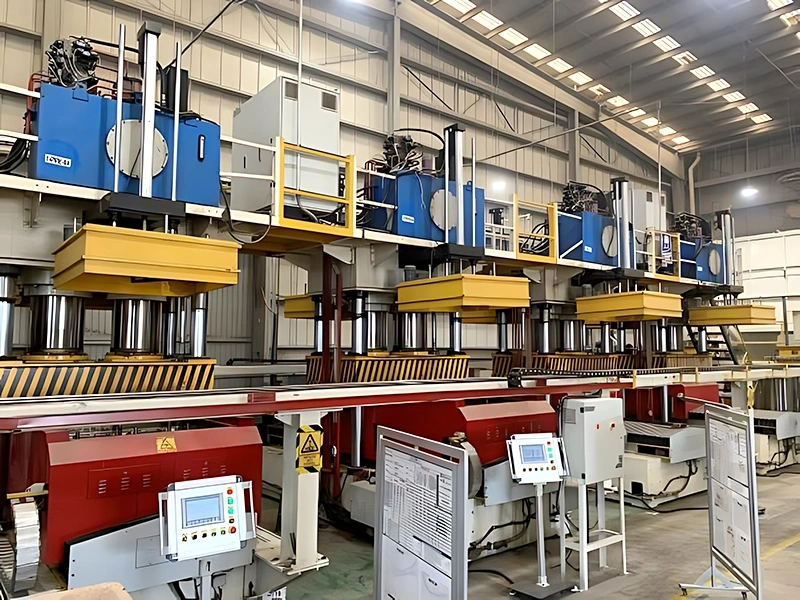
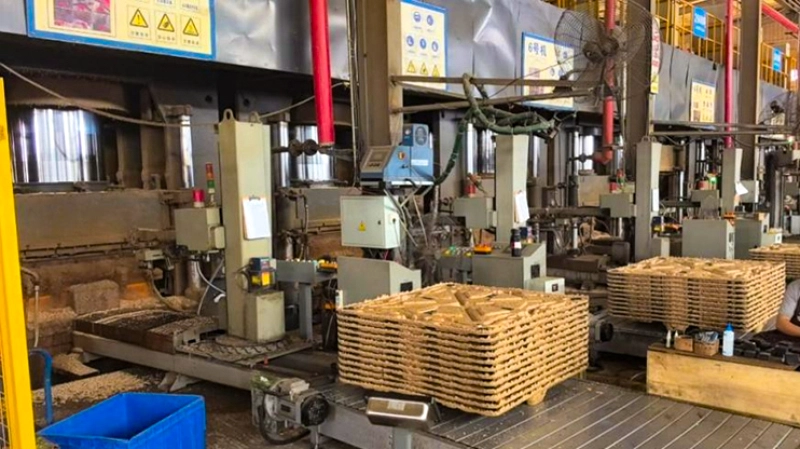
The structural evidence is visible in the two photographs. The first shows the press front of the line: rail-mounted weighing and dosing spreaders under a central PLC screen, which is the point where the weighed batch stops being an operator judgement and becomes a set value. The second shows the other end: freshly pressed pallets already stacked on a powered steel roller conveyor beside the press, so the exit handover is carried by the conveyor instead of by a person waiting at the open die. Behind those two views sits the same reference envelope: a 1600T class press within 1200T to 2200T tonnage tiers, hot pressing at 150 to 180 degrees Celsius and 15 to 20 MPa, a 180 to 240 second cycle, finished density at 0.8 to 1.2 grams per cubic centimetre, MDI commonly around 8 to 10 percent and UF or PF around 10 to 12 percent, with raw material prepared to roughly 5 to 30 mm length and 2 to 5 mm thickness.
What the plant still staffs, and what to confirm first
The claim is deliberately narrower than full automation. The line still needs operators to run and watch it, inspection of density, thickness, ribs and stack quality, forklift and yard staff, and maintenance cover; what changes is the organising weight. The production lead is no longer dispatching people between scattered manual stations all shift, but running one equipment flow, which is the practical meaning of an automated pallet manufacturing line on the shop floor. Four things stay project confirmed rather than promised: moisture must be matched to the glue system from trial data, tonnage, mold and cycle are fixed in the technical agreement, layout and utilities are checked against the site, and the business case for wood waste to pallet conversion is still built from the customer own fibre cost, labour rate and per piece variable cost. A nail-free wooden pallet process and fumigation-free output are outputs of that flow, not a substitute for confirming them per project.
- Both image source_path values come from the resolved AutoML designer gallery and both were imported through the media batch step with index alt text
- Every section body is plain text with no HTML tags, attributes, markdown or angle brackets, so the fixed renderer owns all paragraph markup
- The article follows customer and scene, then old manual line problem, then product fit, then structure and parameter and image evidence, then stated result and limits
- Traffic profile product, scene and result terms appear in the summary, headings and body without banned weak phrases