Press utilization and PLC synchronization on the molded wood pallet line
The scene: a 4–5 minute cycle with an open-mold window the press cannot protect on its own
On a molded wood pallet line, the cycle the press was sold on is not the cycle the line actually runs. The 4–5 minute press takt on a 1250–1600 ton hot press is set by the hydraulic press, the binder cure, and the open/close window of the mold, but the open-mold minute is where single-line OEE is most often lost. A worker standing in front of that open mold cannot move at the press's own beat, so the press waits. AutoG is the automatic pallet take-out robot that ends that wait by handing the pallet out of the mold at 80°C, on the press open/close signal through the line PLC, so the cycle the press was sold on is the cycle the line actually runs.
Why manual take-out erodes press utilization on that cycle
With a manual take-out, that rhythm breaks in two ways at once. The freshly pressed pallet sits at roughly 80°C when the mold opens, so the operator either waits inside the cycle for the pallet to cool enough to grab, which keeps the press idle between cycles, or reaches in while the pallet is still hot, which slows the operator and exposes the worker to heat and to MDI off-gas at the open mold. Either way, the take-out step cannot move at the same beat as the press. The press waits on the worker, the cycle that was supposed to be 4–5 minutes quietly stretches to 5–6 minutes, and the line runs the shift without anyone noticing that single-line OEE is bleeding out at the take-out station rather than at the press itself. The lost time does not show up as a stop. It shows up as utilization that never reaches the number the line was quoted on.
How AutoG fits the press: 80°C direct take-out, vacuum suction, and PLC sync on the open/close signal
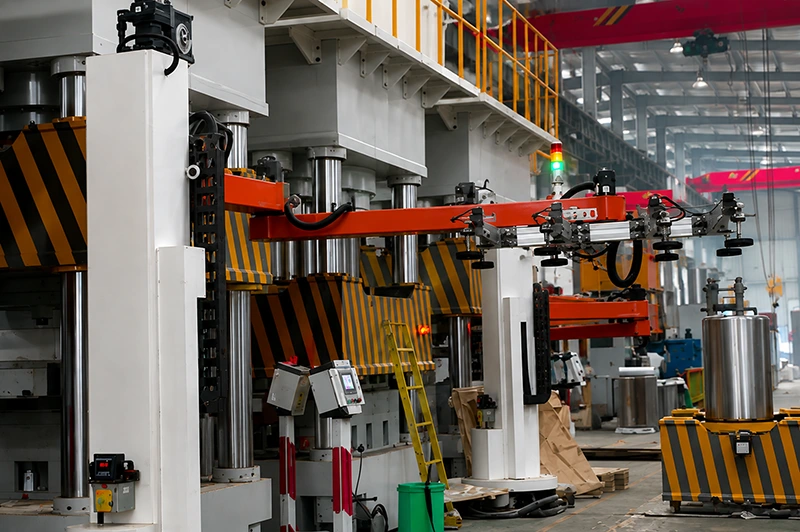
AutoG is the automatic pallet take-out robot that hands the pallet out of the mold at the press's own beat. The robot uses a six-axis articulated arm with a multi-cup vacuum suction end effector, so the freshly pressed pallet at about 80°C is lifted straight out of the open mold without a cooling wait and without a worker reaching into the hot cavity. The robot is wired to the press's open/close signal through the line PLC, which is how it stays in step with the press: the press opens, the robot enters the mold, picks the part, transfers it to the stacking position and stacks it, and the press closes again on the next cycle. One AutoG can serve two 1250–1600 ton presses in alternation, taking one press's pallet while the other is still pressing, so a single robot replaces roughly two manual take-out workers and keeps the take-out step inside the cycle window the press expects. The first image shows a press transfer gantry built around multi-suction vacuum grippers sitting right beside a press; the second image shows an actual hydraulic press line where the robot arm, the shielded mold area, and the stack of finished pressed panels all live on the same shop floor, with the take-out end open to the robot and the press shielded from the operator.
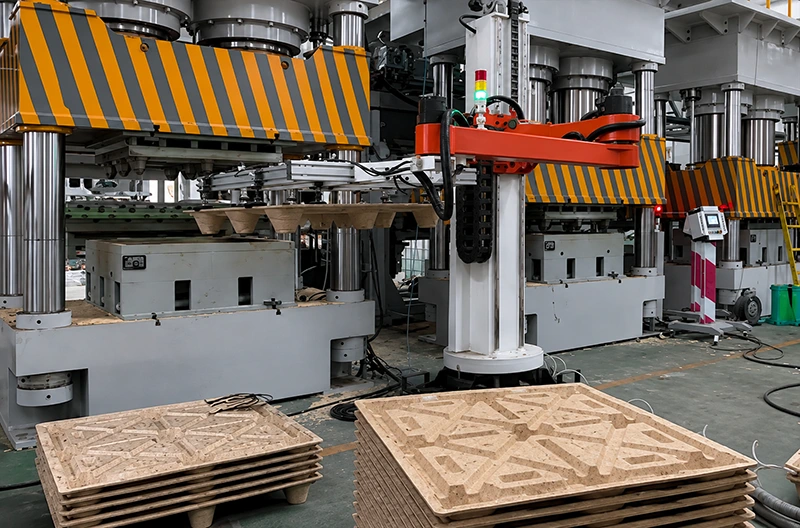
What changes on the line: press utilization recovers and single-line OEE stops bleeding at the take-out station
When the take-out step moves at the press's own beat, single-line OEE starts to recover from the take-out station rather than from the press. The press no longer idles waiting for a worker to clear an 80°C pallet, and the cooling wait between cycles disappears because the vacuum gripper is rated for the hot part. Workers leave the press danger zone and stand at the line PLC cabinet or at the stacking station instead, which is where the cycle is actually controlled and where the next stack is actually formed. The line runs longer shifts without adding headcount, and the press utilization number that shows up on the monthly review starts to reflect the cycle time the line was sold on, not the slower manual rhythm that used to sit on top of it. For a molded pallet plant whose tonnage plan was built around the 4–5 minute press takt, that is the part of OEE the AutoG robotic offloading gives back.
- 80°C direct hot-pallet take-out, no cooling wait, rated for hot part
- PLC synchronization on the press open/close signal drives the cycle handoff
- One AutoG arm tends two 1250–1600 ton presses in alternation, replacing ~2 manual take-out workers
- Six-axis articulated arm with multi-cup vacuum suction end effector for press-side pick-and-place