Export Packaging
Where the Export Order Actually Loses Money
An export packaging house already owns the customer, the channel and the shipping schedule. What it does not control is the heat-treatment kiln. A presswood pallet machine running at 150 to 180 degrees Celsius turns recovered wood fiber into a one-piece molded pallet that sits outside the ISPM-15 heat-treatment and fumigation requirement, which means the same sales team can quote a fumigation-free SKU that never waits for a kiln slot.
Why a Molded Pallet Is a Different Product Category
ISPM-15 regulates wood packaging material made from raw wood. Wood that has been processed into a manufactured material such as plywood, particleboard or fiber based board is treated differently, because the high temperature and pressure manufacturing step already removes the pest risk that the standard exists to address. This is the hinge the whole argument turns on. A presswood pallet machine does not saw a pallet out of a log. It takes sawdust, wood chips, shavings, straw or similar lignocellulosic residue, mixes it with adhesive, and presses it into a single piece pallet under a 1600T class hydraulic press at 150 to 180 degrees Celsius. The pallet that leaves the mold is a molded wood fiber product, not a piece of raw timber, and it is produced by a hot pressing process rather than by a treatment applied after assembly. Practically, that means the delivery you send to your export customer does not require a separate fumigation or heat treatment step, and does not need an IPPC mark applied by a treatment operator. There is also a second structural advantage that matters at the same border: a molded pallet is pressed in one piece and assembled with no nails. Nail free wooden pallet construction removes the loose nail and protruding fastener findings that inspectors and receiving docks look for, and it removes the split boards that nailed pallets develop under repeated handling. For a packaging company, this is a new line item in the catalogue rather than a replacement for everything already sold: the same customers, the same export channels, one additional fumigation-free option that does not consume kiln time.
What the Line Looks Like When It Is Installed
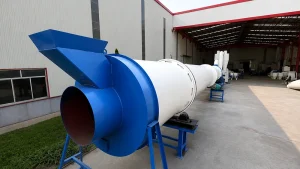
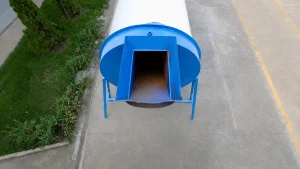
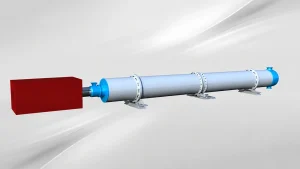
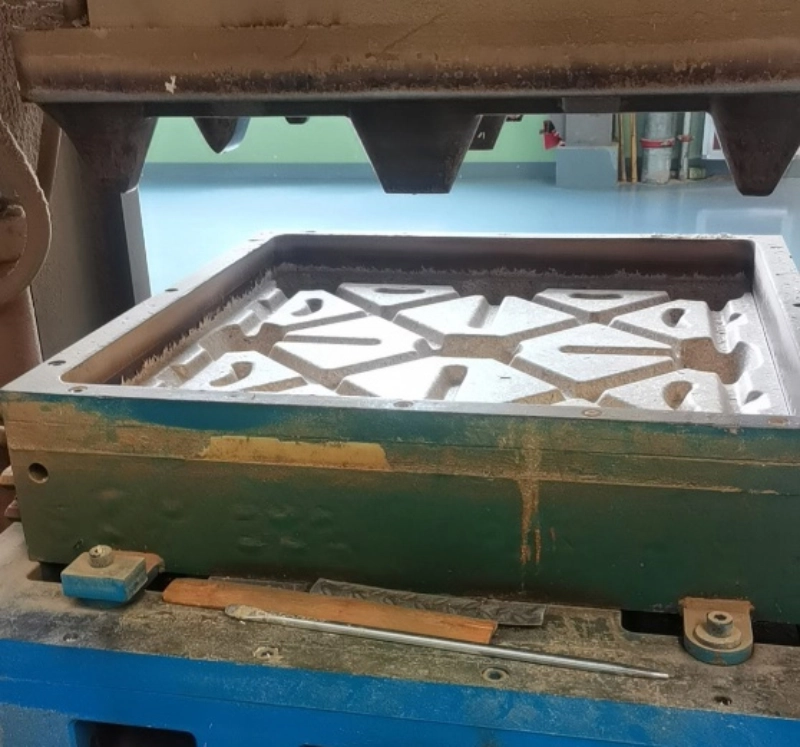
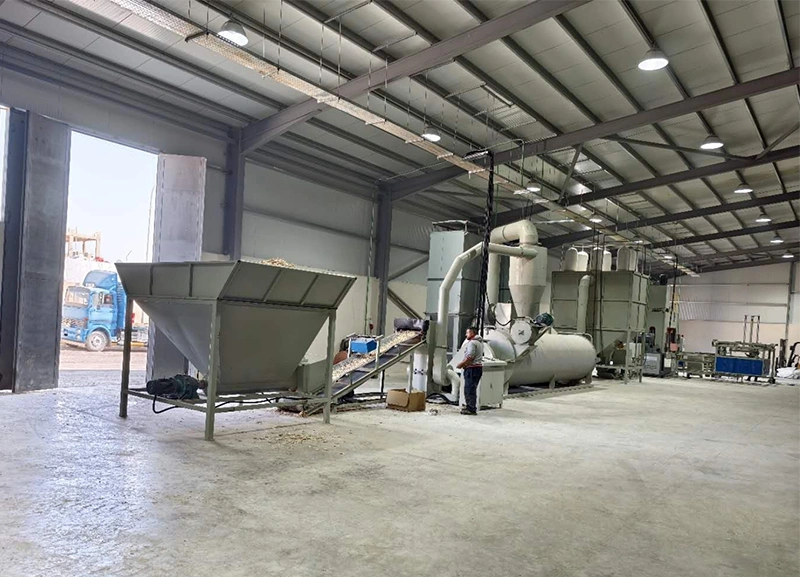
AutoML is not a single machine. It is a modular molded pallet production line, and the process chain is deliberately complete: crushing, drying, glue mixing, metered dosing and spreading, hot pressing, demolding, and stacking. Upstream, a hammer mill reduces recovered wood to a defined particle range and a rotary drum dryer with a feeding hopper and cyclone dust collection stabilises the fiber before it reaches the mixer, because moisture that drifts from lot to lot is what produces density variation and weak corners. In the middle, dual adhesive blenders feed metered material onto the molds instead of relying on a manual scoop, which is how density spread across the pallet is held. At the press, the pallet is formed in a steel mold cavity. The photograph above of the open mold shows the bottom structure a buyer actually receives: the load bearing reinforcement ribs and the four way entry recesses are formed by the tooling, not added afterwards by a fabricator. The typical line parameters quoted in AutoML project files are a 1600T class press, 150 to 180 degrees Celsius of mold temperature, 15 to 20 MPa of pressing pressure, and a cycle in the range of 180 to 240 seconds, with finished product density around 0.8 to 1.2 grams per cubic centimetre. Common mold sizes include 1000 by 1000, 1100 by 1000, 1200 by 1000 and 1219 by 1016 millimetres, and the structure family covers nine leg single face pallets, flat single face pallets, cross base double layer pallets and three runner flat pallets, with custom molds for special loads. Structure choice is what makes the export argument practical rather than theoretical: nestable pallet manufacturing lets the empty pallet stack into the footprint of a fraction of its own footprint, which cuts both warehouse space at your site and return freight volume on the reverse leg. Moisture windows and adhesive ratios are not universal constants. They follow the glue system, the mold and the trial data for the specific project, and they belong in the technical agreement rather than in a sales sheet.
What Changes in the Order Book
The commercial result is a change in what your sales team is able to promise. An export packaging business adding a presswood pallet machine gains a fumigation-free pallet that ships through the channels it already owns, and it stops treating heat treatment capacity as the ceiling on export volume. A late order no longer competes for a kiln slot, because there is no kiln step in the route for this SKU. A compliance hold on a treated lot no longer threatens the whole shipping programme, because the fumigation-free SKU carries a different risk profile. And because the raw material is recovered wood fiber rather than purchased timber, the cost base moves with the waste stream you already handle instead of the lumber market. Automation boundary is a business decision, not a technical one. The line can be built semi automatic for markets where labour is affordable, or fully automatic where multi shift staffing is the constraint, and the servo hydraulic option is quoted in the AutoML files at 25 to 55 percent energy savings against conventional pump control on the pressing side. Capital figures circulating in project costing notes run around RMB 2 million for a semi automatic line and around RMB 4 million for a full automatic line, with payback modelled at roughly 1.3 to 1.8 years in favourable cases and extending towards three years in weaker ones. Those are model outputs, not guarantees: they depend on local pallet price, raw material cost, utilisation and financing, and they should be rebuilt for your own numbers before a purchase decision. What does not depend on the model is the compliance position. A molded, nail free pallet pressed from processed wood fiber is not a raw wood pallet, so your export programme stops paying the ISPM-15 tax on every lot it ships. If you want the exemption position and the line configuration checked against your own pallet sizes and export lanes, send the pallet drawing and the monthly volume to our engineering team and we will respond with a layout and process proposal.
- ISPM-15 heat treatment and fumigation burden on export packaging lots identified as the core pain
- Molded hot pressed wood fiber pallet positioned as a processed wood product that removes the treatment step
- Line chain, 1600T press class, 150-180 degree Celsius, 15-20 MPa and mold sizes documented as evidence
- Nail free and nestable structure plus capital and payback references given with validation caveats