Field Note — GCC Wood Waste Recycling
The customer and the scenario
A Dubai-area wood recycler running a thirty-ton-per-day yard rarely loses same-day collection trucks because the chipper is undersized. He loses them because the chipper sat dead for nine days waiting on one fly knife and one operator who knows how to fit it. This field note is for owners comparing a large capacity wood chipper against the Gulf reality of expensive blue-collar labor and a thin bench of trained operators. Below is what actually changes when a stationary drum chipper replaces outsourced chips, a legacy diesel mobile unit, or a manual sawing bench.
Why the old setup breaks
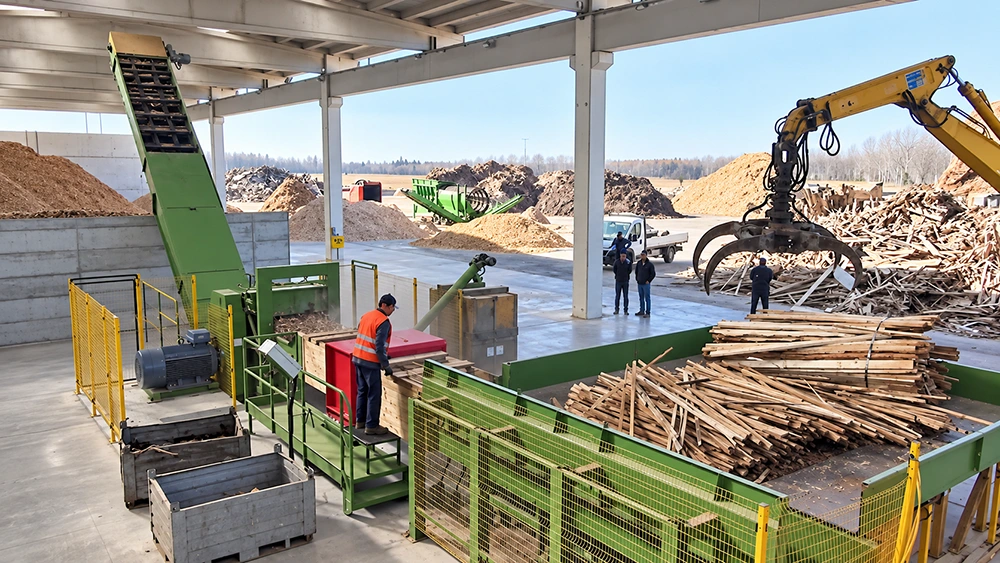
Three legacy setups dominate the region, and each one breaks in a way that hits the recycler exactly when he cannot afford it.
Outsourced chip purchase is the first. The yard ships pallets, broken crates and demolition formwork to a chip supplier, then buys back finished chips or fines for downstream customers such as particleboard mills, biomass plants and pressed-pallet lines. The math works on a quiet quarter, and then the chip supplier’s own line goes down for a week, his haulage rate moves with diesel, or his price goes up twice in six months. The recycler is exposed twice: he pays out for disposal he cannot control, then pays again for feedstock he cannot control. The variable cost in his P&L is the variable cost he is least able to forecast.
Diesel mobile chippers are the second legacy. They look cheap on a tender and they look like a quick fix, and in the Gulf heat, on contaminated feedstock, they spend their working life at the edge of their cooling capacity. Failures cluster on the engine, the clutch, the feed-roller hydraulics and the radiator. Spare parts for a Western-built mobile unit clear local customs and a freight forwarder, and the typical lead time is measured in weeks, not days. When a unit goes down in the middle of August the recycler is effectively chipper-less until the part lands.
Manual sawing and splitting on a band-saw bench is the third, and it is still common in smaller yards. It is cheap on paper and lethal on the unit economics of a yard that has promised its customers same-day collection. One band-saw operator with a helper can move roughly half a ton per shift on clean pallet timber and far less on dirty demolition wood. A yard doing thirty tons a day would need a bench crew larger than the rest of its workforce put together, and that bench crew is exactly the staff a Gulf recycler can no longer retain.
Why a drum wood chipper fits this scenario
A drum wood chipper is chosen for the GCC recycler not because it is the largest machine on the market but because three of its design choices line up with the constraint that actually hurts — operator scarcity and downtime risk.
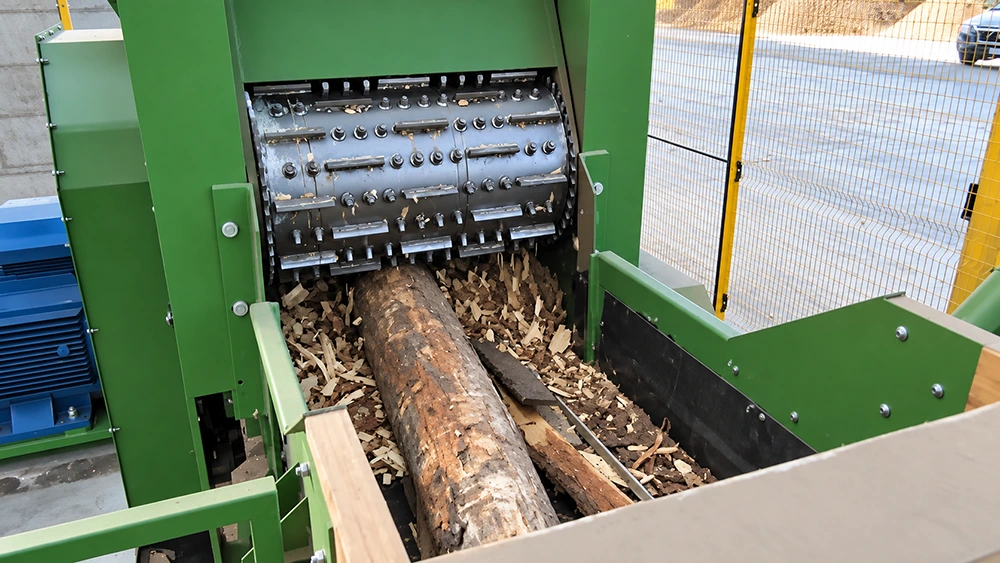
The cutting geometry is simple. A drum chipper uses a horizontal knife roller carrying two or three fly knives set against a fixed counter knife, plus a sizing screen at the discharge. Compared to a disc chipper or a multi-shaft shredder, there are fewer moving parts, fewer clearances to set, and one component — the fly knife — that an operator can swap by hand with basic tools after a short on-site briefing. The knife gap is adjustable from outside the housing, so a single operator can tune chip length without entering the cutting zone or stopping the line for a workshop call-out.
The wear parts that fail on a chipper are stocked as a kit. Fly knives, counter knives, sizing screens, feed-roller bearings and hydraulic seals are all on the EMP wear-parts list, and they are sized so a yard can hold one and a half to two sets on a wall-mounted shelf inside the control room. An X-216 drum chipper at 55 kW runs 6–8 tons per hour and an X-218 at 110 kW runs 8–12 tons per hour, both through a 216 mm feed inlet with a 30–35 mm chip length set by the sizing screen, and both can be re-supplied with fly knives and screens by air freight rather than by sea freight — which is the difference between a 48-hour recovery and a nine-day recovery.
The chipper talks to the rest of the line through a single PLC panel. The infeed conveyor, the chipper, the discharge belt and a downstream hammer mill or pellet press can all be started, stopped and interlocked from one screen, with hydraulic auto-feeding through a feed roller and a lower pressing roller that pulls timber in without a man standing at the chute. One operator at the panel replaces three or four at the line. CE marking and the EU Machinery Regulation 2023/1230 framework come as part of the build, so a Dubai yard that ships chips onward into Europe is not forced into a separate compliance project on the customer’s end.
What the recycler ends up with
A Gulf yard that replaces outsourced chip purchase with an in-house large capacity wood chipper typically moves from a variable cost per ton — chip-supplier pricing plus disposal fees that are priced by someone else — to a fixed per-ton conversion cost that the yard itself owns. With a yard running close to nameplate on low-cost or negative-cost feedstock (demolition formwork, broken pallets, off-cuts from neighboring joinery shops), the payback window on an X-216 sits in the six-to-twelve-month range, and on an X-218 it is shorter if the yard already has downstream offtake for the chips.
The operational result is more important than the financial one. A one- or two-person crew can run the chipper and the downstream line from the PLC panel, swap a set of fly knives on site in roughly the time it takes to do a shift handover, and keep the same-day collection promise through the routine blade change. The chipper does not need the operator to be present for the routine work — it needs him available for the unusual work, and that is exactly where the Gulf labor market punishes owners the hardest.
For a recycler weighing the move, the practical questions are three and only three: which scrap streams are coming through the gate, what chip size the downstream offtake wants (the drum chipper ships at 30–35 mm and the sizing screen is the only thing standing between that and a coarser product), and which wear parts the yard wants on the shelf before commissioning. Answer those three and a large capacity wood chipper becomes a fixed cost the same-day collection promise can be built on, not a variable cost that quietly breaks it.
- Hydraulic feed roller, lower pressing roller, adjustable knife gap, and PLC centralized control are the cited design choices for low-manpower operation.
- X-216 at 55 kW delivering 6–8 t/h and X-218 at 110 kW delivering 8–12 t/h are the stated capacity figures; 30–35 mm chip length set by the sizing screen is the cited output specification.
- Fly knives, counter knives, sizing screens and bearings are the listed wear-parts kit; air-freight restock is cited as the lead-time lever versus sea-freight mobile-chipper parts.
- CE marking and EU Machinery Regulation 2023/1230 are cited as the compliance package for downstream EU chip shipments; on-site fly-knife change with basic hand tools is cited as the maintenance path.