Feedstock contamination control
Where the contamination actually enters the chip preparation stage
Boiler fuel pellets inherit whatever arrives with the wood: nails out of used pallets, wire and staples out of slab bundles, and stone or grit that rides in with branch wood and yard scrap. This is not a chipping problem, and a drum wood chipper machine cannot solve it on its own, because a wood chipper machine reduces size and does not sort material. What actually closes it is the sequence: pull the metal and the stone out upstream, then let the drum chipper deliver uniform 30 to 35 mm chips into milling, drying and pressing. Read on for where the contamination enters, why the chipping stage cannot remove it, what EMP supplies as an upstream separation package matched to a 45 kW, 55 kW or 110 kW drum wood chipper platform running 4 to 12 t/h, and what the plant ends up with at the boiler.
Why a bigger knife roller is not the answer
The reflex is to buy a heavier drum chipper, thicker knives, a stronger rotor. That purchase improves how the machine survives contact with tramp material. It does not reduce how much of that material reaches the boiler, because the metal leaves the chipper in the same chip stream it entered. This is the honest boundary of the Shred drum wood chipper and it needs to be stated plainly: metal separation and destoning are upstream and independent stages, they are not built into the chipper body, and the EMP chipper parameter set does not list a self-contained metal removal device. Where a plant is running a chipper against nail-bearing pallet timber with no separation stage in front of it, the correct fix is not a longer knife life claim. The correct fix is to put the separation stage in front of the chipper, sized for the tonnage and the material, and to wire it into the cleaning step the plant already operates. A drum type wood chipper is the right tool for reducing irregular material to a controlled chip length. It is not a sorting machine, and treating it as one is how a plant ends up with metal in the boiler and knives replaced on a schedule nobody planned.
The package that closes the gap: separation upstream, drum chipping behind it
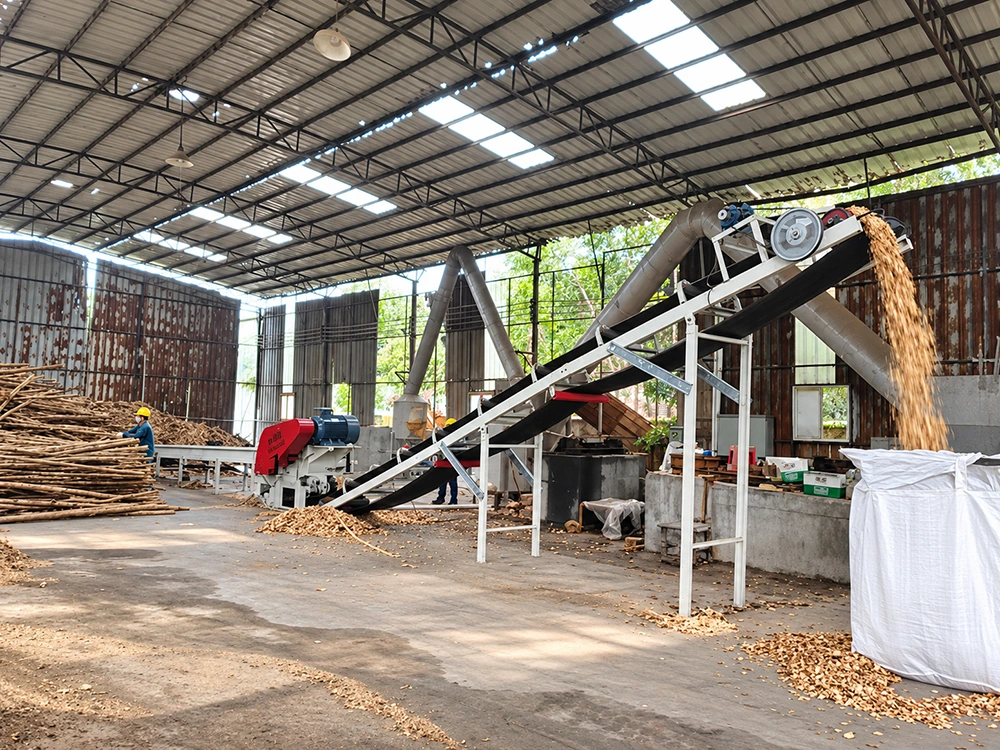
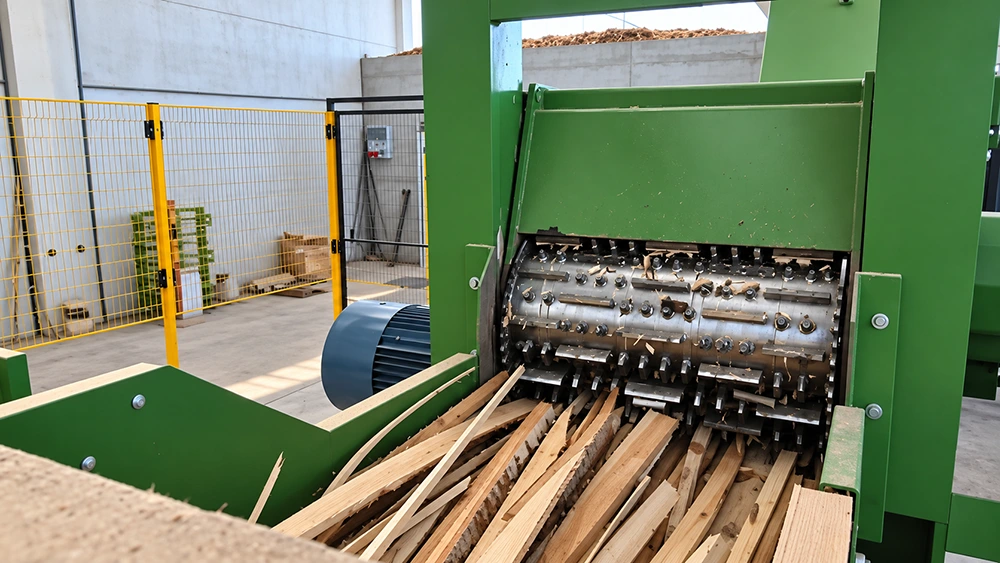
EMP supplies the two stages as a matched preparation package rather than as one machine carrying the other's job. On the upstream side, magnetic separation takes ferrous material off the infeed stream, and screening separates stone, grit and fines, with both stages interfaced to the conveyors and the cleaning arrangement already on the customer's floor, so the plant does not rebuild its material flow to accept them. On the downstream side sits the Shred drum chipper platform. The X-215 uses a 45 kW main motor for 4 to 5 t/h, a 600 mm knife roller, a 400 by 180 mm feed opening and 160 mm maximum feed diameter. The X-216 uses 55 kW for 6 to 8 t/h, a 650 mm knife roller, a 540 by 240 mm feed opening and 200 mm maximum feed diameter. The X-218 uses 110 kW for 8 to 12 t/h, an 800 mm knife roller, a 680 by 310 mm feed opening and 300 mm maximum feed diameter. All three run the same working principle: a hydraulic feed roller system that floats to suit varying material thickness, a knife roller carrying bolted fly knives with counter knives, and a sizing screen that lets accepted chips fall through while oversize pieces recirculate inside the chamber for another cut. Chips leave the machine at roughly 35 mm, which is the first-stage size the milling, drying and pressing stages behind it are built to receive. On site, the discharge end feeds an inclined conveyor and a collection or bagging point, as shown in the line photograph above, and the feed chamber is where the bolted knife arrangement sits behind guarding, as the second photograph shows. The electrical side is a 380 V supply with a soft-start cabinet, variable frequency control of feed speed and wireless remote start and stop. That is the combination worth stating on a specification sheet: contaminant removal handled thoroughly at the separation stage, and chipping handled uniformly at the chipper, each with its own scope, its own acceptance criteria and its own performance responsibility.
What the plant ends up with at the boiler
The result is not a better chipper. It is a preparation line with a defined division of labour. Ferrous material and stone are taken out before the wood is reduced, so the knife roller is cutting wood rather than cutting through hardware, and the chip stream carried forward to the mill, the dryer and the press is wood chip rather than wood chip plus tramp. The chipper stage then delivers a consistent 30 to 35 mm first-stage chip from irregular feedstock, which keeps the downstream stages working on a stable input instead of chasing a variable one. At the furnace, the mineral load that drives ash and tube wear is managed at the gate instead of being discovered in a maintenance report. Four checks make this real for a buyer. First, quantify what you are feeding: metal pulled per week and grit content on a screened sample. Second, decide where separation physically sits, on the infeed conveyor or ahead of it, and confirm the interface with your existing cleaning step. Third, match the chipper feed opening to your largest piece of incoming material, since 160, 200 and 300 mm maximum feed diameter is the constraint that decides the model, not the headline tonnage. Fourth, buy the separation stage as a separately scoped deliverable with its own acceptance test, and do not accept a verbal assurance that a chipper handles metal. Two figures here carry an honest caveat. The 4 to 5, 6 to 8 and 8 to 12 t/h capacity values are the figures EMP publishes, and they are only comparable when the wood species, moisture content, density and target chip length are stated with them. Until that test basis is confirmed for your material, treat capacity as a sizing conversation with an engineer and not as a guaranteed output number.
- The article states that metal separation and destoning are upstream, separately scoped stages and are not built into the Shred drum wood chipper body.
- No claim is made that the chipper carries a self-contained metal detector, a destoner, or a knife protection feature against tramp metal.
- Capacity figures of 4 to 5, 6 to 8 and 8 to 12 t/h are attributed to EMP published values with the moisture, density, species and chip-length basis flagged as still to be confirmed.
- All section bodies are plain text with no HTML tags, markdown or angle brackets, and every device parameter quoted matches the X-215, X-216 and X-218 specification disclosed for Shred.


