Packaging suppliers · adding the pallet step
The range stops at the platform under the load
A packaging supplier can hold the accounts, the call-off schedules and the whole consumables basket and still hand the pallet out of house, because the pallet is the one item in the offer that arrives on someone else's production date and someone else's spec sheet. This page follows that gap onto a molded pallet production line: what a buyer sees when the platform under the load is the only part of the order the supplier does not make, which numbers on a presswood pallet machine actually decide whether the add-on works, and what has to be verified on real pallet demand and real pallet specifications before a line is quoted.
What a resold pallet costs before the invoice arrives
Buying the pallet in is not a neutral pass-through. Four things land on the supplier that are not on the pallet price: allocation, spec custody, documentation and the repair loop. Allocation first, because a purchased program is the first order a pallet plant reschedules when lumber or press hours tighten, and the supplier absorbs the late delivery as its own service failure. Spec custody next, because a bought unit is a dimensions, mass, fastener and moisture set the supplier did not define, so a batch change on the pallet plant side arrives as a change on the supplier's own account. Documentation sits beside it, since every heat treated solid wood pallet carries an ISPM-15 treatment route, an IPPC stamp and a certificate chain that somebody has to produce at the port gate. And a nailed or stringer unit brings a repair bench, a re-board loop and the fastener and splinter questions buyers increasingly write into a packaging specification. A nailing cell answers the outsourcing question with a different assembly of boards and nails, and keeps the same treatment, repair and incoming-board obligations.
Why a presswood pallet machine fits a packaging catalogue
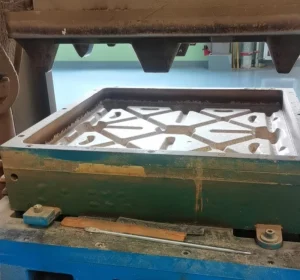
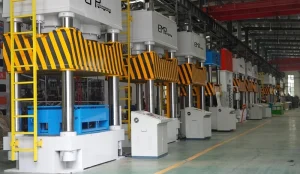
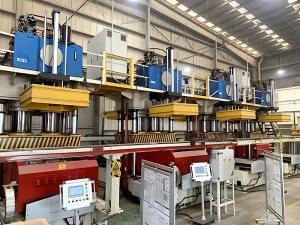
A presswood pallet machine answers the same gap from the material side instead of the assembly side. The pallet is molded in one piece from plant fibre, wood processing residue, sawdust, shavings or agricultural straw, with the deck, the reinforcing ribs and the support feet formed together in a steel mold under an MDI or UF/PF binder, so there is no board to cut, no bearer to nail and no separate foot to work loose. That removes the whole purchase chain a supplier would otherwise have to enter: no saw line, no nailing cell, no heat treatment chamber, no re-boarding bench. The line arrives as a sequence rather than a single machine: hammer mill and rotary drum dryer for pretreatment, a metered glue mixing stage, a rail-mounted weighing and dosing spreader, the hydraulic hot presses, then a servo take-out and a chain or roller conveyor that stacks the finished pallet. A supplier can start semi-automatic on the stages that carry the most repetition and add the automated pallet manufacturing line later, and a molded pallet sits in the processed wood category that supports a fumigation-free reading, subject to the destination rule and the forwarder.
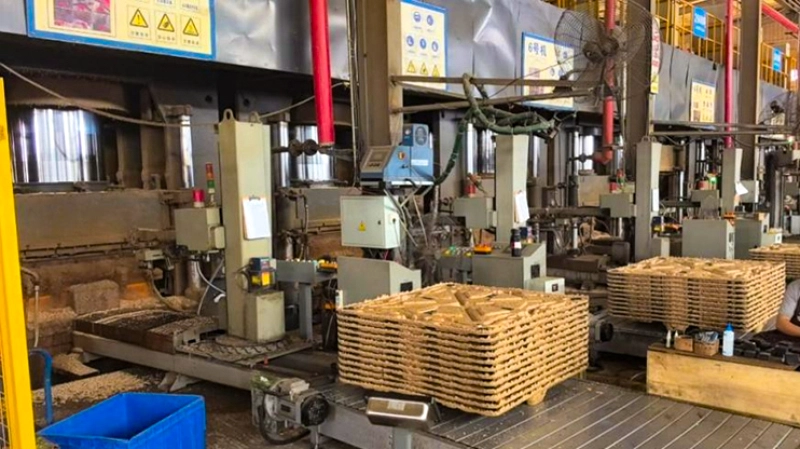
Parameters and photo evidence that decide the add-on
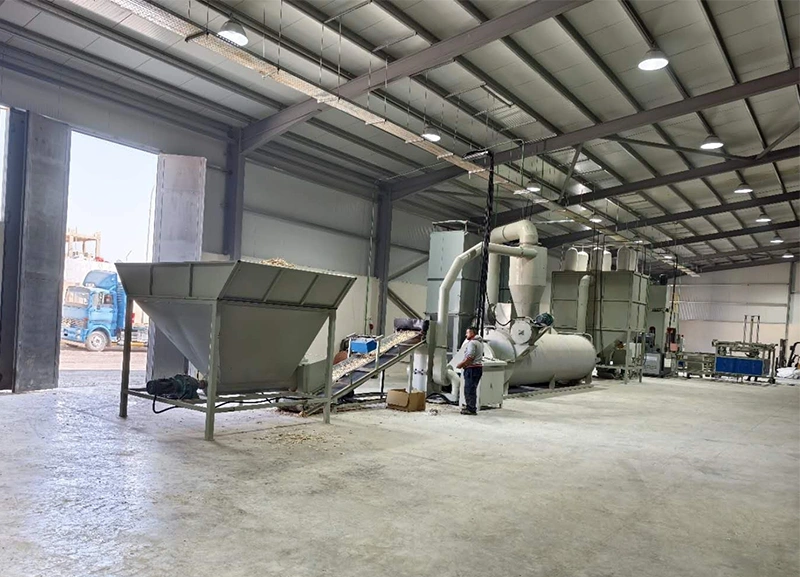
The parameters that decide whether the add-on becomes a catalogue line or stays a side project are unglamorous. Tonnage is quoted in tiers from 1200T to 2200T, with a 1600T class press as the common reference for a general pallet footprint; hot pressing runs at about 150 to 180 degrees Celsius, 15 to 20 MPa and a 180 to 240 second cycle; finished density lands at 0.8 to 1.2 grams per cubic centimetre, with MDI commonly around 8 to 10 percent and UF or PF around 10 to 12 percent. Output is then a function of press count, cycle time and shift pattern, and one fully automatic press at about 12 pallets per hour is a planning reference for a stated configuration rather than a promise. The two photographs on this page mark where that arithmetic starts and ends: the pretreatment stage, with the receiving hopper, belt feeder, rotary drum dryer and cyclone dust line that turn a waste stream into a metered fibre, and the discharge end, where molded pallets leave the open press, run out on a powered steel roller conveyor and stack beside the machine. What a supplier holds at the end is a pallet with its own mold, its own mass and its own moisture, quoted in the same basket as the cartons and shipped alongside them. The order of work still runs the other way round: confirm real pallet volume and the pallet specifications your own buyers will accept before a line, a tonnage or a mold is chosen, then confirm tonnage, mold, cycle and any fumigation-free reading per project in the technical agreement. No payback figure is offered here, because the case has to be built on the customer's own fibre, crew and order book.
- Pallet volume and pallet specifications validated by the customer's own buyers before any line configuration is quoted
- Fibre or wood waste source, moisture and volume confirmed at the site rather than assumed
- Floor area, power, thermal oil and shift plan checked against the proposed line layout
- Tonnage, mold, cycle and any fumigation-free reading confirmed per project, per destination and per forwarder