MOLDED WOOD PALLET AND BIOMASS PELLET PRODUCTION | WOOD PULVERIZER MACHINE
1. The Cost Problem Starts Before the Dryer
Wood Pulverizer Machine for Biomass Pellet Lines: Reduce Raw-Material Haulage Before Drying. When raw-material availability, energy-intensive drying, and long-distance transport dominate a wood-pellet cost structure, placing a Pulvz Wood Pulverizer Machine at the material source or at the front of the line can change the preparation route. It converts wood waste into controlled feedstock for the sawdust preparation section while reducing the volume that must be transferred. The result is a practical route to review logistics and drying costs without promising a fixed saving before feedstock and process data are measured.
2. Why the Old Route Pressures Thin Margins
The older options are easy to understand but difficult to control at scale. Manual wood splitting by axe or saw is slow and labor intensive. Buying ready-made sawdust transfers the crushing step and its logistics cost to a supplier, while shipping bulky wood waste before size reduction consumes truck space. Burning or landfilling old pallets loses a potential feedstock stream. A wood chipper produces chips, a wood shredder performs coarse size reduction, and a wood flour mill targets finer powder; none should be selected merely because the names sound similar. The required result here is uniform preparation for downstream drying and pelletizing, not just rough volume reduction or fine milling.
3. Why a Source-Side Wood Pulverizer Fits the Process
Pulvz is designed as a Molded Pallet Line Wood Crusher and biomass raw material crushing unit for the sawdust preparation section. It can be positioned near the wood-waste source or at the front of the production line, with belt conveyor feeding for continuous material flow instead of repeated manual batches. The F-series Wood Pulverizer range includes F-800, F-1000, F-1200, and F-1500 models. Depending on the selected configuration and feedstock, the machine is associated with 1-8 t/h continuous output and preparation of ≤5mm wood particles. This makes the Wood Pulverizer Machine a better fit than a chipper when the next process needs a controlled sawdust-like feed.
4. Structure, Parameters, and Image Evidence
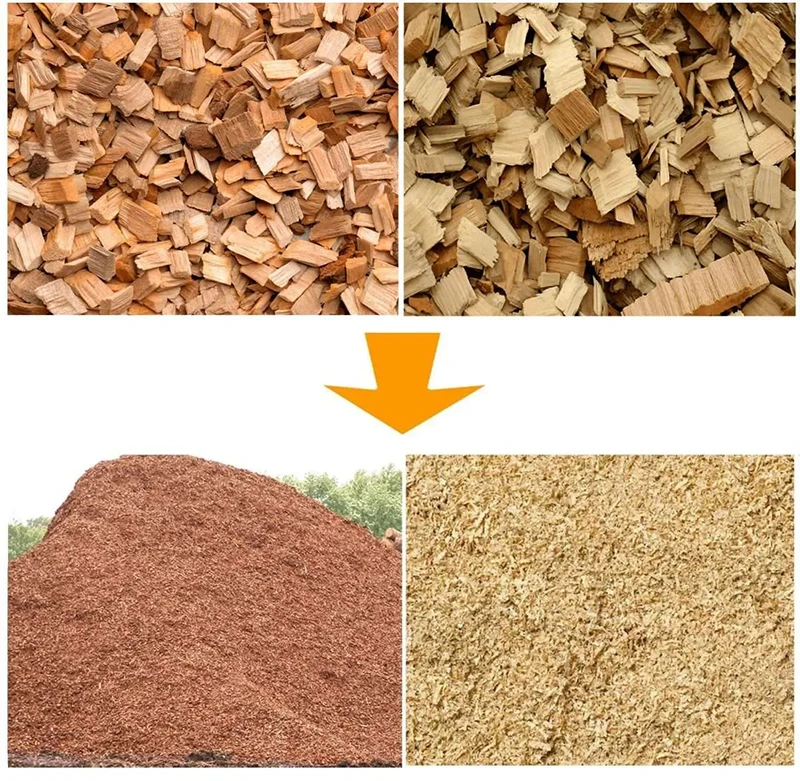
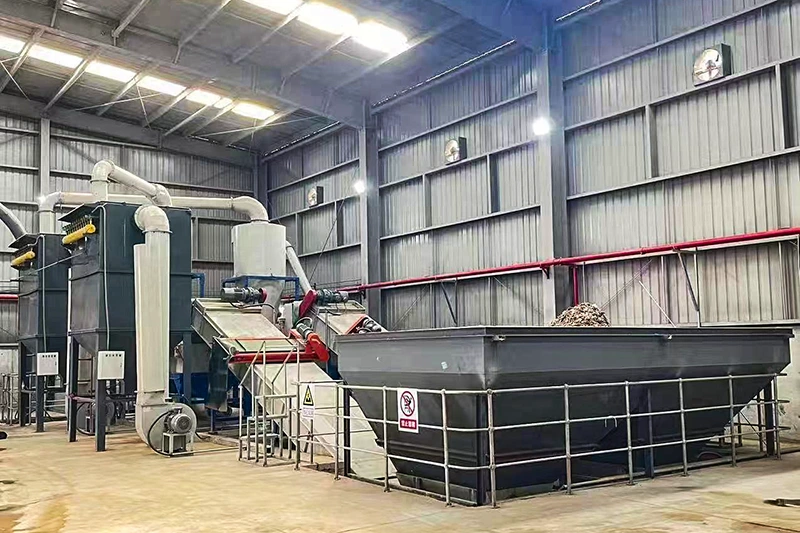
The evidence to check during sizing is mechanical and measurable. Particle size control by screen uses a replaceable or adjustable screen, with listed screen sizes in the 780-1480 mm range for the relevant equipment specification; final selection should follow the required throughput and material. The crushing chamber uses manganese steel hammer plates and a manganese steel liner, while dynamic balancing supports stable operation. A hydraulic open cover system provides access for inspection and hammer plate set replacement. Cyclone separation and magnetic separation can be configured for dust handling and removal of ferrous contamination where required; they should be confirmed against the final line design. The first image shows the change from coarse wood chips to fine shredded biomass. The second shows a receiving hopper, inclined feeder, and connected dust collection ductwork, illustrating how source-side feeding can connect to a larger processing line.
- Use Wood Pulverizer Machine as the primary product term and distinguish it from Wood Chipper, Wood Shredder, and Wood Flour Mill
- Present raw-material availability, energy-intensive drying, and long-distance transport as linked cost pressures without claiming a guaranteed percentage saving
- Use supported Pulvz facts including 1-8 t/h continuous output, ≤5mm particle preparation, screen-based particle-size control, belt-conveyor feeding, and a hydraulic cover
- Follow the required order from customer scenario and old-route problems to product fit, structure and parameter evidence, and operational results


