Established pallet plant, staged upgrade
The plant already owns the market; repetition is what holds the plant
A pallet maker that has spent fifteen or twenty years building buyers, size history, load classes and a repeat order book does not need to be taught the pallet market. What it usually lacks is labour headroom, because inside one shift the same crew still weighs fibre by eye, charges glue, spreads the mat, walks each cured pallet out of a hot die and builds the stack. This page follows an established operation into a modular presswood pallet machine configuration: which repeat actions an automated pallet manufacturing line can take over first, how line scope is settled against target capacity and budget instead of a fixed package, and which references, including 1200T to 2200T press tiers, a 1600T class press at 150 to 180 degrees Celsius and 15 to 20 MPa, and a 180 to 240 second cycle, are confirmed per project before a plant commits its whole process at once.
Why the old scheme caps that experience
On a traditional pallet nailing machine or a manual molded layout, output is rarely lost at the press itself; it is lost at the handovers. Feeding, dosing, spreading, take-out and stacking sit as separate stations, one production lead carries the span between them, and when a shift is one person short the line does not fall by a percentage, it drops to the pace of the slowest remaining station. That is also why a plant that has run this way for years hesitates over an all-at-once replacement: the team can picture the new machine but not the quarter in which the old crew learns it, so the decision stalls between a process nobody trusts to change and a market that keeps asking for more pallets.
What a modular presswood pallet machine configuration changes
AutoML scopes a molded pallet production line as modules measured against target output and budget rather than as one fixed package: crushing and drying of wood residue, glue mixing with dosing, a weighing and dosing spreader, the industrial pallet press machine, demolding, and take-out with conveyor or four-axis servo stacking. A plant can start where repetition is heaviest and add the rest in a later stage; staying semi-automatic at a given station is a real option, and the equipment plan follows the customer conditions instead of pushing full automation onto a site that has not asked for it. Read this way, wood waste to pallet conversion is an upgrade of a process the plant already understands, and where the sales channel ships export packaging or stores empty pallets, a nestable pallet manufacturing option answers floor space as well as output.
The numbers and the shop-floor evidence behind that scope
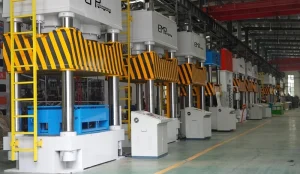
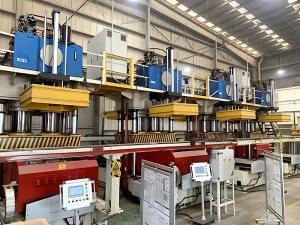
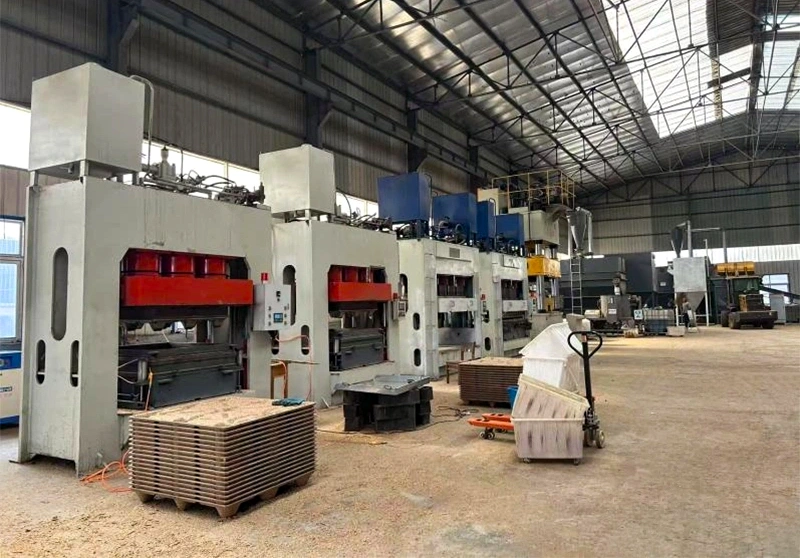
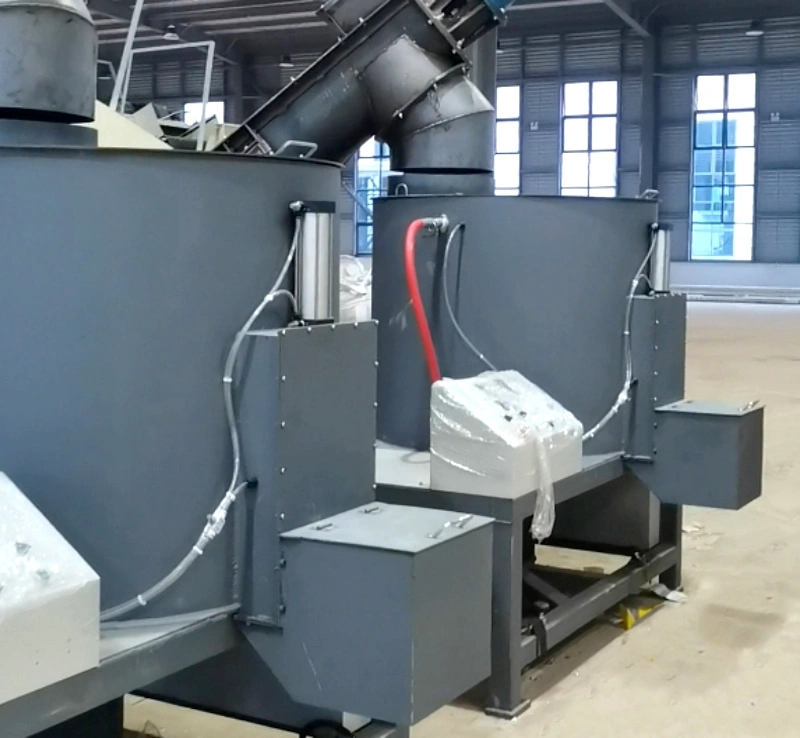
Press scope runs across 1200T to 2200T tiers, with a 1600T class press as a common reference, hot pressing at 150 to 180 degrees Celsius and 15 to 20 MPa, a 180 to 240 second cycle and finished density around 0.8 to 1.2 grams per cubic centimetre, with MDI binder commonly near 8 to 10 percent and UF or PF near 10 to 12 percent. The first photograph shows the press row, and that row is the clearest argument for a staged plan: one press is one module, a second press is the capacity step, and both presses share the same preparation and take-out flow instead of a second spreading bay and a second take-out hand. The second photograph shows the automated glue mixing and feeding system, which is where the dosing judgement that used to sit with one experienced operator becomes a metered setting. The result the plant is buying is narrow and honest: the market experience stays where it is and the repeated handling moves to the equipment, while tonnage, mold and cycle are confirmed per project in the technical agreement, fibre moisture is matched to the glue system from trial data, an ISPM-15 exempt reading of a one-piece molded pallet stays a destination rule and forwarder question, and any labour or reject change is measured on the customer own shift roster rather than promised.
- Confirm target pallet size, daily output and shift pattern before any line scope is quoted
- State which stages stay manual or semi-automatic at start and which are added in a later stage
- Match fibre moisture to the glue system from trial data rather than assumption
- Measure reject rate, cycle time and labour change on the customer own shift roster after commissioning