Pallet plant manning
Where the labour problem lands first: the nailing bench
A pallet plant that cannot staff its nailing benches stops growing, and in most markets the wage line keeps climbing while the applicant list keeps shrinking. This page follows that problem onto a molded pallet line, where a wood pallet hydraulic press forms one finished pallet per cycle on a Y32 three-beam four-column frame at 1250 to 2500 ton with no nailing stage and no manual board sorting, so output per shift stops depending on how many people can be hired. The boundary is stated plainly: crushing to about 5 mm, drying to 8 to 12 percent moisture and even MDI adhesive mixing have to be in place before the press forms anything, and the press is not sold as a stand-alone machine.
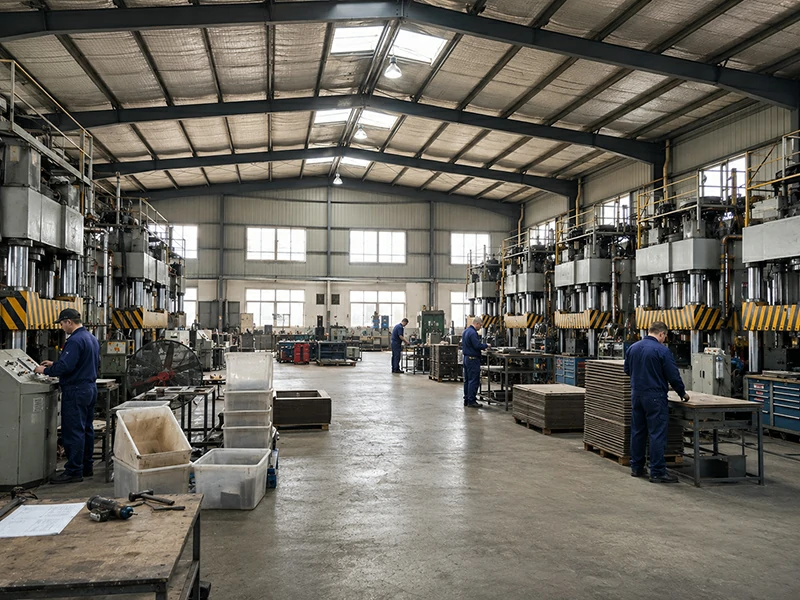
Why the nailed wooden pallet line keeps buying labour instead of capacity
The traditional nailed wooden pallet line is built around manual stations, so capacity is added in people rather than in cycles. Boards are sorted by hand, nails are driven by hand or at a bench, and every nail is a potential splinter, a proud head or a loose joint that returns later as a repair job. Consistency depends on the operator, which is a difficult thing to promise to a customer running an automated warehouse. The same line also carries material it cannot fully control: virgin timber cost, moisture variation and offcuts that have to be moved, stored or paid to dispose of. None of these problems get cheaper when wages rise, because each of them is solved with another pair of hands. A plant fixing its labour exposure by hiring faster is competing for a shrinking pool at a rising price, and the automation decision arrives on the wage bill rather than on the shop floor.
Why a wood pallet hydraulic press answers that curve instead
Molded pallet production replaces the manual stations with a hot press cycle. An automatic feeding unit spreads mixed wood fibre into the lower mould, the slide closes with the upper mould, heat and pressure hold the shape while the binder cures, and the ejector pushes one finished pallet out. That is one pallet per cycle with no nailing station, no board sorting and no joint assembly, which is why a molded pallet line is manned far lighter than a nailing line for the same tonnage. On the same process platform a plant can start semi-automatic and step up to a fully automatic configuration later instead of building a second factory: published line tiers run from 30,000 to 80,000 pallets a year on a semi-automatic EMP-500T, through 80,000 to 200,000 on an EMP-800T or EMP-1000T with the full auxiliary set, to 200,000 to 500,000 on two EMP-1000T machines in the automatic configuration. Crushing, drying, glue mixing and hot pressing can all run as a continuous line, and the Y series covers 1250, 1600, 2000 and 2500 ton so the machine is sized to the platen and the pallet, not to the roster.
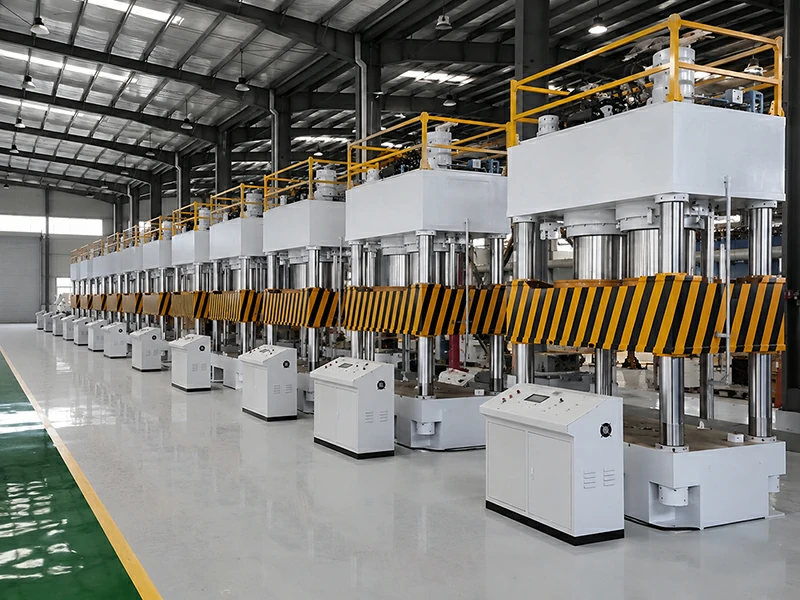
Structure, parameters and the result the plant is left with
The Y32 press is a three-beam four-column machine: top beam, slide and worktable, carried on four solid columns that both guide the slide and lock the frame together, with the hydraulic station mounted on the back of the top beam. System working pressure is 25 MPa. Slide stroke runs from 700 mm at Y-1250 and Y-1600 to 800 mm at Y-2000 and 900 mm at Y-2500, platens run from 1700 x 1400 mm up to 2500 x 1700 mm, and motor power runs from 55 kW to 75 kW. The published forming window is about 150 to 180 C at 15 to 20 MPa on a 180 to 240 second cycle, with the site also quoting about 200 C and a 3 to 5 minute cycle. The workshop images on this page show the press stations, the guarding and the control cabinets that go with a line laid out for cycle work rather than bench work. What the plant ends up with is one-piece, nail-free molded pallets that nest about four to one, suited to a fumigation-free and ISPM-15 exempt export route, with output set by the press cycle instead of by how many nailers answered the advert. Servo drive energy saving of 25 to 55 percent is stated by the manufacturer and is not independently verified here, and the upstream stages remain the customer's own responsibility.
- Y32 three-beam four-column frame at 1250, 1600, 2000 or 2500 ton, platen up to 2500 x 1700 mm
- One finished molded pallet per press cycle, about 150 to 180 C at 15 to 20 MPa with a 180 to 240 second cycle
- Crushing to about 5 mm, drying to 8 to 12 percent moisture and even MDI adhesive mixing must be in place first; the press is not sold stand-alone
- Semi-automatic and automatic line tiers on one platform, with servo energy saving of 25 to 55 percent stated as a claimed figure


