Waste wood recycling yards and molded pallet lines
The intake runs all year, the offtake runs by season
A recycling yard takes wood in twelve months a year and sells it into a market that wants it for part of one. This page follows a wood pallet hydraulic press line placed inside the yard, where the same recovered wood that used to sit in a regulated stockpile is pressed into a finished molded pallet on the shift it arrives, and where the finished pallet nests about four to one, so the space the yard is short of holds saleable units instead of loose fibre.
Why a bigger pile and an outside buyer both fail
The first instinct is to build the buffer out of the material itself, and that is exactly what the storage cap is aimed at. A larger pile does not lower the storage exposure, it raises it, because the yard is holding the least valuable form of the wood it owns and paying permit, dust and space costs to hold it. The second instinct is to hand the problem to someone else. Sending the tonnage into a biomass terminal means one buyer sets the price and the volume, and when that buyer slows down, the yard owns the material again. Buying in pallets instead, whether a traditional nailed wooden pallet, a heat-treated wooden pallet, a plywood pallet or a plastic pallet, does not consume a single ton of the yard's own intake, and none of those units nest, so the yard is still storing air when the units are empty. A wooden pallet nailing machine is not a way out either: it needs sawn timber, which is the input the yard does not have.
Why the press fits a yard that is short of space, not of material
The fit is not that a press makes pallets, it is that a press turns an unstoreable material into a storable one on the same site. The molded pallet hydraulic press machine, also sold as a presswood pallet press machine or a compressed wood pallet machine, is a Y32 three-beam four-column hot press built around a pallet mold. Weighed fibre and binder are loaded into the lower mold, the slide closes, and heat and pressure cure the mat in one pressing, so one cycle produces one finished molded wood pallet instead of a stack of components. The published parameter table runs four models, Y-1250 through Y-2500, covering 12500 to 25000 kN, with a maximum platen of 2500 x 1700 mm, a 25 MPa system pressure, a working speed of 5 to 10 mm per second, and motor power from 55 kW to 75 kW. Molding sits in the 150 to 180 degree Celsius band at 15 to 20 MPa, on a cycle in the region of 180 to 240 seconds. The output is a high density molded pallet at roughly 900 kilograms per cubic metre, and it is nestable at about four to one, which removes more than 60 percent of the storage volume a comparable set of empty pallets would need. One boundary has to be said plainly: EMP does not sell the press as a stand-alone machine. Particle size of about 5 mm or finer, drying to 8 to 12 percent moisture and even MDI adhesive mixing all have to be in place upstream, or the press forms nothing usable.
What the four-column structure and the row layout prove on site
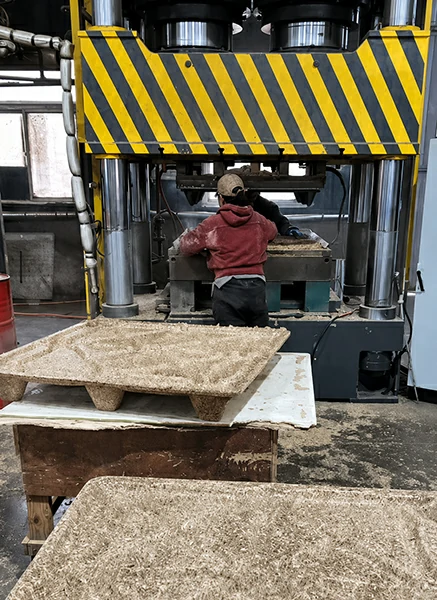
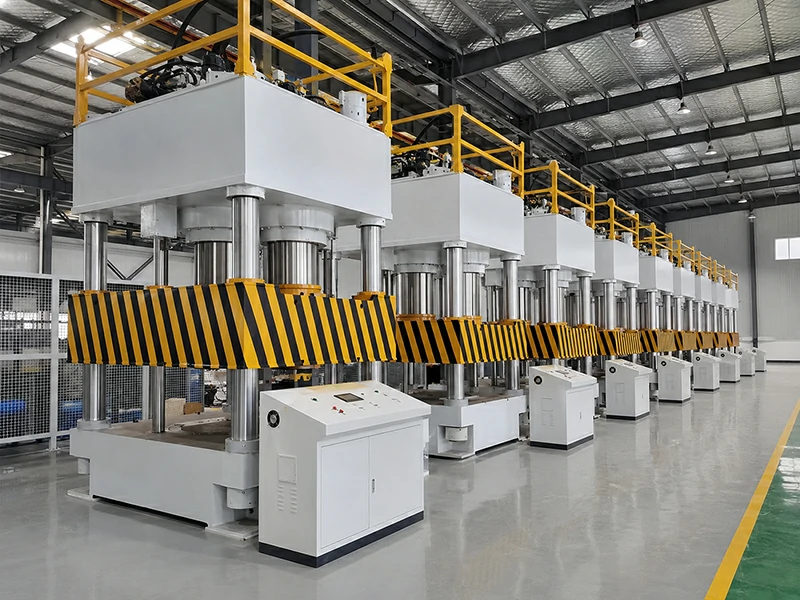
The structure is what makes a continuous shift pattern realistic rather than a maintenance project. The frame is a three-beam four-column design: top beam, slide and worktable, held by four solid cylindrical columns that act as guides and lock the frame at the same time, with the hydraulic station carried on the back of the top beam. A separate ejector cylinder pushes the finished pallet off the mold, and the control cabinet and hydraulic power unit sit outside the machine body, so the pressing area stays clear. The brief and the image set both support the same reading. The first photograph shows the pressing workstation itself, with the platen and the mold table under the guard and the formed part in the foreground, which is the stage the yard has to size for. The second shows several machines of the same type installed in a row with their own guards and control cabinets, which is what a per shift production pattern looks like on a factory floor. Read honestly, these images evidence four-column press structure and line layout, not a verified molded wood pallet production site. The result the yard is buying is a lower stockpile water level: the intake is consumed as it arrives instead of accumulating, the yard holds finished pallets that nest about four to one rather than loose fibre, and the finished unit is a processed wood product that travels outside the ISPM-15 treatment route, so it can be sold by the piece into export lanes when the boiler market is quiet. On the numbers, cost per pallet at around 40 percent of purchased pallet cost and a 12 to 18 month payback are EMP claims, not independently verified results.
- Problem first: the page opens on the recycler's year round intake and seasonal offtake, and on the storage cap, before any machine is named.
- Every number used (1250 to 2500 ton, 2500 x 1700 mm platen, 25 MPa system pressure, 150 to 180 C, 8 to 12 percent moisture, 4 to 1 nesting) is taken from the published MldP parameter table and product brief, and nothing is extrapolated.
- The two images are described only as four column press structure and row layout evidence, not as proof of a verified molded wood pallet production site.
- The ISPM-15 position is stated as a processed wood product route, not a certificate EMP issues, and no third party ROI figure is claimed as verified.


