Pallet repair and refurbishment
The repair bench has a second output nobody prices
A pallet repair and refurbishment yard already sits on the feedstock: the units that fail the repair check come off the bench every shift and leave the gate priced by the ton instead of by the piece. A wood pallet hydraulic press changes where that stream ends. Crushed repair rejects, dried and mixed with MDI adhesive, can be pressed into a finished molded pallet in the same yard, on a Y32 three-beam four-column machine at 1250 to 2500 ton, so the pallets nobody can repair come back as a product the yard can sell again.
The value cliff is structural, not a discipline problem
This is where a refurbisher's economics break. The same pallet that leaves the yard as a repairable unit and returns as a repair reject loses its unit identity the moment it is broken down. Per piece, it was a saleable pallet in a lane the yard already serves. Per ton, it is feedstock competing with every other yard's chips, and it carries none of the labour the yard spent sorting it. A traditional nailed wooden pallet cannot be repaired forever: heat-treated wooden pallet stock still carries the ISPM-15 mark and the treatment history, stringer and block wooden pallets fail at the joints, and once the failure is distributed across several boards the bench is out of options. The yard then does the only thing available to it, which is to downgrade the unit and sell the material into a bulk market where price is set by someone else. Improving sort discipline helps at the margin, but the reject stream is the definition of the business rather than a defect in how it is run. What the yard actually lacks is not another repair trick, it is a second use for the tonnage it has already paid to collect.
Repair rejects do not have to leave the gate as chips
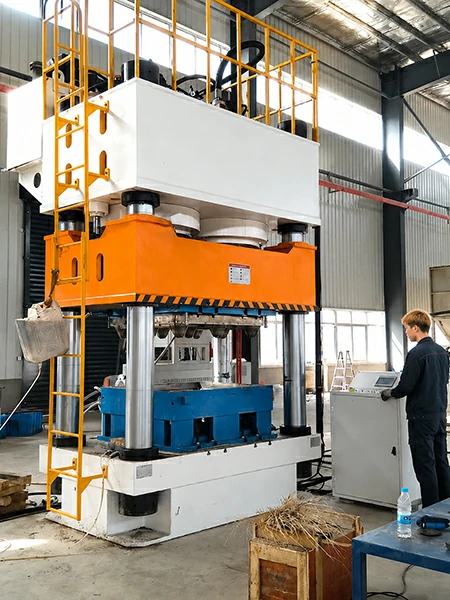
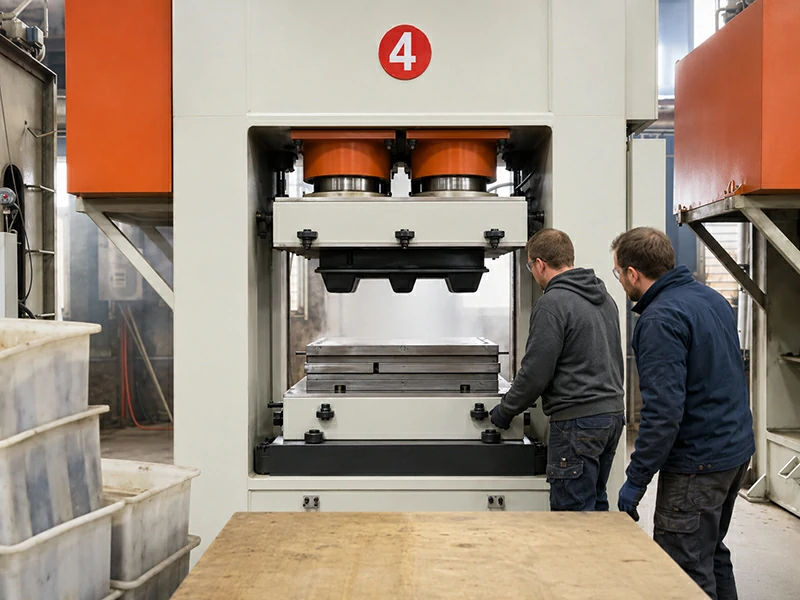
The tonnage that fails the repair check is wood fiber, which is exactly the feedstock a molded pallet is built from. Crushed to roughly 5 mm particle size, dried to 8 to 12 percent moisture and mixed with MDI adhesive, repair-reject material can be pressed on a wood pallet hydraulic press into a finished molded pallet inside the same yard. The machine this route is built around is a Y32 three-beam four-column hydraulic press, sized from 1250 to 2500 ton, with a platen up to 2500 x 1700 mm, forming one finished pallet per cycle at 150 to 180 C. The four-column frame, the slide and the worktable carry the tonnage, and the press footprint fits the space a refurbisher already has, which is why the installation photos on this page show a machine dropped into an existing industrial workshop rather than a greenfield plant. The boundary has to be stated plainly, because a press is not a whole line. Crushing, drying to the moisture window, moisture control and MDI glue mixing are upstream stages the press depends on, and they have to be in place before it forms anything. A repair-reject stream carries nails, staples and grit that have to be separated magnetically ahead of the crusher. The press is not sold as a stand-alone machine, and on a refurbisher's tonnage the first real question is how much of the reject stream is consistently available per shift.
A second catalogue line that reaches customers you already have
What comes off the press is a different product from anything on the repair bench. The molded pallet is one-piece molded shape, so there are no joints to loosen; it is a nail-free pallet, so handling carries no nails and no splinters; it is a nestable design that stacks about four to one, so empty returns take a fraction of the trailer volume a nail-jointed unit does; it is a lightweight pallet, which cuts return freight further; and it sits on the ISPM-15 exempt and fumigation-free route, which matters to any customer shipping into export lanes. None of that replaces the repair business. It gives it a second product that is complementary rather than competing, because a customer with damaged boards on an outbound load still wants a repaired traditional nailed wooden pallet, and a customer packing for export wants a molded one. That is where this matches a refurbisher better than it matches almost any other buyer: the customer list, the sales team and the delivery round already exist, so a new pallet category goes into a catalogue the yard already sells from instead of into a market it has to go and find. The honest version of the result is that the repair bench still decides repair yield, and the press only converts what cannot be repaired into something the yard can sell per piece again.
- Feedstock check: repair reject boards crushed to roughly 5 mm and dried into the 8 to 12 percent moisture window before any pressing
- Adhesive check: MDI mixing and consistent release agent coverage confirmed on the trial mold before production rates are quoted
- Machine check: Y32 three-beam four-column frame sized between 1250 and 2500 ton with a platen up to 2500 x 1700 mm for the target pallet size
- Stream check: nails, staples and grit separated magnetically ahead of the crusher, with the yard's own reject tonnage per shift confirmed first


