 | Are constant sensor faults, jammed roller conveyors, and ASRS downtime eating into your facility’s throughput? In automated intralogistics, a 0.5-inch dimensional variance or a single protruding nail on a traditional wooden pallet can halt a multi-million-dollar automated storage and retrieval system. You need a load carrier engineered with the precision of a machine part, not a nailed-together variable. |
The ASRS Nightmare: Why Traditional Pallets Fail in Automation
Before: Warehouse managers and automation engineers know the daily struggle. A standard GMA solid wood pallet enters your palletizing cell. Because wood naturally shrinks and swells, the dimensional tolerance varies wildly. As it moves down the high-speed roller conveyor, a loose fastener (nail pop) catches on a roller, causing a severe jam. Worse, when the load reaches the Automated Storage and Retrieval System (ASRS), the photoelectric sensors misread the warped edge of the pallet, triggering a system-wide fault alarm. Your maintenance team spends hours inside the high-bay racking clearing the error, costing thousands in lost operational time.
Why it works: The compressed wood pallet is manufactured using a 1600-ton servo-controlled hydraulic press. This high-heat, high-pressure one-piece molding process eliminates all metal fasteners. More importantly, it guarantees a dimensional consistency with a tolerance of less than ±0.08 inches (±2mm).
After: Your laser positioning systems and palletizing robots read a perfectly uniform target every single time. Conveyor jams caused by splintered wood or protruding nails drop to zero, allowing your automated lines to run 24/7 without unnecessary human intervention.
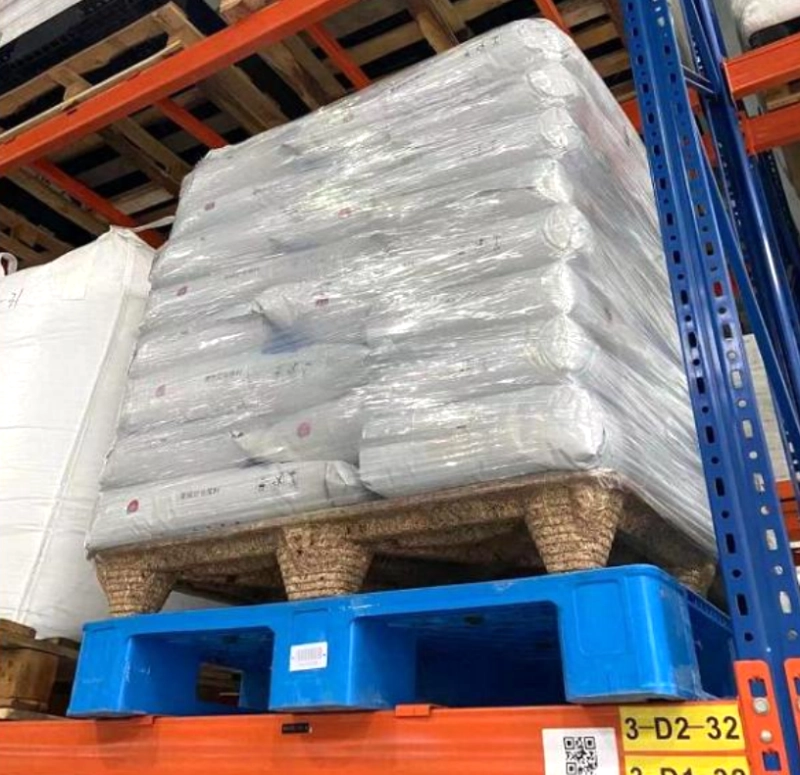
Deflection Control on High-Bay Racking Beams
Before: Storing heavy loads like 208L chemical drums or bulk bagged goods on standard rack beams requires strict deflection limits. Traditional wood pallets often suffer from internal stress inconsistencies. When placed on a 2-tier or 3-tier racking system, a weak bottom board can sag beyond the safe deflection limit, risking a catastrophic rack collapse or product spillage.
Why it works: By utilizing advanced MDI (Polymeric Methylene Diphenyl Diisocyanate) adhesive mixed with refined wood fibers, the pressed wood pallet forms an irreversible polyurethane molecular chain. This gives the pallet extraordinary rigidity. It easily supports a dynamic load of 5,500 lbs (2.5T) and a static load of up to 15,400 lbs (7T). When configured as a double-face pallet, it evenly distributes the load across the racking beams, keeping deflection well within strict ASRS safety margins.
Seamless AGV and Forklift Interaction
Before: Automated Guided Vehicles (AGVs) rely on precise fork entry points. If a traditional pallet is slightly skewed or has a broken bottom board, the AGV forks will crash into the pallet, causing a “load mismatch” error and stopping the vehicle mid-aisle.
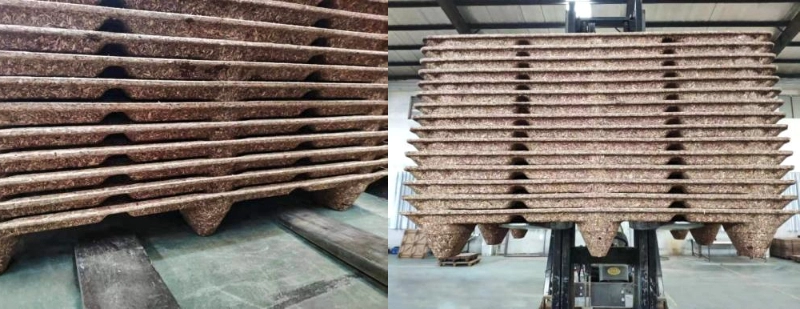
Why it works: Engineered with a standard 4-way entry and specialized guide slots, the entry height is strictly controlled between 3.5 to 3.7 inches. The smooth, contoured edges of the molded wood pallets allow AGV forks and automated shuttle carts to glide in effortlessly, even if the alignment is slightly off by a few degrees.
After: Your AGV fleet operates at maximum speed. The smooth interaction reduces wear and tear on the AGV lifting mechanisms and increases your hourly pallet movement rate by up to 15%.
The Financial Equation: Replacing Expensive Plastic Pallets
Many logistics directors believe that heavy-duty plastic pallets are the only option for highly automated warehouses due to their uniform size. However, plastic pallets cost between $50 and $120 each, tying up massive amounts of capital (CAPEX). As a highly engineered alternative to wood pallets, our solution provides the exact same dimensional consistency and sensor compatibility as plastic, but at roughly one-third of the procurement cost.
| Specification | Traditional GMA Wood Pallet | Ampallet Molded Solution |
| Dimensional Tolerance | High (Prone to warping) | ±2mm (Perfect for AGVs) |
| Fasteners | Nails & Staples (High Jam Risk) | 100% Nail-Free One-Piece |
| Moisture Resistance | Absorbs water, changes weight | MDI Adhesive (Waterproof) |
Frequently Asked Questions (Intralogistics & Automation)
1. Will the compressed wood pallet trigger false readings on our ASRS photoelectric sensors?
No. The one-piece molding process ensures zero splintering and a uniform edge profile. Your laser positioning systems and photoelectric sensors will read a consistent, solid surface every time, eliminating false fault alarms.
2. What is the maximum deflection when placed on standard racking beams?
When utilizing our specific double-face configuration designed for racking, the high-density MDI-bonded core keeps deflection strictly within the standard 0.5-inch safety limit, even under a 2,500 kg (5,500 lbs) dynamic load.
3. Can these pallets be used seamlessly with our existing AGV fleet?
Absolutely. The pallets feature precise guide slots and a standard 4-way entry height (approx. 3.5 inches), allowing automated forks to enter smoothly without load mismatch errors.
4. Are there any risks of conveyor jams caused by this pallet?
Because they are 100% nail-free and staple-free, there is zero risk of “nail pops” catching on your roller or chain conveyors, drastically reducing maintenance downtime.
5. How does the weight consistency compare to standard wood pallets for our automated check-weighers?
Traditional wood absorbs moisture, causing its tare weight to fluctuate wildly. Our pallets are bonded with waterproof MDI adhesive, keeping the tare weight consistent (around 30-40 lbs depending on the model), ensuring your automated check-weighing systems remain accurate.