Capacity Expansion on a Presswood Pallet Machine Line
When the order book grows faster than the station count
A molded pallet supplier that wins two more programs does not usually run out of demand first, it runs out of stations: on a manual line every extra thousand pallets a week is bought as another spreading bay, another pair of hands at the press exit and another pair at the stack, and the floor area plus the supervisory span run out before the order book does. This page follows that problem onto an automated pallet manufacturing line built around a presswood pallet machine, where automatic spreading, hydraulic molding and robotic stacking turn weekly output into a number set by press cycle, tonnage and shift pattern rather than by headcount. EMP reference figures are used plainly: press tiers from 1200T to 2200T, a 1600T class hot press at 150 to 180 degrees Celsius and 15 to 20 MPa on a 180 to 240 second cycle, and one fully automatic press at about 12 pallets per hour. That hourly figure is a planning reference for a given configuration, not a delivery promise: real output still depends on the fiber, the mold, the cycle actually run and the uptime the plant achieves, and it is confirmed per project.
Why the manual arrangement cannot be quoted against
The problem is not effort, it is that a hand-fed line has no fixed rate to promise against. Fiber is shovelled into the cavity by eye, binder is poured against a mark, moisture is judged by feel, the mat is spread by hand, and between the press open and close signals the press waits while a person reaches into a hot die and stacks the pallet. Two plants with the same mold and the same tonnage can produce visibly different weekly volume, because the difference sits in the crew and the shift, not in the machine. That makes capacity expansion a headcount plan: each new shift adds operators, training, supervision and turnover risk, and a delivery commitment signed today depends on people who may not be on the line in three months. It also hides the true constraint, because nobody can say whether the next forty thousand units need another press, another shift or simply one less manual handover in the cycle.
What an automated pallet manufacturing line actually takes over
AutoML is EMP's presswood pallet machine line, configured as an automated pallet manufacturing line that owns the handovers instead of staffing them. A rail-mounted weighing and dosing spreader with belt feeders lays the fiber charge into the mold by weight rather than by eye, a metered glue mixer with dosing screw conveyors sets the binder fraction per batch, a hydraulic press forms the pallet in one piece on a nail-free wooden pallet process, and a demolding and stacking stage takes the cured unit out and builds the stack without an operator reaching into the die. Because those steps are sequenced on the line control, the pallet per hour figure becomes a function of press cycle and station count rather than of how many people can be recruited, and capacity can be raised by adding a press unit to the same process instead of adding a workbench to the same crew. That is the structural reason a molded pallet production line is bought for growth: it changes what an extra order costs in labor before it changes anything about the pallet.
Reading capacity off the press, the dosing stage and the numbers
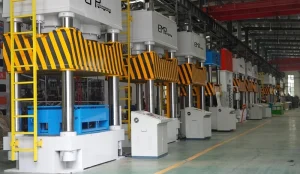
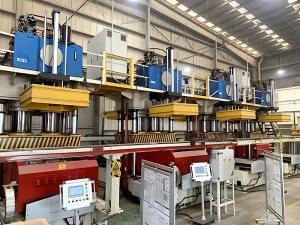
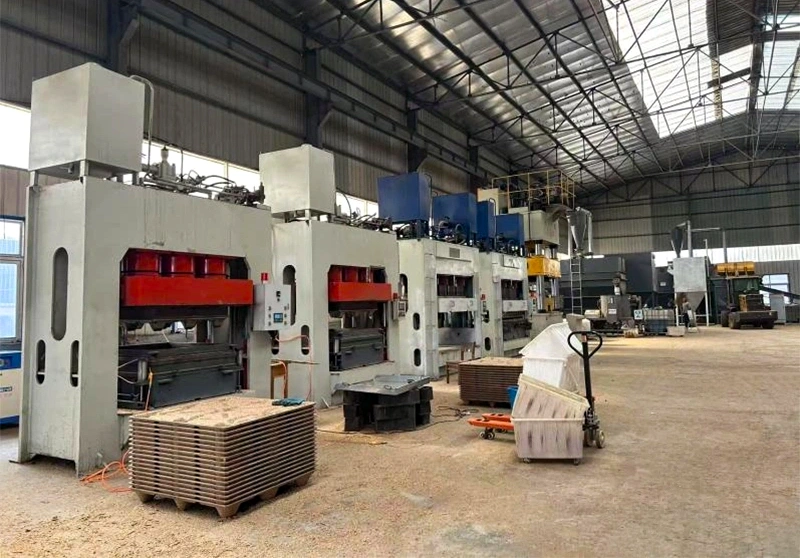
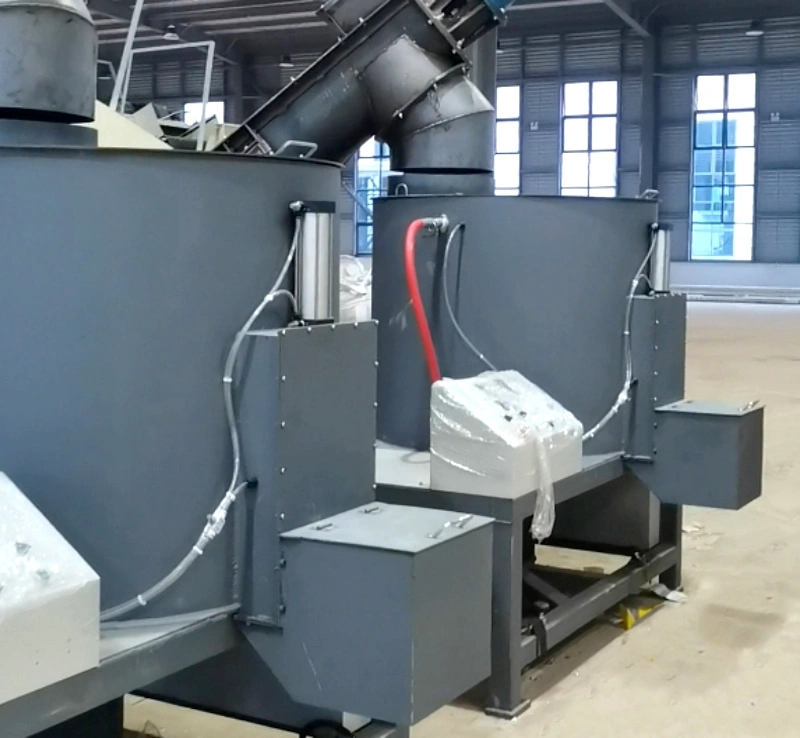
The two reference photographs in this page show where the number comes from. The press row shows several hydraulic press units standing side by side on one floor, which is what capacity expansion looks like on this line: an additional press unit inherits the same mold, the same recipe and the same control logic, so the second or third machine is a repeat of a validated configuration rather than a new learning curve. The dosing and glue mixing station is the other half of the argument, because a metered charge is what keeps the cycle stable shift after shift, and a stable cycle is what makes hourly output predictable enough to plan against. Reference figures used in configuration are a 1200T to 2200T tonnage ladder, a 1600T class hot press at 150 to 180 degrees Celsius and 15 to 20 MPa, a 180 to 240 second cycle, and one fully automatic press at about 12 pallets per hour. The sizing arithmetic is the part most suppliers skip: planned output equals the hourly rate multiplied by scheduled hours, shifts, uptime and first-pass yield, less mold changeover, and every one of those variables moves with fiber species, moisture, pallet size and the crew running the line. Used that way, about 12 pallets per hour per press is a defensible planning input for a 30 to 40 percent volume step, and a nominal tonnage or catalog capacity is not. The result for a supplier is narrower but real: a bigger order can be answered with an equipment-based capacity statement, an expansion plan that adds press units and dosing capacity instead of relying entirely on new headcount, and a delivery commitment that is checked against the plant's own fiber, mold and shift pattern before it is signed. Send the pallet drawing, load class, weekly unit count, shift pattern, fiber source and available power to the EMP engineering team through the contact page, and the first answer comes back as a configuration to verify rather than a nominal figure to believe.
- Capacity is expressed as cycle-based planning output, not a delivery guarantee
- About 12 pallets per hour is attributed to one fully automatic press configuration and confirmed per project
- Both images come from the AutoML designer gallery: a press row and a metered dosing and glue mixing stage
- No tonnage or output promise is made without the customer's own fiber, mold and shift pattern