Press exit take-out and stacking
A Batch That Leaves the Die Differently Every Cycle
A molded wood pallet plant selling into European and Australian lanes does not lose its export file in the press, it loses it at the die exit, where a pallet at roughly 80 degrees Celsius is taken out and stacked by hand. Two operators, two 1250 to 1600 ton presses, and every pick is a slightly different pose: one pallet comes out square, the next is dragged at a corner, one stack is built true and the next one leans. AutoG is the automatic pallet take-out robot from EMP that takes the freshly pressed pallet on the press open signal, transfers it by vacuum suction and stacks it where it leaves the gripper, so the pick position repeats and the stack repeats with it. What cannot be quoted today is stated on the page: rated load, working radius, repeat accuracy, suction and vacuum configuration, footprint, power and air demand, robot body source and control interface stay project confirmed, and no ROI, payback or hourly output is claimed.
Drop and Skew Become a Sales Problem When the Pallet Is Sold on Strength and Compliance
An export buyer does not inspect a plant, it inspects units and it inspects paperwork. Load performance is referenced against a pallet standard such as ISO 8611, and the figures used in this trade sit around 1.5 to 2 t dynamic and 5 to 8 t static on a formed density near 900 kg per cubic metre, with a nestable unit that stacks about four to one when empty and a material category that keeps the pallet inside an ISPM-15 processed wood exemption file. Those are pallet-side claims, they are not an AutoG certificate and they are confirmed per project. What matters here is that every one of them is argued with the condition of the delivered unit. A deck edge crushed on a drop at the die, a pallet stacked out of square so a stack leans in the container, a face scuffed where the unit was dragged across the press frame: none of that shows up in a compression figure, all of it shows up in a claim. Manual take-out does not fail loudly, it fails as variation, and variation is what a strict market notices first. Destination acceptance of a fumigation-free pallet stays a buyer and plant protection authority question, and it is answered with a plant that can show the same unit made the same way.
What Changes: A Taught Pick Path and a Stack Built Where the Gripper Releases
AutoG is fitted at the press exit of a presswood pallet line. After the die opens, a six-axis arm reaches into the mold area and a vacuum suction end effector seats on the deck face, which on a molded pallet is textured and grooved rather than a clean flat sheet. The pallet is taken directly at about 80 degrees Celsius, so there is no cooling wait between the open signal and the close signal, then transferred to the stacking position and stacked as the gripper releases, with no second manual lift and no intermediate set-down where a pallet can be dropped or turned. Because the take-out motion is a taught program triggered from the open-die signal on the line PLC, every cycle starts from the same position and ends at the same release point, so the variable is the program rather than the person on shift. One arm alternates across two 1250 to 1600 ton presses, A while B is pressing and B while A is pressing, which sets press-exit manning per press pair instead of per press. The MDI pressing cycle quoted on the press side is about 4 to 5 minutes per pallet and is a press figure, not an AutoG cycle time, and continuous 24 hour running is a supplier statement rather than a published duty rating. No repeat accuracy figure is published for AutoG, so this page does not quote one.
The Evidence in the Photos, the Parameters Still Open, and the Result on the Batch
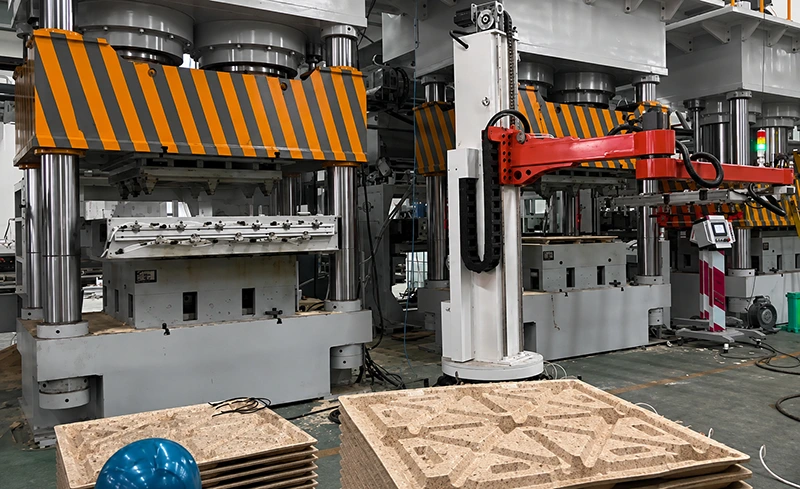
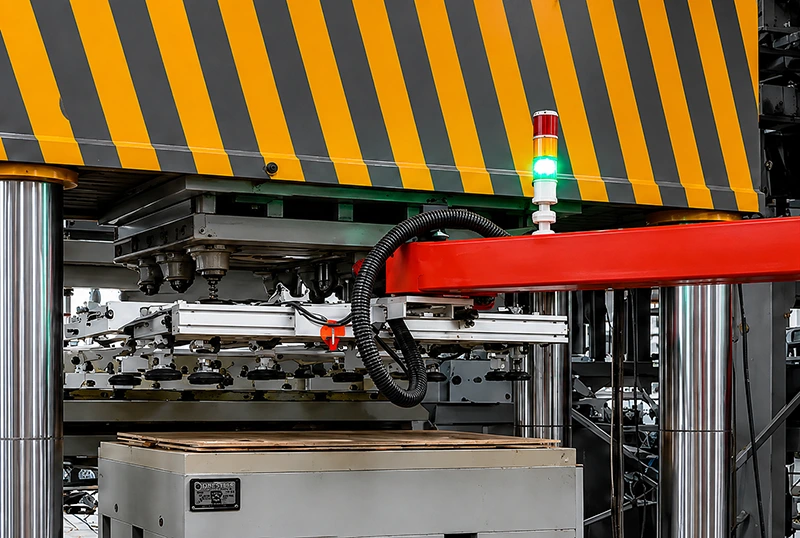
The first photo shows the press-side relationship the unit is bought for: a four column hydraulic press in a workshop, guarded with high visibility shielding, a handling arm working the die area and molded units already stacked at the station. The second photo comes closer to the end effector, with a vacuum suction gripper under a striped safety enclosure, a status beacon and the guide and cable chain that carry the head. Both are evidence of structure and of layout only. They do not prove load, reach, cycle, accuracy or a temperature limit, and the white-background studio views of the arm are used for the same reason, to show a column base, a long arm, a multi pad head and cable management rather than to document a specification. The open items stay open: rated load, working radius, repeat accuracy, suction cup count and size, vacuum generation, footprint, power and air demand, PLC model detail, robot body source and control interface are all confirmed per project. What the batch gains is narrower and more useful than a specification claim. The pallet leaves the die on the same path every cycle, the stack is built where the gripper releases, two operators no longer stand inside the press guarding, and the strength and compliance narrative the plant sells on is written on units that were handled the same way rather than on units that happened to be handled well. To place AutoG on a presswood pallet production line or on a semi-auto to full-auto upgrade, send the press tonnage, the pallet size and the take-out position to the EMP team through the contact page.
- Scope: AutoG is the press exit take-out and stacking device on a presswood pallet line; it is not the hydraulic press, not the crush, dry or glue stage, not a general case palletizer and not a stand-alone line.
- The 80 degrees Celsius handling figure is quoted from the EMP equipment centre description; the 1250 to 1600 ton press range, the 4 to 5 minute MDI pressing cycle and the replacement of about two take-out operators are supplier statements.
- ISO 8611 and the 1.5 to 2 t dynamic, 5 to 8 t static and 900 kg per cubic metre figures are pallet-side references confirmed per project, not an AutoG certification or AutoG performance evidence.
- Rated load, working radius, repeat accuracy, suction and vacuum configuration, footprint, power and air demand, robot body source and control interface stay project confirmed; no ROI, payback or hourly output is claimed.