PRESSWOOD PALLET LINE / PRESS EXIT TAKE-OUT
The takt of a presswood pallet line is set at the die exit, not by press tonnage
A presswood pallet production line rarely loses output inside the press; it loses it at the die exit, where a manual pallet take-out post decides whether a 1250 to 1600 ton press waits on a person between the open signal and the close signal. This page follows the bottleneck through a molded wood pallet plant that has already bought tonnage and still cannot lift line OEE, and sets out where AutoG, the automatic pallet take-out robot from EMP, sits in that gap as a press tending robot and robotic offloading system that takes the freshly pressed pallet at about 80 degrees Celsius, transfers it by vacuum suction without a cooling wait and stacks it at the press exit on the open and close signals of the line PLC.
Why a staffed die exit cannot stay locked to the press open and close signals
A press cycle with MDI adhesive runs in the region of four to five minutes per pallet, and the part of it that is not the press is the part that varies. Manual hot press pallet unloading depends on a person noticing the open signal, stepping in, setting a grip on a grooved deck, clearing the die, walking the unit to the stacking position and lowering it true, then being ready for the next cycle. Two operators on two presses do that differently, and the same operator does it differently at the start of a shift and at the end of one. Because that motion is not on the press signal, the press waits between the open signal and the close signal, and the wait is paid on every pallet. Line OEE falls even though the press is mechanically capable, and unit cost carries the delay plus the manning. Adding a third press copies the pattern rather than breaking it.
What AutoG changes at that station: signal locked take-out and a hot direct pick
AutoG is the automatic pallet take-out robot from EMP, configured as the press exit take-out and automatic stacking cell on a presswood pallet line rather than as a general case palletizer. Its take-out motion is coordinated with the press open and close signals on the line PLC, on the same Siemens or Mitsubishi control and 4G remote diagnosis that run the rest of the line, so the sequence is open die, take-out command, vacuum suction pallet transfer, stack, next cycle, instead of a person watching for the die. The end effector is a vacuum suction cup head that grips the textured, grooved surface of a freshly pressed pallet at about 80 degrees Celsius, which removes the cooling wait that a manual pick either endures or creates. The unit is stacked where it leaves the gripper, so no second manual move exists between the press and the stack, and one arm alternately tends two presses as a dual press tending cell.
What the structure and the parameters support, and where the numbers stop
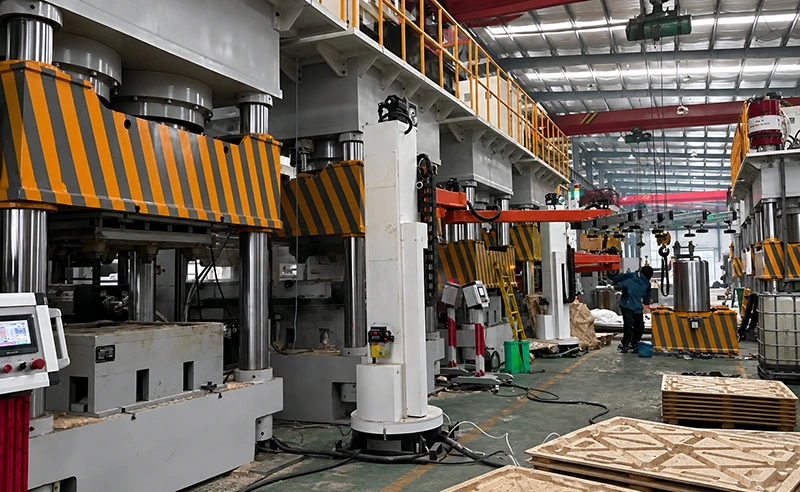
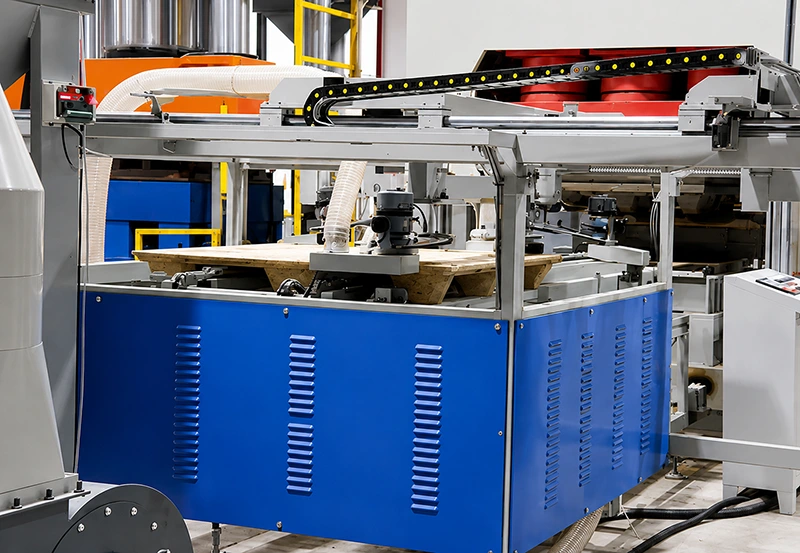
The first image shows the press side of this decision: a heavy four-column hydraulic press with striped safety guarding and an overhead crane in the assembly hall, the guarded die area a take-out head has to enter on a signal. The second shows the handling side as built: a gantry automation station on a sheet metal enclosure with vacuum hoses, a cable carrier, a linear rail and a separate control panel. Both photographs evidence visible structure and station layout, including base, arm, multi cup head, cable chain, beacon and guarding. They do not evidence rated load, working radius, repeat accuracy, suction or vacuum configuration, footprint, power, air demand or robot body source, which stay project confirmed. The 1250 to 1600 ton press range, the four to five minute MDI cycle, continuous running and the replacement of about two take-out operators are supplier statements, and the 80 degrees Celsius direct take-out figure is quoted from the EMP equipment centre description. What follows at the line is not a tonnage claim: the press wait between the open and close signals is shortened, exit manning is set per press pair instead of per press, and the unit cost a plant carries for the last metre at the die stops scaling with the crew it cannot hire. The unit remains the press exit take-out and stacking device on a presswood pallet line, not the press itself, not the crush, dry or glue stage, and not an independently running line.
- Keyword automatic pallet take-out robot and the presswood pallet line takt appear in the eyebrow, intro, headings and both image ALT texts
- Both images are taken from the resolved AutoG designer gallery and neither was used in the previously published AutoG posts returned by the site readback
- Every performance claim is limited to supplier statements, the EMP equipment centre 80 degrees Celsius description and visually evidenced structure, with load, radius, accuracy, suction, footprint, power and air demand left project confirmed
- Body text is plain with no added H1, and the CTA route is contact inside the fixed renderer root section