Presswood pallet line replication
The replication plan is approved for the take-out post, not for the process
A presswood pallet maker that expands on a proprietary fibre recipe and a proprietary press curve faces two questions at once when plant two is approved: how does the new line get built to the same output without the recipe leaving the company, and who carries the risk if the take-out and stacking end does not match the presses it was bolted onto. Both questions land on the press exit, where an automatic pallet take-out robot sits between a hot die and a stacking position. EMP delivers that end as a turnkey scope: press, AutoG take-out, automatic stacking and the line PLC integrated as one package, with the customer's confidential process parameters treated as inputs to the integration layer rather than as something the supplier is asked to reverse engineer. The scope is the hydraulic press pallet take-out and stacking layer only. AutoG does not crush, dry, glue or press, it is not a general case or bag palletizer, and it is not sold as a stand-alone line.
A third-party arm plus a separate integrator splits the risk at the worst seam
The usual first answer is to buy a general press tending robot, then hire an integrator to make it work with the press. On paper the split looks cheaper. On a hot press pallet unloading duty it moves every unresolved interface onto the buyer: the open and close signals of a 1250 to 1600 ton press, the moment the die is clear enough to enter, the gripper that has to hold a molded pallet whose deck carries texture and recesses, and the stacking height that follows the press cycle. It also asks a plant to explain its process to a second and third supplier to get those interfaces configured, which is exactly the disclosure a confidential recipe cannot tolerate. When something drifts, the press builder points at the robot, the robot supplier points at the integration, and the plant carries the downtime on a line it has not yet learned to run.
What the turnkey scope actually delivers at the press exit
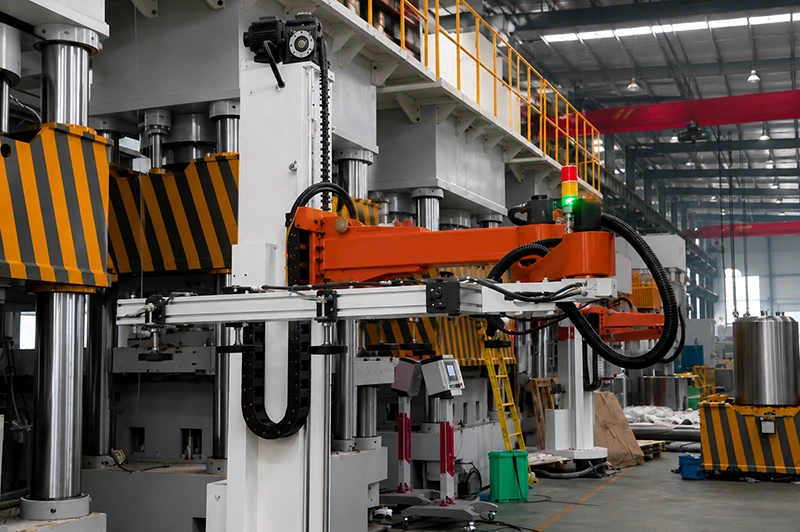
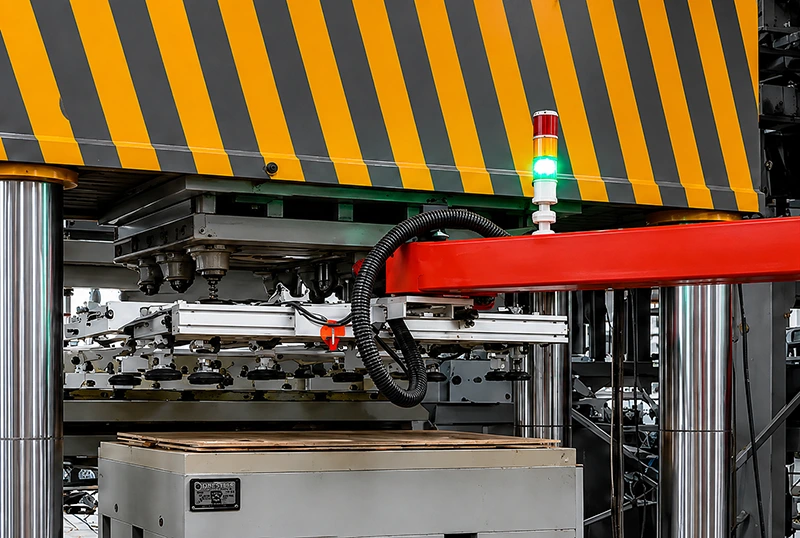
The EMP answer is scope, not a catalogue unit. The pressed pallet is taken on the press open signal by a six-axis articulated robot arm with a vacuum suction cup end effector, held on the pallet deck rather than gripped by its edges, and it is moved and stacked without a cooling wait, so the press is not held open while a unit comes down to a temperature a person can touch. One arm serves two presses as a dual-press tending cell, alternating on their open signals so the take-out sequence overlaps the other press's closed time, and the open and close signals are wired into the same line PLC that runs the press, the levelling station and the conveyor, with Siemens or Mitsubishi control and 4G remote diagnosis at line level. The photographs here show what the scope looks like installed: a gantry handling unit tied into a heavy press line with its cable chain and beacon, and a vacuum suction gripper under a striped safety enclosure at the handling station. They show visible structure and press-side layout. They do not prove load, reach, repeat accuracy, cycle time or a temperature rating.
What actually gets copied into plant two is the automation layer
A second plant therefore receives a repeatable automation layer instead of a copy of the recipe. The confidential inputs stay with the customer and enter the project as parameters the integration layer has to honour: press tonnage and die geometry, cycle, pallet footprint, stacking height and the hand-over point to the conveyor. Everything downstream of that hand-over is delivered as one acceptance: hydraulic press pallet take-out, vacuum suction pallet transfer from press to stacking position, automatic stacking and palletizing, and the control link that ties the cell to the line. Press-side manning is then set per press pair rather than per press, the press exit is physically unoccupied between the open and close signals, and the second site is commissioned against a sequence the first site already runs rather than against a fresh engineering exercise. Limits are stated plainly: rated load, working radius, repeat accuracy, suction cup and vacuum configuration, footprint, power and air demand, control interface detail and robot body source stay project-confirmed. The 1250 to 1600 ton compatibility, the four to five minute MDI press cycle, the continuous running statement and the two-operator replacement figure are supplier statements rather than published specifications, and no ROI, payback or hourly output is claimed here. The unit is the press exit take-out and stacking device on a presswood pallet production line, not the press itself, not the crush, dry or glue stage, and not a stand-alone line.
- Both images are chosen from the AutoG designer gallery and prove visible structure and press-side layout only, not load, reach, accuracy, cycle or temperature rating.
- The 80 degrees Celsius handling figure is quoted from the EMP equipment centre description; the 1250 to 1600 ton range, four to five minute MDI cycle, continuous running and two-operator replacement are supplier statements.
- Process parameters, fibre blend, moisture setpoint, adhesive ratio and press curve remain the customer's confidential inputs; the scope is the take-out and stacking automation layer.
- AutoG is not the hydraulic press, not the crush, dry or glue stage, not a general case or bag palletizer and not an independently running line.