AutoML presswood pallet machine
A three-shift molded pallet plant and four decisions per cycle
A presswood pallet machine plant running two or three shifts rarely loses consistency inside the press. It loses it in the handover between the people who weigh the fibre, judge the glue, spread the mat and pull the cured pallet out, because on a manual line each of those steps is a decision taken fresh on every cycle. AutoML is EMP's modular automated pallet manufacturing line, built so that weighing and dosing, glue mixing, spreading, hot pressing and take-out are carried by the equipment sequence instead of by the person standing at the station.
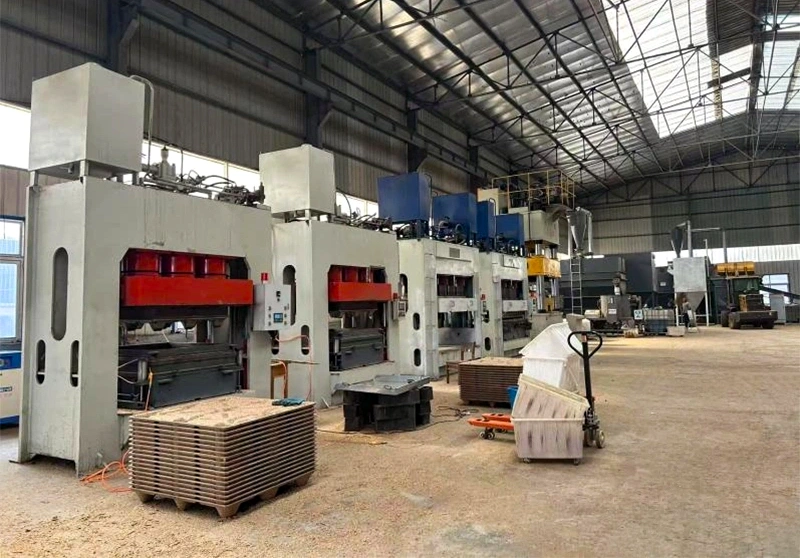
Why experience-based steps drift: weighing, glue, spreading and the press window
Three failures repeat across plants. Manual weighing and spreading put a density spread into the mat, so one mold produces pallets of different mass and the press answers with a hold time somebody chooses on the spot. Glue dosage by eye or by habit moves the resin fraction, which on an MDI system surfaces as mold sticking and extra cleaning time and on a UF or PF system as a curing and strength spread. And the spreading rhythm is not the press rhythm, so the press waits between the open and the close signal, and that wait is absorbed by the shift instead of by the machine. Training, checklists and supervision all help, and a plant should still run them, but none of them makes a dosing decision repeatable at 180 to 240 seconds per cycle across three shifts.
What AutoML chains instead: one equipment sequence from weighing to take-out
AutoML is a modular compressed wood pallet machine line, not a stand-alone press. The scope runs from crushing and drying through glue mixing into weighing and dosing, automated spreading, hot pressing, demolding and stacking, with the dosing, spreading and press motions sequenced on the line control. Instead of a person judging a batch, the weighing and dosing station meters the fibre and the blender meters adhesive to setpoints, the spreading unit indexes over the open mold, the press follows a stored temperature, pressure and hold profile, and the take-out device answers the press open signal. Product files reference 1200T, 1250T, 1600T, 1800T and 2200T press tiers with a 1600T class press as the repeat reference, hot pressing at 150 to 180 degrees Celsius and 15 to 20 MPa, a cycle near 180 to 240 seconds, raw material at 5 to 30 mm length and 2 to 5 mm thickness, MDI at roughly 8 to 10 percent or UF and PF at roughly 10 to 12 percent, and finished density at 0.8 to 1.2 grams per cubic centimetre. The same line supports the nail-free wooden pallet process and a fumigation-free pallet machine position for export packaging, and it can be built semi-automatic where labour is cheap or fully automatic where shift coverage is the binding constraint.
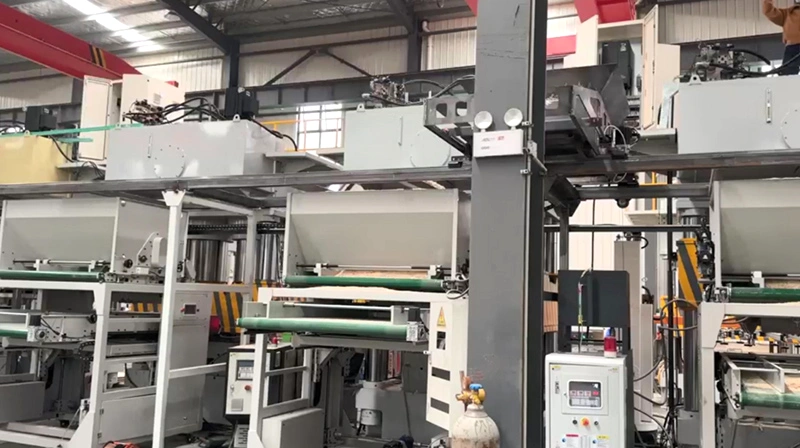
Image and parameter evidence, and the part automation cannot do
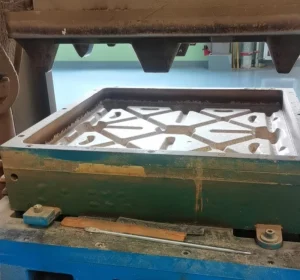
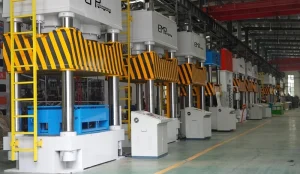
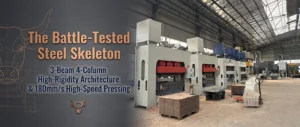
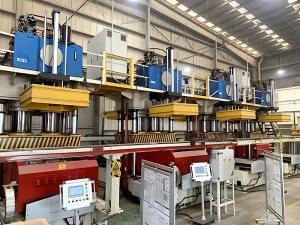
The photographs on this page are the argument in hardware form: the rail-mounted weighing and spreading station with its central PLC screens, the overhead dosing belt feeders and hoppers dropping a metered glue-fibre mix into the tooling, the dual blenders with pneumatic discharge gates and dosing screws, the chain and roller conveyor that receives the demolded pallet, and the row of hydraulic hot presses the industrial pallet press machine scope is built around. The press record on the same line is a force and displacement curve, which is what makes a hold and a release auditable rather than remembered. What automation does not do is replace training, process confirmation or shop-floor management. Moisture still has to be matched to the glue system from trial data rather than from a fixed number, tonnage, mold and cycle are confirmed per project in the technical agreement, dust and glue fume control still decide whether the PLC cabinets and sensors survive a year in that room, and layout, power and raw material supply still decide whether a semi-automatic start is the better entry into wood waste to pallet conversion. Used that way, the line gives a plant what individual experience cannot: the same steps, in the same order, at the same window, on every shift, and a crew change that moves the people instead of the process.
- Process scope held to the AutoML chain: weighing and dosing, glue mixing, spreading, hot pressing, demolding, take-out
- Press tiers, temperature, pressure, cycle, particle size, glue dosage and density quoted as product-file references confirmed per technical agreement
- Automation limits stated plainly: training, process confirmation, moisture trial and shop-floor management stay with the plant
- No ROI, payback, hourly output or certification claim made; keywords taken from the AutoML traffic profile