Boiler fuel feedstock and chip size control
A fuel seller's real complaint: the boiler gets a different chip every week
A boiler fuel buyer does not buy wood chips, they buy combustion stability, and the specification that decides it is size distribution inside a working window of roughly 25 to 50 mm. This page follows one fuel supplier's problem, from chips bought off several yards, through the chipping stage that actually sets particle length, to what a drum wood chipper machine can hold and what the screening station downstream still owns. The Shred drum wood chipper machine covers 45, 55 and 110 kW across X-215, X-216 and X-218, producing a controllable first-stage chip of about 30 to 35 mm at 4 to 5, 6 to 8 and 8 to 12 t/h, and the boundary is stated plainly: uniform and controllable chip length, with the final graded window set by the customer's boiler specification.
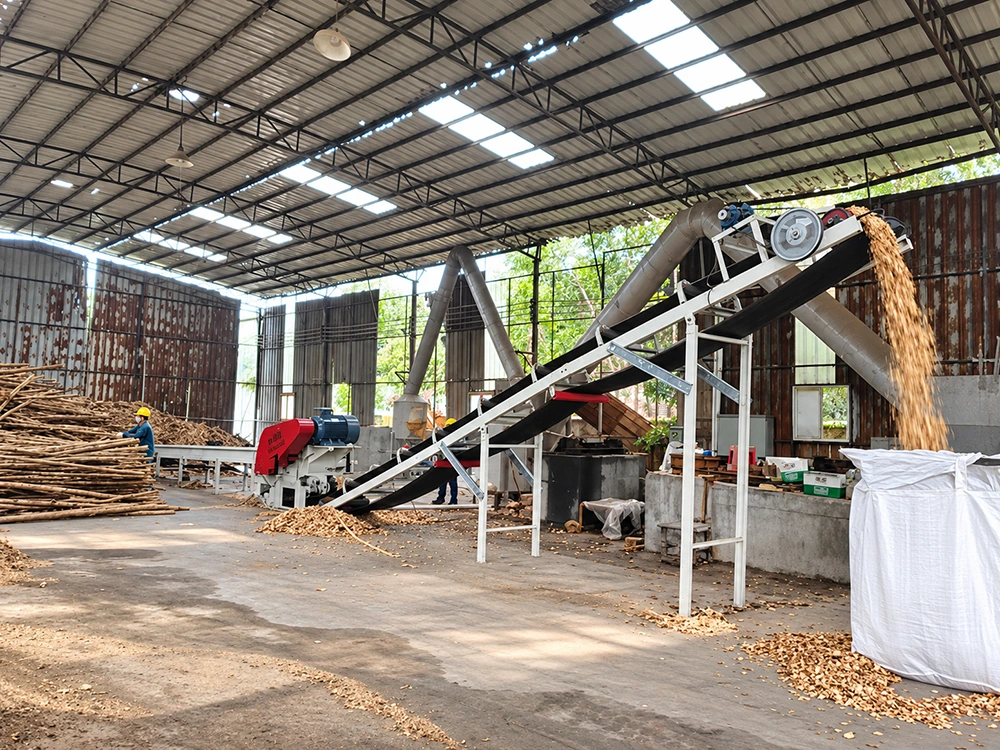
Why the chipping stage can only own part of the 25 to 50 mm window
The straightforward answer is that a drum wood chipper machine sets chip length, not the final graded particle size. On the Shred platform the knife roller and fly knife cut the wood to a nominal length of about 30 to 35 mm, which lands inside the 25 to 50 mm boiler window, and the chip screen keeps oversized material inside the housing until it is reduced. What leaves the discharge end is a first-stage chip. The final grade the boiler actually receives is set downstream by the screening and classifying stage the plant owns, and the exact window is set by the customer's own boiler specification. So the claim worth making is controllable, repeatable first-stage chip length, not one fixed particle size on the truck. That distinction matters more than it looks: a supplier who promises a single number is promising something only the screening station can deliver, and the first shift where the raw material changes will prove it.
Inside the machine: hydraulic feed rollers, knife roller, fly knife and chip screen
Raw material for a boiler fuel yard is irregular: branch wood, small diameter logs, slabs, edgings, broken veneer and offcuts. A drum type wood chipper handles that shape of feedstock because the wood is drawn in and held rather than dropped onto a cutting disc. This industrial wood chipper uses an upper and a lower feed roller that pull the material through under hydraulic pressure, with the upper roller floating within a range so the thickness of the incoming piece does not decide the chip length, and the two rollers are synchronised by chain and sprocket drive. Behind them, fly knives are bolted to the knife roller with dedicated bolts and clamping blocks, and the knife roller runs at 590 rpm on the X-215 and X-216 and at 650 rpm on the X-218. Three models cover the capacity tiers: X-215 at 45 kW and 4 to 5 t/h, X-216 at 55 kW and 6 to 8 t/h, and X-218 at 110 kW and 8 to 12 t/h, with maximum feed diameters of 160 mm, 200 mm and 300 mm. Each capacity figure is nominal at a defined material condition, and the moisture, density and species basis behind those numbers is not published yet, so a fuel yard comparing quotations should ask every supplier for that basis instead of comparing raw tonnes per hour.
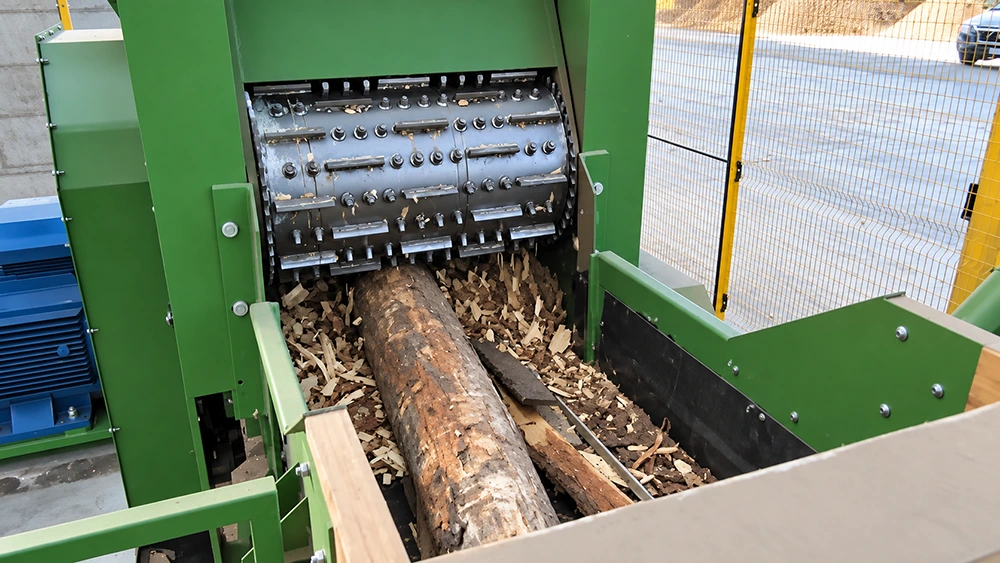
What changes at the boiler, and what the plant still has to verify
Once the chipping stage holds a controllable first-stage length, the supplier's conversation with the boiler changes from defending a load to documenting one. The chip leaving the discharge conveyor is consistent enough that the screening station, the dryer and the fuel yard work on a known input instead of re-normalising whatever arrived, which is also why the same machine sits at the front of a chipper and hammer mill line or a wood chipper for pellet plant feed. Three capacity tiers let a fuel yard start on the X-216 and add X-218 capacity later without changing the process logic, and the same platform serves a presswood pallet production line upstream of the pulverizer, the dryer and the press. What EMP cannot hand over yet is the paperwork behind the numbers: knife material and hardness are not published, wear part consumption per ton is not published, and machine weight, overall dimensions and container loading are still missing, all of which a buyer needs for freight, foundation and transformer planning. Those belong in the engineering reply attached to the quotation, not in a brochure.
- Chip length claim is limited to controllable first-stage output of about 30 to 35 mm; the final graded window is explicitly assigned to the screening stage and the customer boiler specification.
- No capacity, wear or certification claim is made beyond EMP product data; the missing moisture, density, species and test basis is stated as a gap instead of being filled with a number.
- Every structural statement traced to EMP product data: hydraulic feed rollers, chain and sprocket synchronisation, knife roller with clamped fly knives, chip screen recirculation, 590 and 650 rpm roller speeds.
- No absolute or unverifiable wording used, no tramp metal removal credited to the chipper body, and no weak filler terms from the banned list appear in the body copy.


