Dryr sawdust dryer as a pre-treatment module behind the sorting stage
Recycled Wood Arrives With More Than Wood in It
Recycled wood from demolition timber, used pallets, crates, block offcuts and garden waste reaches the hopper carrying two problems at once: moisture between 35 and 60 percent, and tramp metal, stones, grit and plastic film that the loader picked up with it. This page follows the sawdust dryer decision on a line that already sorts, where the rotary drum drying unit is placed downstream of the existing air separation, screening and iron removal as a standard pre-treatment module instead of being asked to handle material no dryer was built to handle.
Why a Sawdust Dryer Is Not a Contamination Fix
The default answer is to dry everything the loader delivers and let the downstream stage absorb the consequences. It does not work for long. Tramp metal and stone ride the drum, wear the lifting plates, score the shell and turn up as hard points in a molded pallet or as damage in a pellet die. Plastic film melts on hot surfaces and smears. Oversize slabs and block ends stall the drum and burn fuel without drying anything, so the operator raises furnace heat to compensate, which is the wrong lever on a material whose ignition temperature sits at or below 280 degrees Celsius. The cheap corrections also fail on their own: manual picking at the hopper does not hold across three shifts, screening after drying blinds a wet deck, and buying a new line to solve a material-handling problem is the most expensive answer available. A rotary drum dryer has no metal separation device of its own, and no drum is designed to sort. It is a continuous drying unit, and it works best on a stream that has already been cleaned.
Put the Drum Behind the Sorting Stage, Not In Front of It
The arrangement that holds is a drying module placed downstream of the separation and iron removal the site already runs, as a standardized pre-treatment stage rather than as a substitute for it. DRYR is a continuous rotary drum drying unit, so it can be bolted into the sequence after the screen and the magnet and ahead of glue mixing, molding or pelletizing, and it does not require the existing line to be rebuilt around it. The assembled structure and bolted flange sections let the drum, the feed connection, the ducting and the dust side be tied into the layout the plant already has, and the drum itself can be built out to 17 to 18 m and shipped in sections for on-site assembly where transport sets the limit. Selection then follows the tonnage that reaches the dryer after screening, across H-1010 to H-1815 at 0.8 to 2 t/h, with the honest boundary that throughput and final moisture move with contamination level, oversize content, species, initial moisture and site conditions. Fuel choice stays open too, so coal, oil, gas, biomass solids and pellets, powder or electricity can be matched to local supply and emissions rules.
What the Bolted Module Looks Like on Site, and What Comes Out of It
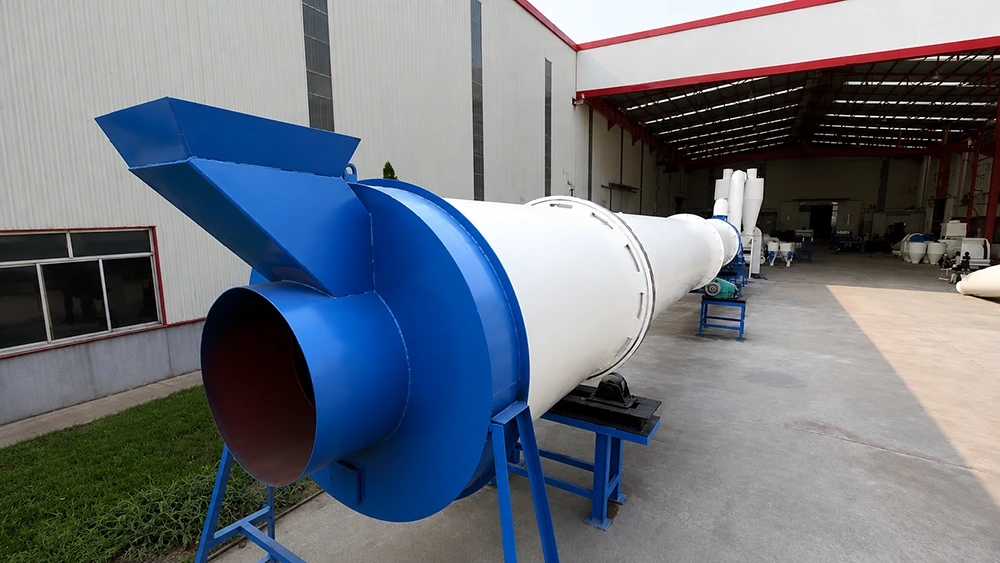
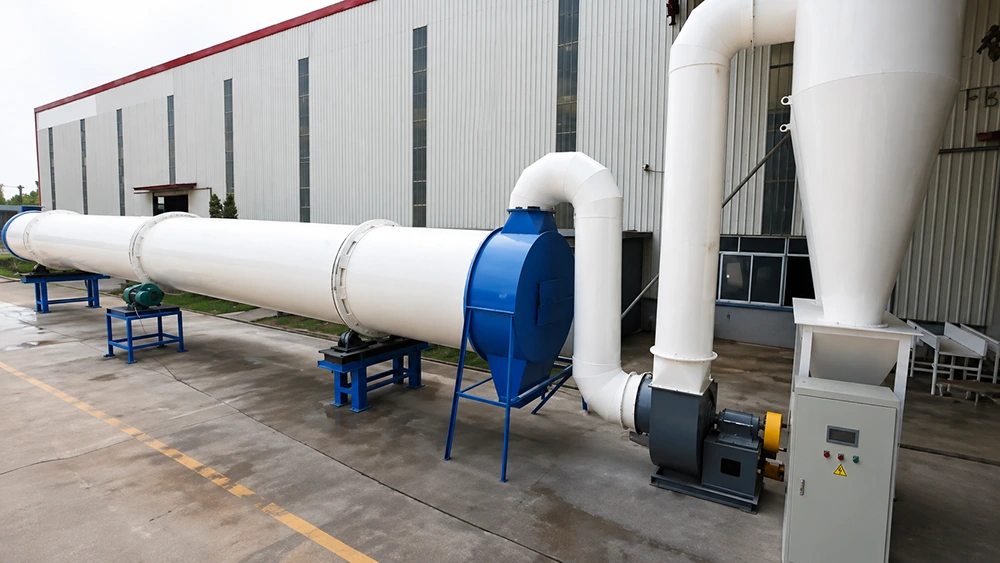
Two site photographs carry the arrangement. The first shows the feed end of the sawdust dryer: a blue large-diameter feed housing and inclined hopper, a white cylindrical shell and roller supports, which is the material handover point where the sorted stream enters the drum. The second shows the module in its working layout, with the drum built in bolted flange sections on steel supports, ducting running to a vertical cyclone separator, a centrifugal blower and a control cabinet, which is what makes it connectable to a line that already exists. The published tiers are H-1010 to H-1815 on 1000, 1200, 1500 and 1800 mm drums, 4, 5.5, 7.5 and 11 kW main motors, 7.5, 7.5, 11 and 15 kW induced draft fans and 0.8 to 2 t/h; drum internal hot air is quoted at 200 to 500 degrees Celsius with output moisture stated below 10 percent; combined lifting plates, temperature sensing, uniform vibration and a sealed drum carry the heat into the material; self-insulation is quoted above 80 percent thermal efficiency and under 8 kg of coal per tonne dried, with a cyclone dust collector standard and a baghouse optional. The result on a sorted stream is a repeatable process input: stable moisture into MDI or UF glue mixing, molding or pelletizing, and wear parts that are not being asked to grind metal and stone. Those figures are quoted without published test conditions, so tonnage and final moisture move with species, initial moisture, particle size, fuel and climate, and tramp metal, stone and plastic removal stays an upstream, project-confirmed stage.
- Sawdust dryer positioned downstream of the line's existing screening and magnetic separation, not used as a sorting device
- Assembled structure and bolted flange sections let the drum, ducting and cyclone tie into an existing recycling line layout
- H-1010 to H-1815 at 0.8 to 2 t/h on 1000 to 1800 mm drums, drum internal hot air quoted at 200 to 500 degrees Celsius, output moisture stated below 10 percent
- Tramp metal, stone and plastic removal stays an upstream project-confirmed stage, and capacity moves with contamination and oversize content



