Boiler fuel capacity, added in modules
The buyer behind the demand: a boiler fuel market that will not stand still
Boiler fuel demand in Australia and across the export lanes into Japan and Korea is expanding faster than a fixed drying plant can follow, and the purchase that decides whether a recycler takes the next contract is the biomass sawdust dryer, not the boiler. This page follows a wood and biomass recycler adding drying capacity in modules: the DRYR rotary sawdust dryer covers 0.8 to 2 t/h across four tiers on 1000, 1200, 1500 and 1800 mm drums, each tier driven by its own main motor and induced draft fan, with output moisture stated below 10 percent on drum internal hot air quoted at 200 to 500 degrees Celsius, and drums built out to 17 to 18 m in bolted flange sections where residence time rather than heat is the constraint. The limits are stated plainly: those figures are quoted without published test conditions, so tonnage and final moisture move with species, initial moisture, particle size, fuel and climate, and every project is sized on its own material sampling.
Why the old answer stops working: sun drying, small airflow units and one oversized drum
Most yards answer moisture in one of two ways, and both of them cap growth. The first is natural sun drying or manual open air drying, which is free until the weather changes: recycled wood from demolition timber, used pallets, crates and yard waste arrives at whatever moisture the yard allowed, and a wet season turns a two day drying cycle into a week, with high moisture sawdust moulding and fermenting in the pile before it ever reaches a mill or a boiler feed line. The second is a single large purchase, one drum big enough for a tonnage nobody has signed yet, which pushes the whole decision through a capital threshold at once and leaves the plant running flat out to justify it. A small airflow dryer looks like the cheap third option, but it is built for a lighter duty and does not hold a continuous tonnage across a shift. There is also a structural problem with the one machine answer: a single unit turns one seal, one fan or one lifting plate into a plant stop, and a plant carrying three contracts on one drum has no way to dry around the failure. Recyclers who describe themselves as signing orders while they expand are not looking for one big machine. They are looking for a unit that can be added to.
The fit: a rotary sawdust dryer that grows one module at a time
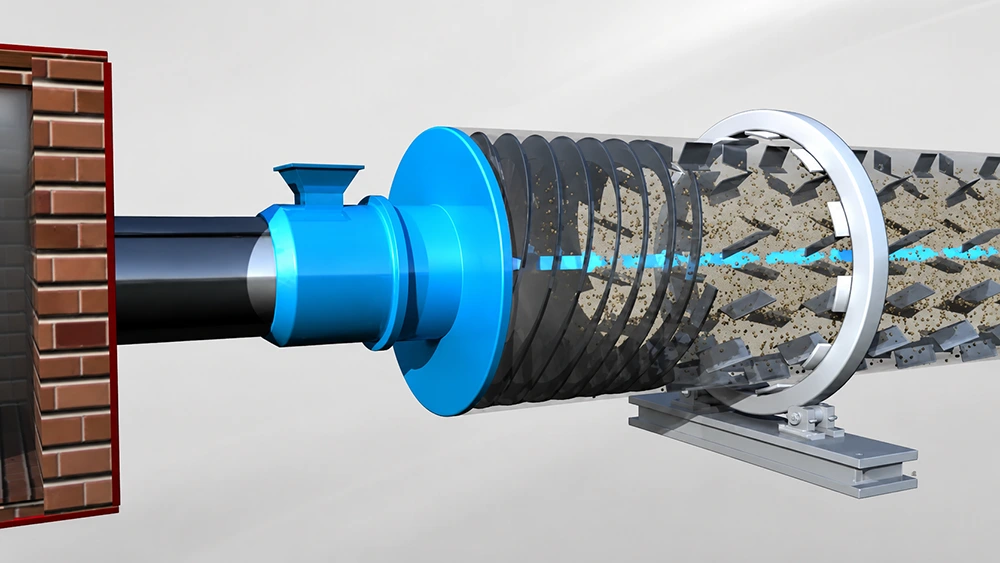
DRYR is a rotary drum dryer built as four tiers rather than one model, and the tier is chosen against the moisture, the tonnage and the climate the project actually has. H-1010 runs a 1000 mm drum on a 4 kW main motor and a 7.5 kW induced draft fan over 0.8 to 1 t/h. H-1212 runs a 1200 mm drum on 5.5 kW and 7.5 kW over 1 to 1.2 t/h. H-1512 runs a 1500 mm drum on 7.5 kW and 11 kW over 1.2 to 1.5 t/h, and H-1815 runs an 1800 mm drum on 11 kW and 15 kW over 1.5 to 2 t/h. The whole ladder shares the same process: hot air from a furnace, lifting plates inside the inclined drum throwing a material curtain into the gas stream, a sealed drum and inlet chute, temperature sensing with uniform vibration, a cyclone separator or an optional baghouse filter, and a control cabinet tying feed, furnace and fan together. Drum internal hot air is quoted at 200 to 500 degrees Celsius against output moisture below 10 percent, the shell is built as a self insulation design with thermal efficiency quoted above 80 percent and coal consumption under 8 kg per tonne dried, and the heat source is multi fuel, taking coal, oil, gas or the yard own sawdust, chips and pellets, so the local fuel price and emissions rules can be answered without changing the machine. The module logic sits in the drum itself: lengths are built out to 17 to 18 m in bolted flange sections, split for shipment and reassembled on site.
What the structure shows, where the numbers stop, and what the yard ends up with
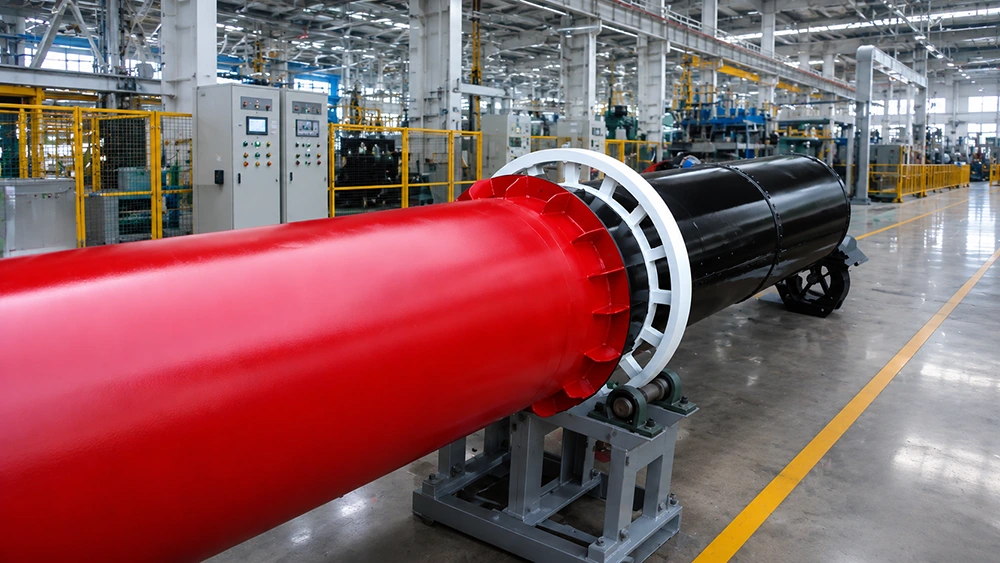
The photograph on this page is site evidence rather than a drawing: a segmented drum shell joined on bolted flanges, carried on steel roller supports inside a production hall, with safety fencing and control cabinets in frame. It is the same construction that makes a 17 to 18 m drum shippable and a second tier addable, because a bolted section is a section that can arrive in a container and be assembled in the yard. The second image is a 3D cutaway rendering of the internal conveying and material path, and it is labelled as a rendering, not as measured site evidence. The numbers carry their own boundary. No published test conditions accompany the tonnage, the below 10 percent output moisture, the above 80 percent thermal efficiency or the under 8 kg of coal per tonne, so each of them moves with species, initial moisture, particle size, fuel and site conditions, and the 200 to 500 degrees Celsius band is drum internal hot air with the measurement position to be confirmed with engineering on the project. Sizing is done on sampling, not on a table: material type, initial moisture, particle size, target output moisture, hourly tonnage, fuel and emissions requirement, and site and transport conditions all go into the selection. What the yard ends up with is a drying stage it can commission at the tonnage it has signed, add to when the next contract lands, and split ship to a site the container can actually reach.
- All figures on the page are traceable to the Dryr product brief and traffic profile, and the below 10 percent output moisture, above 80 percent thermal efficiency and under 8 kg coal per tonne are all stated with their conditions rather than as unconditional guarantees.
- The 200 to 500 degrees Celsius figure is described as drum internal hot air with the measurement position to be confirmed, matching the known conflict between the site temperature wording and the published band.
- The second image is described as a 3D cutaway rendering and is not presented as measured site evidence, and the first image is used only for what it shows: bolted flange sections, roller supports and control cabinets.
- Banned weak phrases (high quality, best solution, one-stop solution, advanced technology, reliable product) do not appear, and the body follows scenario, old method problem, product fit, structure evidence and result order in plain text with no HTML.