Modular drying module for EPC scopes
Where the drying stage lands in a 1 to 20 t/h EPC scope
An EPC contractor quoting molded pallet, pellet and charcoal briquette lines signs projects anywhere from 1 t/h to 20 t/h, and the drying stage is the module it cannot carry from job to job. This page follows the DRYR sawdust dryer as a standardized drying unit that is specified once and repeated: H-1010 to H-1815 covering 0.8 to 2 t/h on 1000, 1200, 1500 and 1800 mm drums with 4, 5.5, 7.5 and 11 kW main motors and 7.5, 7.5, 11 and 15 kW induced draft fans, an assembled structure that bolts into a line already built, drums extended to 17 to 18 m in bolted flange sections, drum internal hot air quoted at 200 to 500 degrees Celsius, output moisture stated below 10 percent, a multi-fuel hot air furnace, self-insulation quoted above 80 percent thermal efficiency with under 8 kg of coal per tonne dried, a cyclone dust collector with optional baghouse and PLC control. It is positioned as an OEM drying module beside an integrator's own machine, not a replacement for it, and the limits are stated plainly: those figures carry no published test conditions, so tonnage and final moisture move with species, initial moisture, particle size, fuel and climate.
Why a bespoke drum per project stops an integrator from scaling
The default answer in most yards is still natural sun drying or manual open-air drying, and both fail the same way: they depend on weather and season, they deliver an intake moisture that swings load to load, and they cannot feed a continuous line at a fixed rate. The step up from there is usually a small airflow sawdust dryer, which is cheap and quick to buy but is sized to a narrow particle band and a light throughput, so on 40 to 50 percent initial moisture and a mixed wood chips, shavings, straw and rice husk intake it becomes the throughput limit rather than the drying solution. The other common answer is worse for an integrator: a hand-welded low-end drum machine built to a single job. An out-of-round field-welded shell loads the girth gear teeth, the support rollers and the bearings unevenly, the lifting plates end up at inconsistent angles so the material curtain inside the drum is uneven, and there is no repeatable drawing, no standard wear part list and no second unit that matches the first. For an EPC contractor this is a warranty exposure that travels with the project. It also caps growth in a way that is easy to miss at bid stage: one custom drum means one capacity, so the next contract either reuses a design that does not fit or starts engineering from zero, and the drying section becomes the slowest part of every tender the integrator writes. Preventing sawdust mold and fermentation from high moisture, and avoiding material degradation before pelletizing, are not one-off problems to be solved per site, they are a repeatable specification to be standardized.
The assembled structure that bolts into a line already built
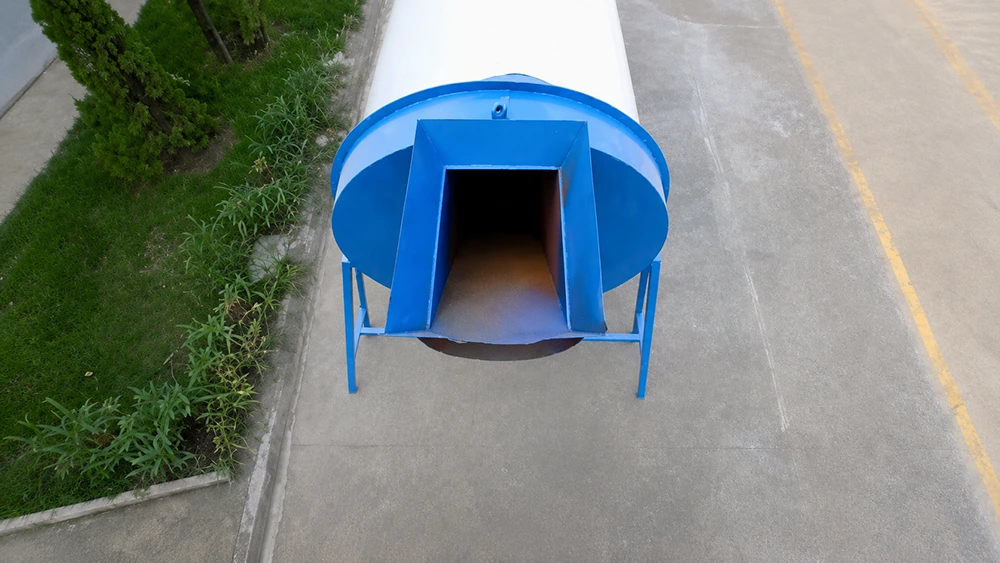
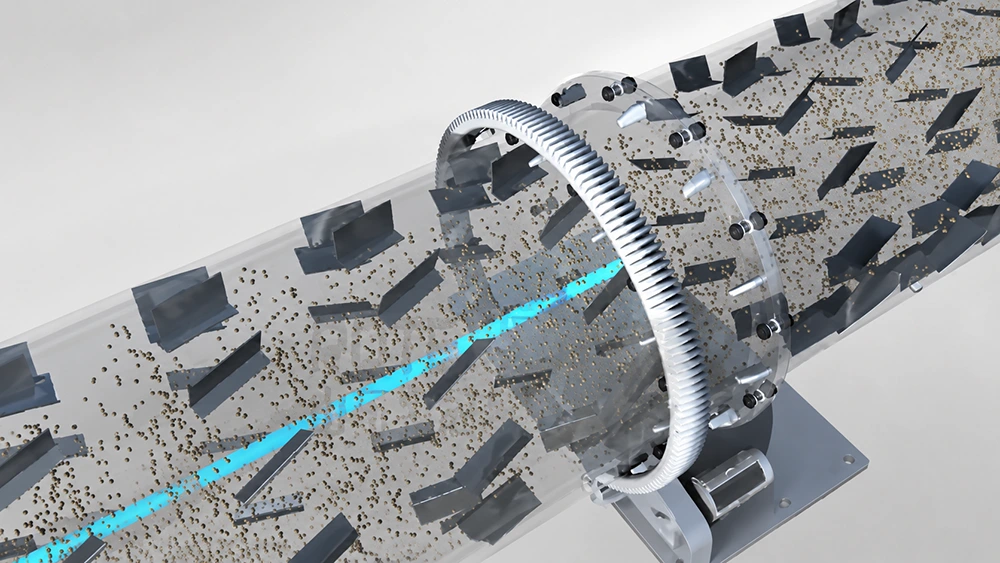
DRYR is an assembled structure sawdust dryer, and that is the feature an integrator actually buys: the drum, feed connection, ducting, dust collector and control cabinet are a packaged drying unit that is tied into an existing layout instead of forcing a line to be rebuilt around it. Where residence time rather than furnace heat is the constraint, the drum is built out to 17 to 18 m in bolted flange sections, so a long shell that no container accepts still ships as sections and is re-assembled and commissioned on site, which is the split shipment and field assembly route an overseas deployment needs. The drum runs on steel support frames with roller supports and is driven through an external girth ring gear and pinion with a gearbox and electric motor, so the drive is a separate serviceable module rather than part of the shell. Combined lifting plates with temperature sensing lift the wet feed into an even curtain for full heat exchange, uniform vibration keeps the material moving, and a sealed drum and inlet chute with monitored seal condition hold the dust inside the system. Behind it sits a refractory lined hot air furnace that accepts coal, oil, natural gas and dry solid, granular or powder biomass fuel, so the same drying module can be quoted into markets with different fuel availability and emissions rules, and a cyclone dust collector at the discharge end with a conical collection hopper, expandable to a baghouse filter, closes the dust path. A PLC control cabinet ties feed rate, hot air furnace and induced draft fan to one signal, which is what turns the module into a unit an integrator's own commissioning team can start up. Two views support the structure. The first is a site photograph of the front end of the drying unit, showing the rectangular inlet chute, the curved guard panels and the steel support legs that land on the prepared foundation. The second is an engineering cutaway rendering of the drum, showing the staggered lifting plates, the granular material load, the girth ring gear, the rollers and the drive support base; it is a 3D rendering used to explain internal construction, not field evidence of a commissioned machine.
What the integrator gets in writing, and where the limits sit
The selection ladder is deliberately narrow enough to specify from a tender document. H-1010 runs a 1000 mm drum on a 4 kW main motor and a 7.5 kW induced draft fan at 0.8 to 1 t/h. H-1212 runs a 1200 mm drum on 5.5 kW and 7.5 kW at 1 to 1.2 t/h. H-1512 runs a 1500 mm drum on 7.5 kW and 11 kW at 1.2 to 1.5 t/h. H-1815 runs an 1800 mm drum on 11 kW and 15 kW at 1.5 to 2 t/h. Across the family, drum internal hot air is quoted at 200 to 500 degrees Celsius, output moisture is stated below 10 percent and can be taken lower where a molding or pellet process asks, self-insulation is quoted above 80 percent thermal efficiency with under 8 kg of coal per tonne dried, and plot footprint and civil foundation investment are quoted at about 50 percent less against comparable models. Those figures are what an integrator needs to reserve space, size the foundation and write a performance clause. They are also quoted without published test conditions, which is the limit that has to travel with them: achievable tonnage and final moisture move with wood species, initial moisture, particle size, fuel and climate, so each project is sized on its own material sampling rather than on a catalogue number, and section count, lifting plan and foundation loads are confirmed per project. The result is a drying section an integrator can specify once and repeat: four standard tiers covering the small end of a 1 to 20 t/h portfolio, an assembled structure that bolts into a line already built, a drum that extends in bolted sections when residence time is the real constraint, and a multi-fuel furnace that answers local fuel and emissions rules. Where the integrator already builds its own dryer, the honest position is that DRYR works as an OEM drying module or a complementary unit beside it, not as a replacement for a machine that is already doing the job.
- Title, slug, first-screen summary and both image alt texts carry the modular sawdust dryer for EPC projects keyword and avoid every forbidden weak phrase
- Content order follows the integrator and 1 to 20 t/h scenario, the old-scheme failures, the fit of the assembled structure, the structure and parameter evidence, then the final result
- Every quoted figure keeps its project-conditional limit, the 200 to 500 degrees Celsius and below 10 percent figures are not written as unconditional guarantees, and the cutaway view is labelled an engineering rendering
- The post is positioned as an OEM or complementary drying module for integrators rather than a replacement, and no title, slug or image repeats an earlier Dryr blog publication