EPC Deployment: Split Shipment and On-Site Assembly
The customer: an integrator that has to land a drying stage at a remote plant
An EPC integrator signs a molded wood pallet line or a wood pellet line in one country and commissions it in another, usually at an inland plant a long way from the port, and the drying stage is the piece that decides how many of its own crew days the site consumes. This page follows the DRYR sawdust dryer through that deployment: a rotary drum built out to 17 to 18 m in bolted flange sections, shipped split, then re-assembled and commissioned on site, against an integral heavy drum that arrives as one oversized cargo item.
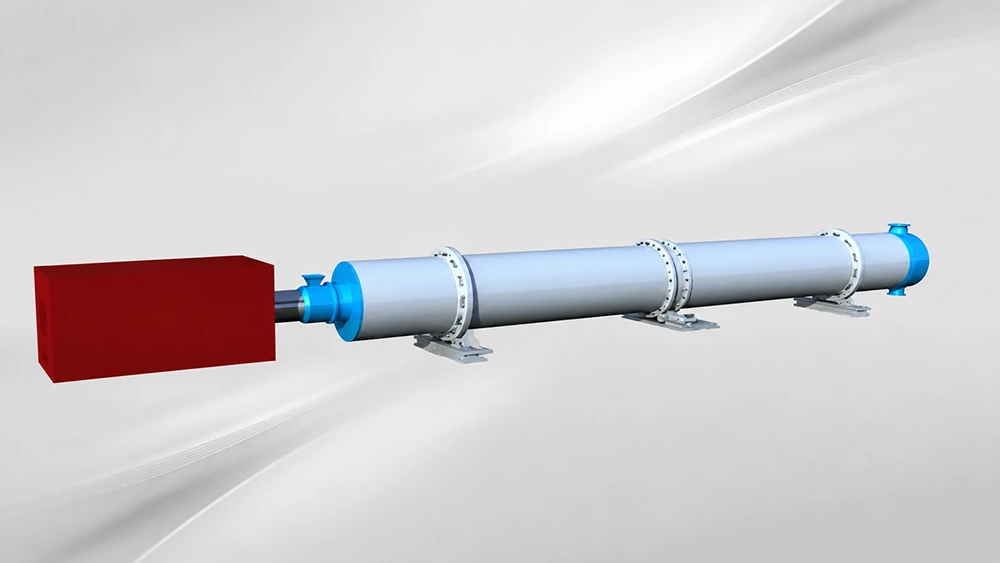
The old answer: an integral heavy drum turns a dryer into an oversized cargo project
The conventional answer is one welded drum shipped whole, and on large sizes that is an integral European style machine weighing over 220 tonnes with a segmented girth gear that still has to be assembled and aligned on site. The integrator inherits the consequences: oversized cargo classification, port crane capacity, customs paperwork and road permits to the plant gate, a civil foundation sized for that mass, and a commissioning window that needs specialist rigging crew on site for weeks. The cheaper alternative is no better. A drum welded up in a yard brings out of round shells, uneven lifting plates and a moisture record nobody can reproduce, while natural sun drying or manual open air drying cannot feed a continuous line through a rainy season. In both directions the integrator carries the risk and the site days.
Why an assembled structure and split shipment fit an EPC scope
DRYR is built as a split shipment assembly dryer: an assembled structure whose drum runs to 17 to 18 m in bolted flange sections, so the drying stage travels as container loadable pieces and is bolted back together and aligned on site the same way the drum is assembled at the factory. The hot air furnace, the cyclone dust collector with an optional baghouse filter, the screw conveyor and the PLC control cabinet are standard interface items, so the drying module can be laid into a line the integrator already designed instead of the line being designed around the dryer. A multi fuel sawdust dryer furnace accepts coal, oil, natural gas or the plant own dry biomass, which matters when the site cannot guarantee one fuel. Self insulation is quoted above 80 percent thermal efficiency with under 8 kg of coal per tonne dried, and against comparable models the plot footprint is about 50 percent smaller and the civil foundation investment about 50 percent lower, which is where an integrator pays twice: once on the ship and once on the foundation.
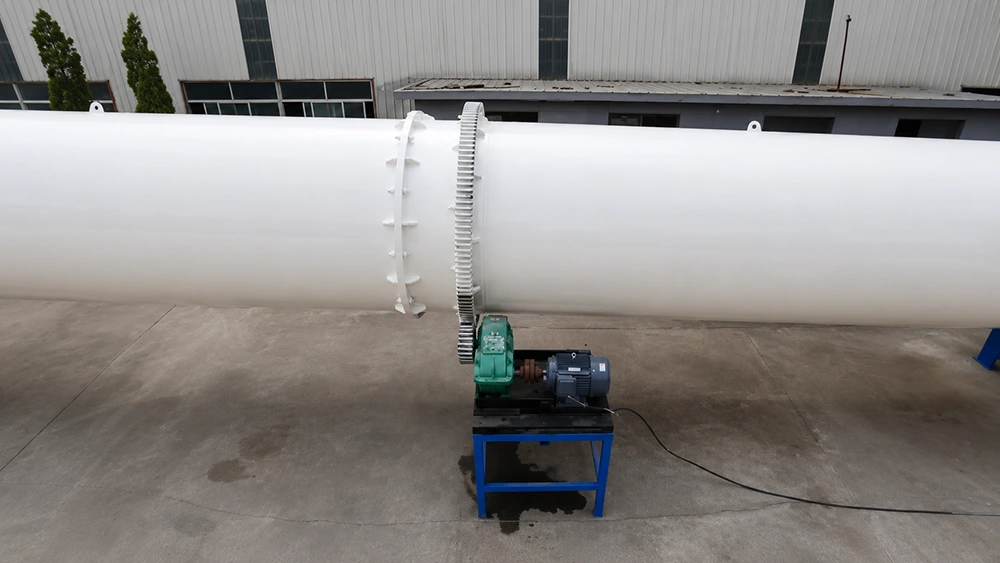
What lands on site: the H-1010 to H-1815 ladder, drawings and the honest limits
The drying module is a four tier ladder at 0.8 to 2 t/h. H-1010 runs a 1000 mm drum with a 4 kW main motor and a 7.5 kW induced draft fan at 0.8 to 1 t/h; H-1212 runs 1200 mm with 5.5 kW and 7.5 kW at 1 to 1.2 t/h; H-1512 runs 1500 mm with 7.5 kW and 11 kW at 1.2 to 1.5 t/h; H-1815 runs 1800 mm with 11 kW and 15 kW at 1.5 to 2 t/h. Drum internal hot air is quoted at 200 to 500 degrees Celsius, output moisture is stated below 10 percent, and the drum carries combined lifting plates, temperature sensing, uniform vibration and a sealed drum and inlet chute with exhaust routed to a cyclone dust collector or an optional baghouse. The first image is a 3D rendering of the horizontal tube dryer with its drive motor, bolted flanges, end housings and support saddles; the second is a drum with an external girth gear, pinion drive, gearbox and motor on a steel base frame. Both show how the machine is meant to come apart and go back together. For the integrator the result is a site scope reduced to bolting, alignment, ducting and commissioning, on a foundation cast for a lighter and smaller footprint. Two limits are stated plainly: the published figures carry no published test conditions, so tonnage and final moisture move with species, initial moisture, particle size, fuel and climate, and section count, lifting plan and foundation loads are confirmed per project.
- Drum built to 17 to 18 m in bolted flange sections for split shipment
- Footprint and civil foundation reduction stated against comparable models
- Published figures carry no published test conditions
- Section count, lifting plan and foundation loads confirmed per project