Dust control and fire scope
Dust Is Made at Three Stages in the Line, Not One
An industrial sawdust dryer sits in the middle of a line that makes dust at every stage, and the dust question is usually answered twice: once by the machine supplier and once by the plant fire and environmental package. This page follows a 0.8 to 2 t/h rotary sawdust dryer through that seam. It sets out what the Dryr drying module actually supplies, a conical cyclone dust collector at the discharge end with an optional baghouse filter, a sealed drum and inlet chute and monitored seal condition, and states the boundary plainly: our published data does not claim built-in spark detection or fire suppression, so where an EPC project mandates it, that duty is interfaced with the client's existing fire system or added as a separate package. Tonnage and final moisture move with species, initial moisture, particle size, fuel and climate.
What the Standard Answer Assumes, and Where the Machine Stops
The industry answer is familiar: multi-stage cyclone separation followed by a pulse baghouse filter, and on a high temperature drying system a spark detection and fire suppression package as well. That answer is correct and it is also bigger than one machine. A rotary sawdust dryer drum runs with internal hot air quoted between 200 and 500 degrees Celsius, while wood dust carries an ignition temperature in the region of 280 degrees Celsius or below, so the fire duty sits inside the drying stage by design. Our published Dryr material does not claim a built-in spark detection or fire suppression system, and we do not state one here. On an EPC pellet line or a turnkey molded wood pallet project where the spec sheet mandates spark detection, extinguishing or explosion venting, that scope is interfaced with the client's existing fire system or supplied as a separate add-on package agreed at project level. Stating that boundary early is cheaper than discovering it at handover.
What the Dryer Supplies: Discharge-End Cyclone, Optional Baghouse and Seal Monitoring
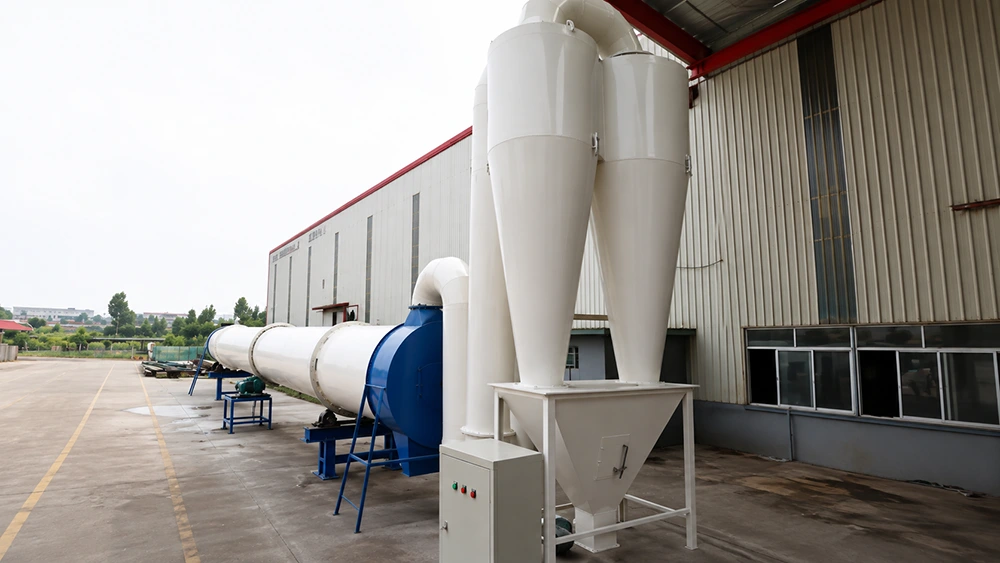
Inside that boundary the drying module carries its own share of the dust duty. Exhaust from the drum is routed to a conical cyclone dust collector at the discharge end, where the separated fibre drops through a conical collection hopper instead of leaving with the air stream, and that arrangement is expandable to a baghouse filter where the project or the local emission limit asks for a finer final stage. The drum shell and the inlet chute are sealed, seal condition is monitored rather than assumed, and the PLC control cabinet ties feed rate, hot air furnace output and induced draft fan together so the drum is not run as three independent settings. The hot air furnace is refractory lined and multi-fuel, taking coal, oil, gas or the plant's own sawdust and pellets, and the shell is self-insulation rated above 80 percent thermal efficiency on our published figures. The practical result is that escaping fibre is captured at the point it is generated and the seal is watched, while the ignition detection duty stays where the project has placed it.
The Numbers and the Two Views a Buyer Can File
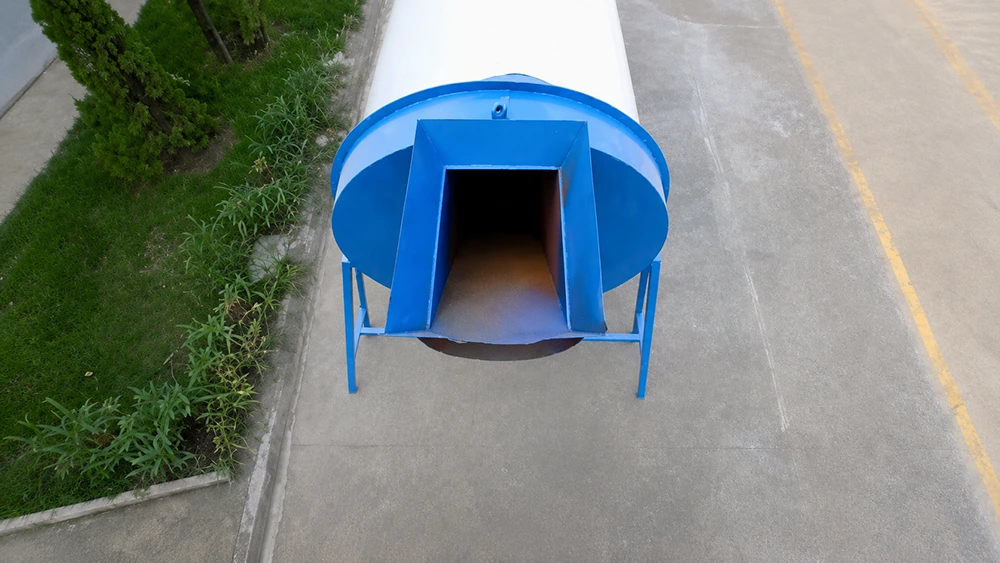
The Dryr ladder covers 0.8 to 2 t/h across four tiers: H-1010 on a 1000 mm drum at 0.8 to 1 t/h with a 4 kW main motor and 7.5 kW induced draft fan, H-1212 on 1200 mm at 1 to 1.2 t/h with 5.5 kW and 7.5 kW, H-1512 on 1500 mm at 1.2 to 1.5 t/h with 7.5 kW and 11 kW, and H-1815 on 1800 mm at 1.5 to 2 t/h with 11 kW and 15 kW. Output moisture is stated below 10 percent, drum internal hot air is quoted at 200 to 500 degrees Celsius, combined lifting plates with temperature sensing and uniform vibration carry the feed into the air stream, and drums are built out to 17 to 18 m in bolted flange sections for split shipment and on-site assembly. The two photographs above are site images, not renderings: the system view shows the drum, ducting, centrifugal fan, control cabinet and the twin cyclone separators with their conical collection hopper, and the second view shows the blue drum end with its rectangular chute, curved guard panels and support legs, which is the transfer point where an open discharge would release the driest fraction. Those published figures carry no published test conditions, so tonnage, output moisture, coal burn and captured dust all move with species, initial moisture, particle size, fuel and site climate, and the dust, baghouse and fire interfaces are confirmed per project rather than assumed from a catalogue.
- Every parameter, tonnage tier, drum diameter, motor rating and moisture figure is quoted from the Dryr product brief, and that brief publishes no test conditions for tonnage, output moisture, thermal efficiency or coal burn.
- The article does not claim a built-in spark detection or fire suppression system; it states that this duty stays with the client's existing fire system or a separately agreed add-on package.
- Both images are site photographs from the Dryr designer gallery, listed as photographs in the image index, not 3D renderings or engineering cutaways.
- Traffic-profile terms are used in the title, headings, body and image alt text: sawdust dryer with cyclone dust collector, sawdust dryer with baghouse filter, industrial sawdust dryer, rotary sawdust dryer, 0.8 to 2 t/h and output moisture below 10 percent.