Biomass pellet feedstock
The Pellet Plant That Has to Buy Its Tonnage Twice
A pellet plant that runs on wood residue alone is a price taker: sawdust and chip availability moves with logging cycles, weather and hauling distance, and the same tonnage is bid for by panel mills, board plants and biomass power stations. This page follows a wood pulverizer machine used to widen the feedstock pool instead of chasing the wood market, so local agricultural residue such as corn stover, wheat straw and rice straw is crushed on site into a controlled particle band and fed to the same pellet line intake as sawmill residue.
Where the Old Route Breaks Down
The first old route is buying ready made sawdust, which moves the problem one step downstream and keeps the plant exposed to the same spot market with a margin added on top. The second is to treat straw and stover like wood chips and send them through a wood chipper, which cuts them into chips rather than reducing them toward the particle band a pellet press needs. The third is a shredder, which reduces volume but does not grade, so the output still has to be handled again before it can be dried and pressed. The fourth is manual work: splitting bales, forking straw into a narrow throat, and stopping whenever the feed runs uneven, which cannot hold a continuous line. Whichever of those four the plant is running, the same three failures repeat. Particle size moves around, so the dryer and the press are re-tuned every shift. Capacity is set by the slowest manual step, not by the press. And the residue that could have been collected locally is either burnt, landfilled or left in the field, because there is no machine at the plant that can turn it into a graded raw material.
Why an F-Series Wood Pulverizer Machine Fits an Agricultural Residue Pool
The Pulvz F series covers F-800, F-1000, F-1200 and F-1500 at 45 kW, 55 kW, 75 kW and 110 kW over a nominal 1 to 8 t/h, with infeed openings from 680 x 380 mm to 1350 x 450 mm, so a pellet line can size the front end to its own tonnage instead of buying the largest machine on the list. The grading element is a replaceable 780 to 1480 mm high hardness alloy screen: the screen is what sets the particle band, and changing it is how the plant moves between a wood residue product and a straw or stover product on the same machine. Feeding is by belt conveyor, which is the part that matters for bulky, light agricultural material, because a belt carries a loose uneven stream into the crushing chamber instead of asking an operator to push bales at a throat. Inside, thickened manganese steel hammer plates work against a one piece manganese steel liner on a dynamically balanced rotor, and a hydraulic open cover puts the hammer plates and the screen within reach for a planned maintenance stop rather than a dismantled one. A cyclone separator is fitted where the layout calls for dust separation, and magnetic separation stays a project confirmed stage rather than a standard item on every unit. The boundaries belong on the page as well. About 5 mm is a screen set target band, not a guarantee, nominal tonnage moves with species, moisture, infeed evenness and screen condition, and each new species still needs its own screen and throughput trial before the plant writes it into the feedstock plan.
One Intake, Two Feedstock Families, Fewer Bidding Rounds
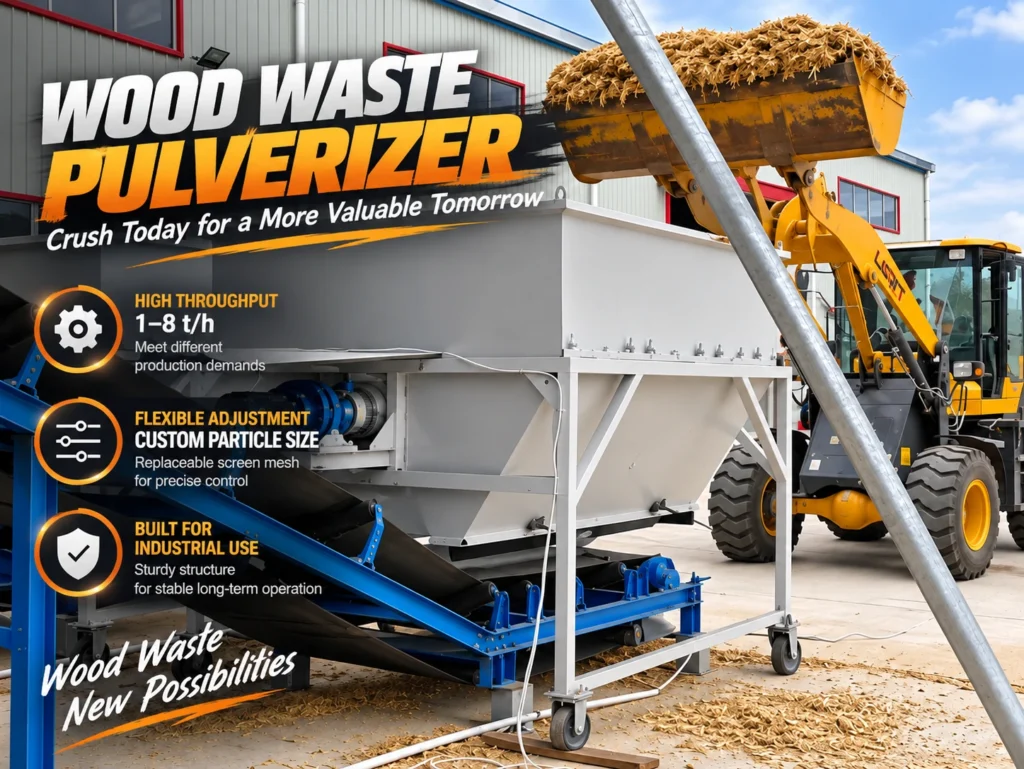
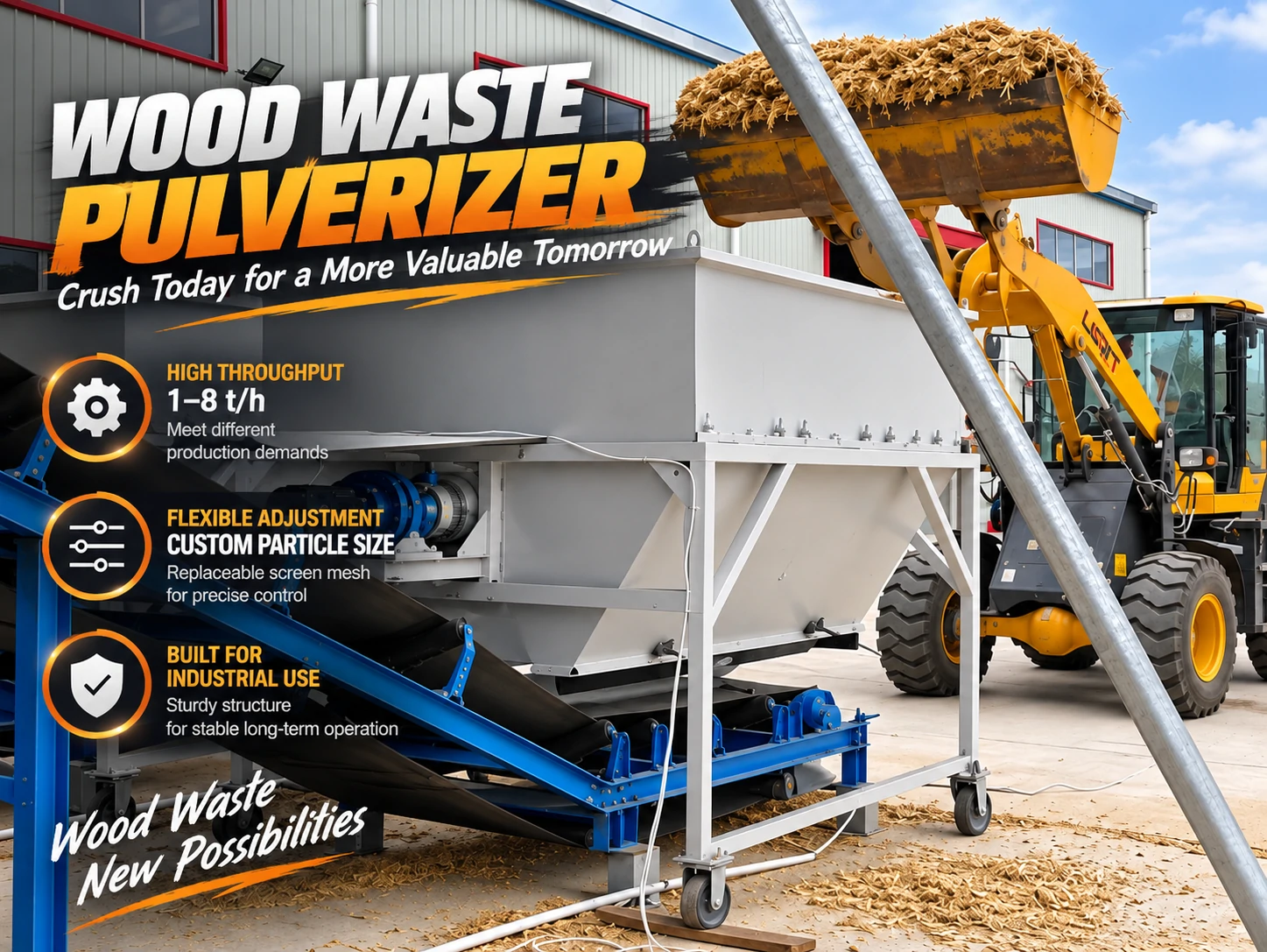
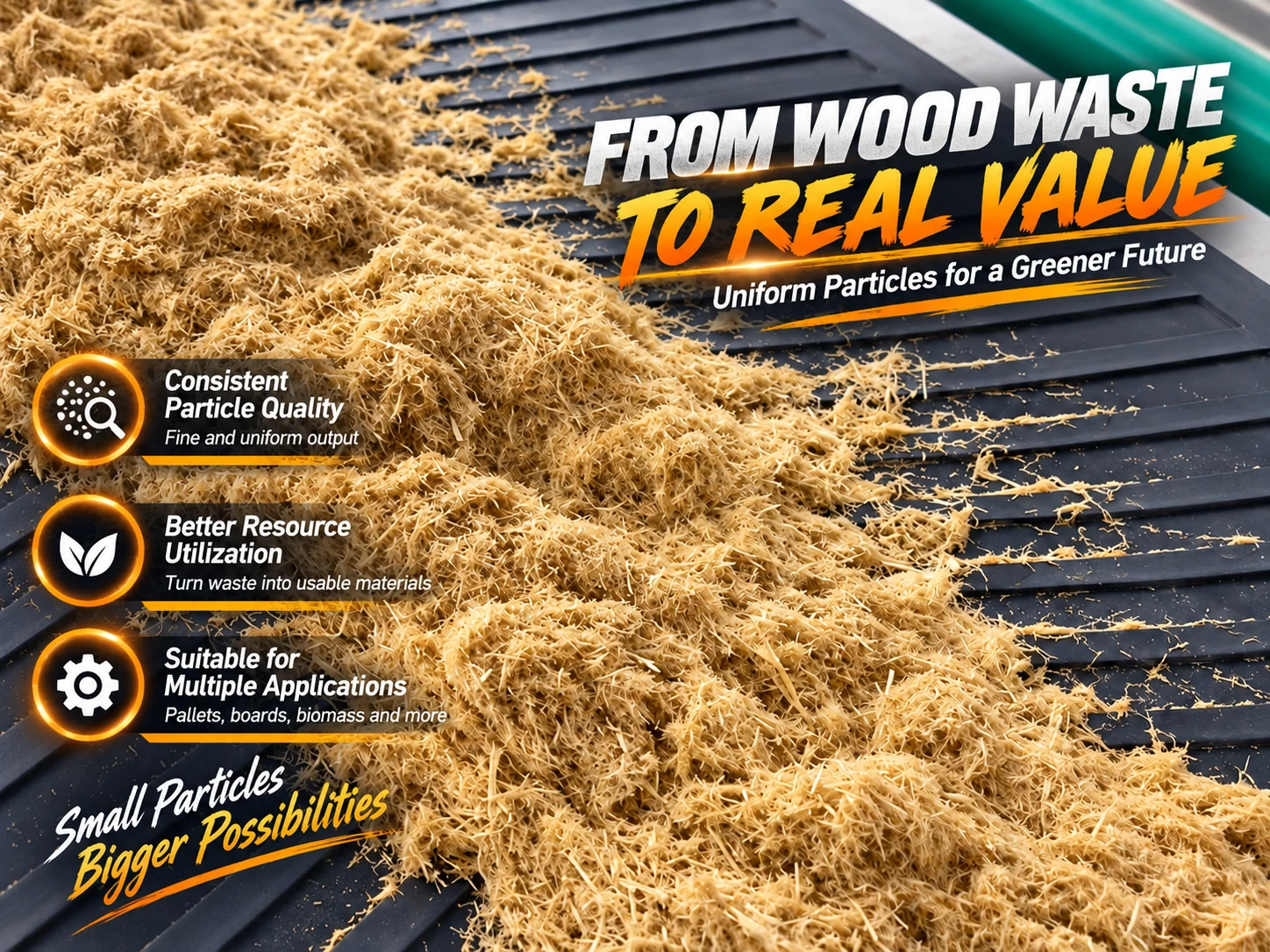
What the plant ends up with is a single raw material intake that no longer depends on one market. Sawmill chips and shavings keep running, and when they get expensive or thin out, corn stover, wheat straw or rice straw collected inside the local radius is crushed on the same machine into a graded material the dryer and the press can accept. That changes the buying position more than it changes the process: the plant has a second source it can actually use, so a wood residue price spike is a reason to shift the mix rather than a reason to slow the line. On site the same machine also does the volume reduction work, because loose agricultural residue takes up far more shed space per tonne before it is reduced than after. Two frames on this page carry the evidence. The first shows a loader discharging corn straw into the pulverizer feed hopper over the belt conveyor, which is the agricultural residue route in operation rather than a claim about it. The second shows the discharge end, where reduced particles sit evenly across the slotted screen deck with no oversized chips left in the stream, which is what the screen setting is there to produce. If the feedstock question at your plant is how much wood residue you can still get and at what price, the next step is a sizing conversation on species, moisture, target particle band and tonnage, and that starts with our engineering team.
- F-800 to F-1500 model tiers, 45 kW to 110 kW drives, 1 to 8 t/h nominal tonnage and the 680 x 380 mm to 1350 x 450 mm infeed range are taken from the published model table.
- The 5 mm figure is stated as a screen set target band, and tonnage is stated as dependent on species, moisture, infeed evenness and screen condition, not as a guaranteed output.
- Magnetic separation is kept as a project confirmed stage and is not claimed as standard fit on every unit.
- The two page images are limited to what the frames show: loader fed corn straw entering the feed hopper, and reduced particles sitting evenly on the discharge screen deck.