Waste Wood Carbon Route
The recycler whose circularity story stops at the boiler stack
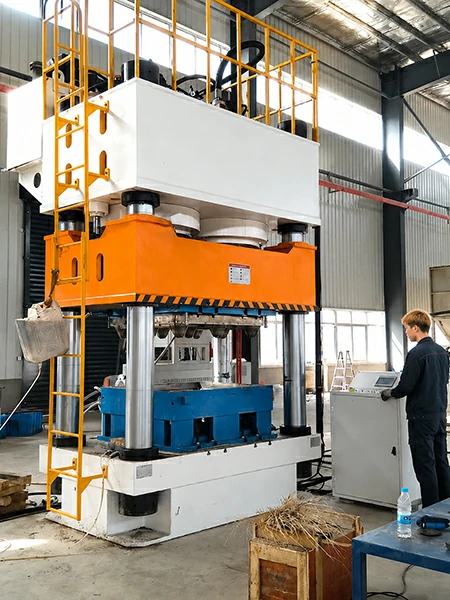
A wood recycler that sends its recovered tonnage to a biomass boiler has one carbon story and it ends at the stack: the fibre burns once, the carbon is released in a single pass, and the ESG file, the government tender and the large customer supply chain audit all read it the same way. This page follows the same recovered wood onto a wood pallet hydraulic press inside the yard, where a Y32 three-beam four-column machine at 1250 to 2500 ton presses it into a molded pallet that keeps the carbon inside a working product across several turnarounds before energy recovery is even considered.
Why a molded pallet holds carbon where a boiler cannot
A molded pallet hydraulic press machine changes the last step. Instead of shipping the fibre to a flame, the yard runs it through a molded wood pallet press machine and a compressed wood pallet machine on the same site, and the output is a manufactured article rather than a fuel. A hydraulic pallet molding machine such as the Y32 platform uses hot press molding and one-press forming to consolidate wood fibre, sawdust and wood shavings with an MDI adhesive into a dense one-piece unit, and the MDI route used here carries no added formaldehyde, which keeps the finished pallet usable in food, pharma and consumer packaging chains that screen for it. The carbon position is the point: the fibre stays inside a reusable molded pallet that travels, is handled by forklift and is returned rather than burned, and the per pallet footprint figure the buyer should carry into its own file is about 5.967 kg CO2e, taken from the customer side study rather than from a marketing slide. Read that against a boiler offtake and the narrative changes shape. Waste wood becomes a product, the product runs for multiple cycles, and energy recovery is pushed to the end of life instead of the first week.
The structure and the parameter table behind the claim
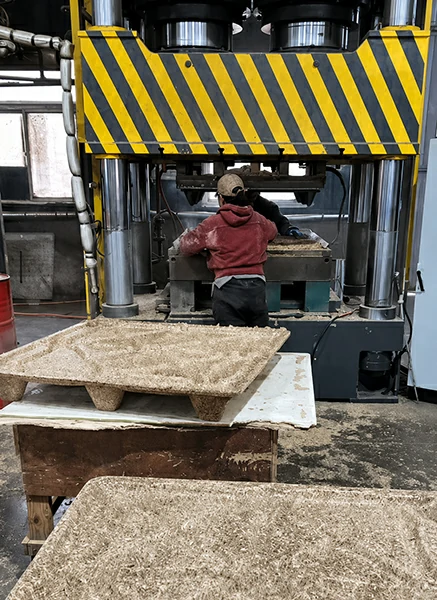
The claim rests on machine structure, not on adjectives. The press is a three-beam four-column hydraulic press: top beam, slide and worktable, with four solid columns that both guide the slide and lock the frame, a hydraulic cylinder group on the top beam and a top ejector that pushes the finished pallet off the mold. The published Y32 range covers the Y-1250, Y-1600, Y-2000 and Y-2500 models at 12500, 16000, 20000 and 25000 kN main cylinder force, slide stroke from 700 to 900 mm, platen up to 2500 x 1700 mm and a 55 to 75 kW motor at a system working pressure of 25 MPa, so a larger pallet size or a denser furnish is answered with tonnage and platen area rather than with a longer cycle. The published process window is a hot press at 150 to 180 C and 15 to 20 MPa with a 180 to 240 second molding cycle, and the frame splits into transportable sections, which matters when the line has to reach the yard inside standard sea freight. Two workshop photographs document the hardware rather than a customer installation. The first shows the four-column frame with its guide pillars, safety railing, climb ladder, hydraulic power unit and independent control cabinet; the second shows the forming station itself, with the slide, the mold and platen area and a formed tray at the press. They are presented as evidence of frame construction, guarding and the forming workstation, and they are not offered as proof of a specific customer molded wood pallet line.
What changes at the yard, and the boundary that comes with it
In service, the output takes the duties the yard already sells into: a warehouse pallet and racking pallet inside distribution centres, a logistics pallet and forklift pallet on material handling routes, and an export pallet in container shipping. Because the unit is formed under heat and pressure and is classed as a processed wood product, it sits on the ISPM-15 exempt route, so a fumigation-free export pallet is available to the recycler own customers without a kiln or a phytosanitary queue. The same hot press step that consolidates the fibre also sterilises it, which is what allows that position. When a pallet finally retires, it is crushed and re-fed into the line, so the material runs several turns as a product before it is ever considered for energy recovery, and the empty units nest about four to one, which keeps return freight and shed space from eating the gain. The boundary belongs in the same paragraph as the benefit. The press forms nothing until the front end is in place: crushing to roughly 5 mm particle size, drying to 8 to 12 percent moisture and even MDI adhesive mixing all have to be working before a pallet comes off the mold, which is why the press is not sold as a stand-alone machine. Tonnage and platen are selected against the pallet size and furnish density the yard actually has, not against a nameplate number, and the ESG or recycled content disclosure itself stays the recycler own document, supported by intake and process records rather than by a claim from the equipment supplier. What the yard keeps is the thing the boiler could not give it: a material route where recovered wood waste is made into a product, held in service, re-fed, and only then released.
- Title, SEO title, slug, H1 and the first screen summary all carry the required phrase wood pallet hydraulic press, and the title does not repeat any title already published on presswoodpallet.com.
- Both image source paths resolve inside the canonical MldP designer gallery, and each carries alt text built around a wood pallet hydraulic press.
- All four section bodies are plain text only, with no HTML tags, attributes or Markdown, because the fixed renderer owns the markup, the blog section root and the contact call to action.
- Every parameter used matches the MldP blog brief: Y32 three-beam four-column frame, 1250 to 2500 ton, platen up to 2500 x 1700 mm, 150 to 180 C hot press window, 180 to 240 second cycle, MDI adhesive with no added formaldehyde, about 5.967 kg CO2e per pallet stated as a customer side study figure, and the front end boundary of about 5 mm particle size and 8 to 12 percent moisture.


