Rotary Sawdust Dryer · Southeast Asia Rainy-Season Feedstock
A 40 to 50 Percent Intake and a Wet Season That Does Not Wait
A rotary sawdust dryer on a Vietnam or wider Southeast Asian site does not get a dry raw material: freshly felled residue and sawmill offcuts arrive at 40 to 50 percent initial moisture, and the wet season adds a second variable on top of the first. This page follows one sizing decision from the intake problem to the drum, the fan and the dust train. DRYR samples the material at the customer's own storage location and reads the climate before quoting, then scales the drum from the standard length out to 17 to 18 metres and raises the induced draft fan tier where the site asks for it, instead of quoting one catalogue drum to every sample. Tiers run H-1010 to H-1815 at 0.8 to 2 t/h, output moisture is stated below 10 percent, and the limits are stated plainly: those figures carry no published test conditions.
Why Sun Drying, a Small Airflow Dryer and a Hotter Furnace All Miss
The usual answers on a Southeast Asian site are natural sun drying, manual open-air turning of the pile, or a small airflow dryer sized for a drier country. All three fail on the same variable. Sun drying has no schedule in the wet season, so the yard either holds wet material or buys dry material at a premium. A small airflow dryer and a sawdust flash dryer move material through in seconds and hold no residence time for 40 to 50 percent feed. The other common answer is to keep the standard drum and raise the furnace instead, and that is where a sawdust rotary drum dryer gets damaged: wood dust carries an ignition temperature at or below roughly 280 degrees Celsius, which sits inside the 200 to 500 degrees Celsius band the drum is designed to run at, so a hotter furnace does not replace the residence time a short shell lacks. A hand-welded low-end drum machine adds out-of-round shells and inconsistent lifting plates on top of that, and a drum length quoted to every customer alike was sized for a drier sample than the one on the ground.
Sizing to the Sample and the Map, Not to the Catalogue
DRYR starts at the sample, not at the catalogue. Before a quotation the material is sampled at the storage location the customer actually uses, and the site is read for its climate, because a subtropical or monsoon site at 80 to 95 percent ambient relative humidity puts different demands on the same drum than a dry inland site. Initial moisture, particle size, target output moisture, hourly tonnage, fuel and emissions rules, plot and transport limits all enter the sizing. Where the sample comes back at 40 to 50 percent, the drum is scaled from the standard length out to a 17 to 18 metre drum so residence time grows with the water load, and the induced draft fan moves up a tier where the site asks for it. Testing a three pass rotary dryer or an airflow sawdust dryer against this route is a fair exercise, and it still ends at one question: how much residence time does this sample need. The long drum ships as bolted flange sections, is re-assembled on site and is commissioned by the DRYR crew, so split shipment, large drum field assembly and on-site installation and commissioning are in the quotation rather than a surprise.
What the Sized Machine Has to Hold: Drum, Fan, Dust Train and Output Moisture
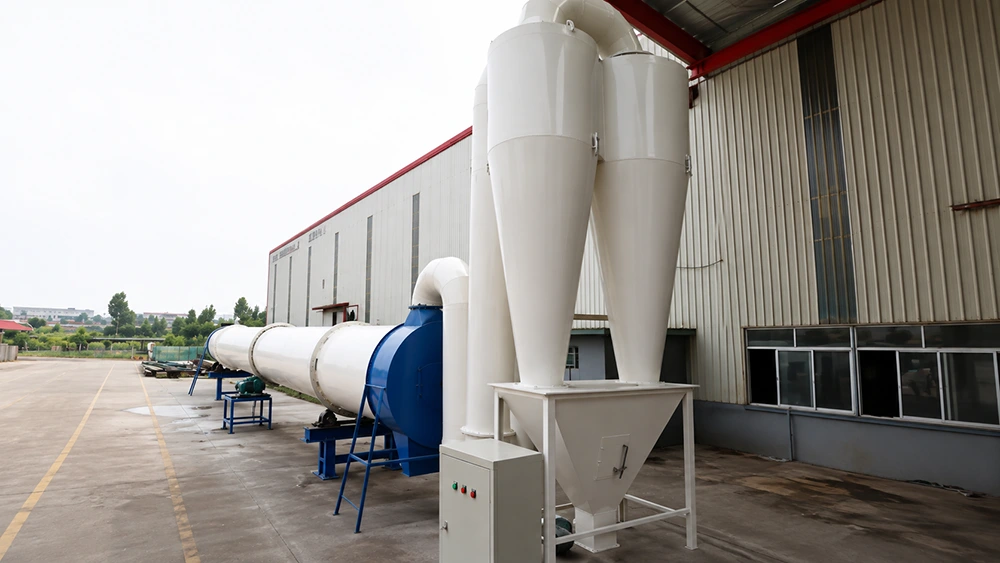
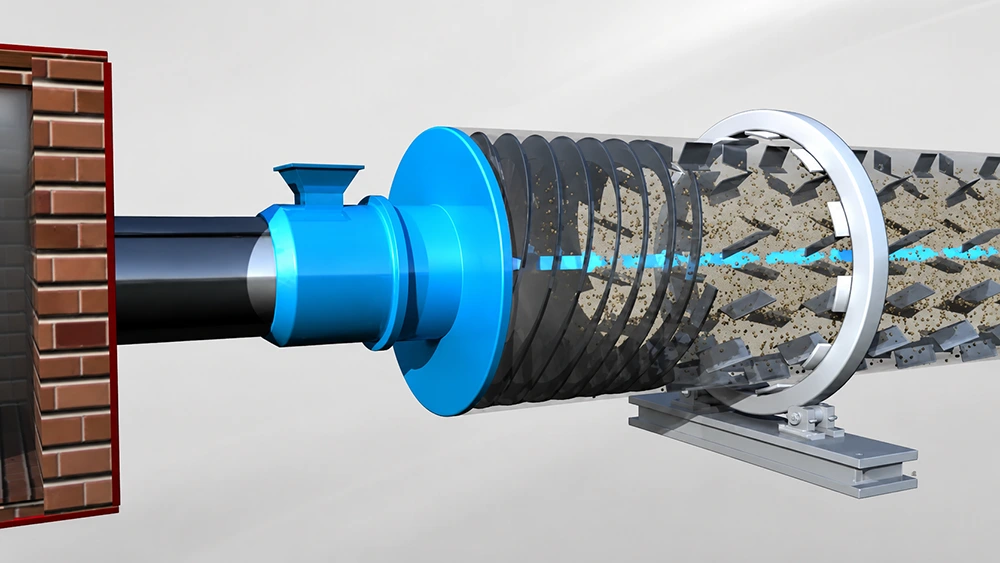
The sized machine has to hold four things: drum, fan, dust train and output moisture. The ladder runs H-1010 to H-1815 at 0.8 to 2 t/h on 1000, 1200, 1500 and 1800 millimetre drums with 4, 5.5, 7.5 and 11 kW main motors and 7.5, 7.5, 11 and 15 kW induced draft fans, drum internal hot air quoted at 200 to 500 degrees Celsius and output moisture stated below 10 percent, taken lower where a molding or pelletizing process asks. Combined lifting plates with temperature sensing and a sealed drum carry the curtain and the heat exchange, the shell is a self-insulation design quoted above 80 percent thermal efficiency at under 8 kg of coal per tonne dried, and a multi-fuel hot air furnace burns coal, oil, gas or the yard's own dry biomass. Exhaust goes to a cyclone dust collector with an optional baghouse filter, feed, furnace and fan are tied together by PLC control, and a screw conveyor closes the feed end. The site photograph on this page shows an installed drum with twin cyclone separators and a conical collection hopper; the cutaway is an engineering rendering, not field evidence. The result is what the sample was taken for: wet sawdust stops molding and fermenting in the pile, furnish moisture sits inside the window that MDI and UF glue bonding and pelletizing need, and continuous operation holds that window across the wet season instead of across one good week. Figures carry no published test conditions, so tonnage and final moisture move with species, initial moisture, particle size, fuel and climate.
- Drum length, induced draft fan tier and tonnage are confirmed per project after on-site moisture sampling, not taken from a catalogue
- The 200 to 500 degrees Celsius drum range, the below 10 percent output moisture and the 0.8 to 2 t/h tiers carry no published test conditions
- The cutaway drum view is an engineering rendering, while the site photograph shows an installed drum with twin cyclone separators and a conical hopper
- Mold and fermentation control, glue bonding stability and pelletizing efficiency depend on species, initial moisture, particle size, fuel and climate



